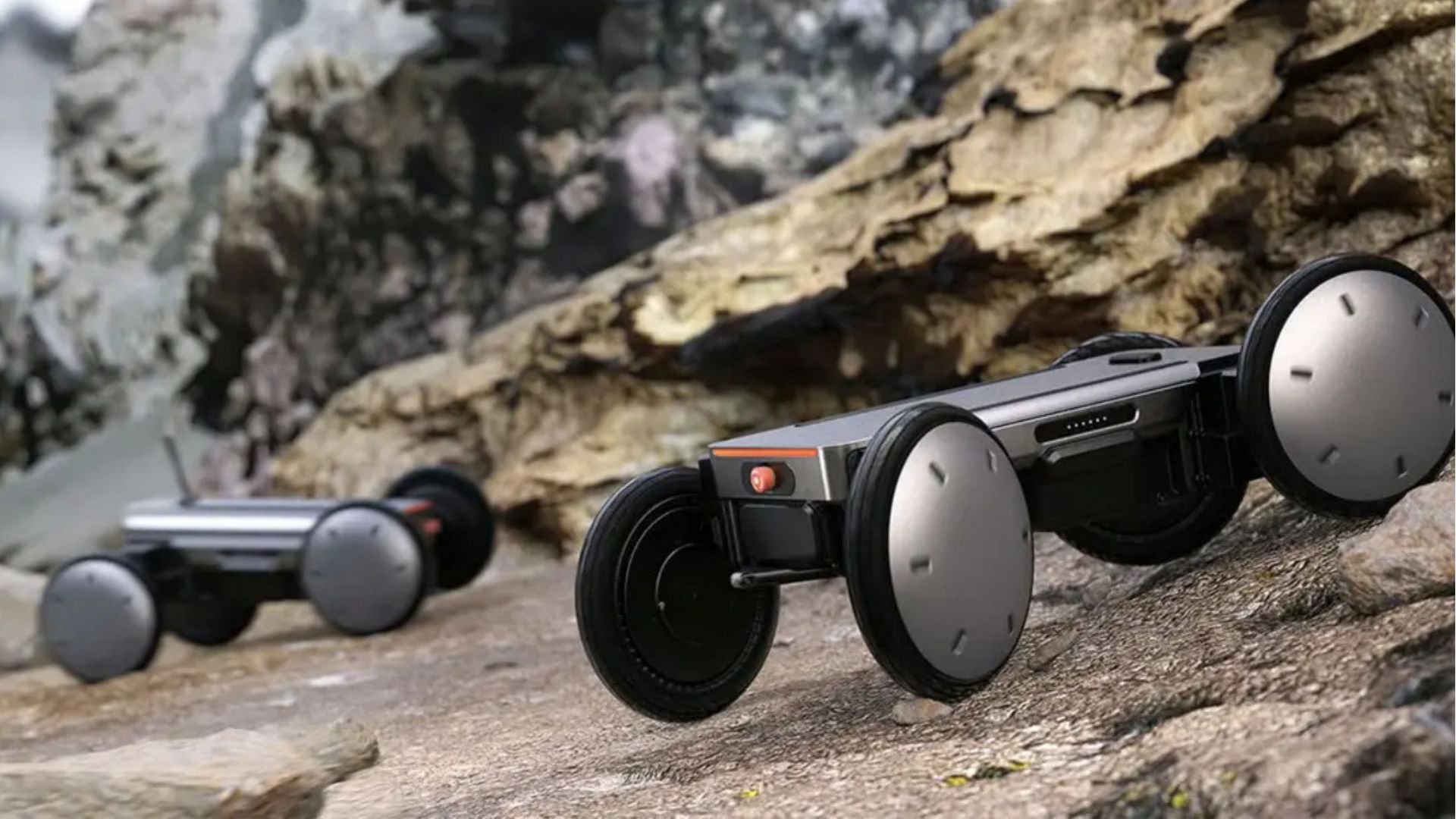
MobED completed autonomous navigation tasks in the vessel’s cargo area.Hyundai Hyundai Motor Group (HMG) has successfully demonstrated what they describe as the world’s first autonomous self-driving robot operating aboard a moving ship, marking a step toward safer maritime inspections. The MobED (Mobile Eccentric Droid) mobile robot completed trials aboard the multipurpose vessel HYUNDAI DUBAI in South Korea, proving it could navigate despite constant vibration, vessel motion, and uneven surfaces. The technology could eventually inspect enclosed cargo holds and other hazardous spaces that may be too dangerous or toxic for seafarers to enter. In December 2025, Hyundai first unveiled its autonomous MobED robot, a compact four-wheeled platform designed for industrial and everyday applications, ahead of future mass production. Autonomous robot sails MobED was tested aboard the multipurpose vessel HYUNDAI DUBAI during a joint demonstration involving Korean Register (KR), HMM, HMM Ocean Service and Goseong Engineering in Changwon, South Korea. The trial evaluated whether an autonomous robot originally designed for land-based environments could operate reliably aboard a moving ship, where constant vibration, vessel motion and uneven surfaces present unique navigation challenges. The demonstration forms part of efforts to advance smart ship technologies by deploying robots for cargo hold inspections, condition monitoring and material transport in areas that may be hazardous or difficult for crew members to access. During the tests, MobED successfully carried out a range of autonomous navigation tasks inside the vessel’s cargo spaces, including straight and curved driving, low- and high-speed movement, route learning and fully autonomous operation. Its independently controlled wheel system enabled the robot to maintain stability while traversing uneven decks, inclines and thresholds commonly found aboard ships. The platform can also be fitted with inspection equipment, cameras and delivery modules, allowing it to perform different onboard tasks. In narrow passageways, the robot completed route-learning and low-speed navigation, although operators switched it to remote-control mode because of the confined space. The project partners said the successful demonstration showed autonomous robots can work effectively inside large cargo areas without requiring modifications to existing ship infrastructure. Multi-purpose mobility robot MobED is a compact four-wheeled autonomous robot developed by HMG’s Robotics Lab to navigate environments that are difficult for conventional robots. Built on the company’s proprietary Drive and Lift (DnL) technology, the platform features independently controlled wheels that automatically adjust to maintain a level surface while traveling over steep ramps, curbs, rocky terrain and uneven ground. This stability allows it to safely transport fragile equipment, cameras and other sensitive payloads across challenging environments. The robot is available in two versions: MobED Basic and MobED Pro, each designed for different applications. The Pro model combines LiDAR and camera sensors with AI-powered navigation, enabling it to move autonomously through crowded environments. It also includes a “follow-me” mode that allows it to accompany users while carrying equipment or supplies. The Basic model, meanwhile, is remotely operated and intended for researchers and developers building customized robotic applications. Designed for both industrial and consumer use, MobED can support a variety of attachments, including inspection tools, delivery boxes, cameras, digital displays and advertising screens. Hyundai says the platform can be used for last-mile logistics, facility inspections, broadcasting support, digital guidance services and mobile advertising. The Basic model can carry payloads of up to 47 kilograms (103 pounds). In comparison, the Pro version supports up to 57 kilograms (125 pounds) and reaches speeds of 10 km/h, making it suitable for a wide range of commercial and service applications. Recommended ArticlesGet the latest in engineering, tech, space & science - delivered daily to your inbox.Jijo is an automotive and business journalist based in India. Armed with a BA in History (Honors) from St. Stephen's College, Delhi University, and a PG diploma in Journalism from the Indian Institute of Mass Communication, Delhi, he has worked for news agencies, national newspapers, and automotive magazines. In his spare time, he likes to go off-roading, engage in political discourse, travel, and teach languages.
World’s first autonomous robot that drives aboard moving ship tested by Hyundai
Full Article
Original Source
Read the full article at Interestingengineering →KhanList aggregates and links to publicly available news content. We do not host full articles from third-party sources. Always verify important information with original sources.