
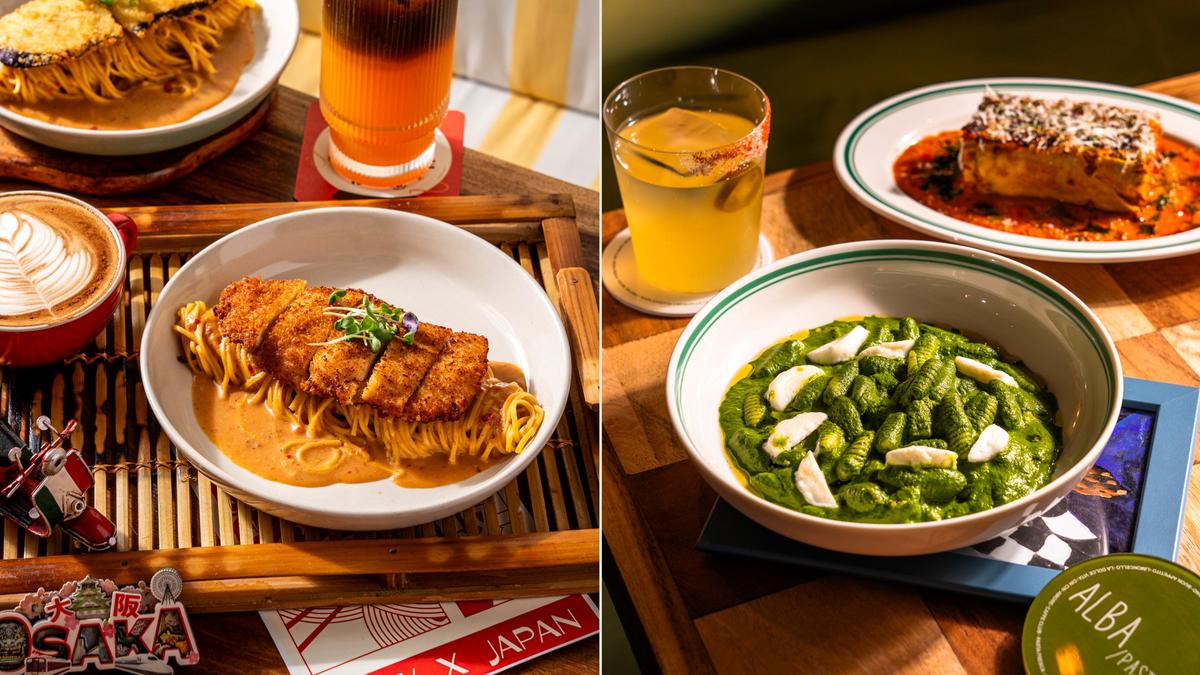
There was a time when ordering pasta in Mumbai meant ordering Italian food. You went to an Italian restaurant, studied a menu full of words you were not entirely sure how to pronounce, and eventually settled for penne in pink sauce. That era is, thankfully, behind us.Pasta has become considerably more ambitious, and more casual. In Mumbai, you can now go out specifically for pasta, rather than encounter it somewhere between the pizza and the tiramisu. Pasta bars are turning up with increasingly singular points of view: handmade shapes, sauces that are treated with the seriousness of small works of art, compact menus and kitchens where the pasta is very much the point. Alba pasta bar in Bandra serves a variety of pasta | Photo Credit: Special arrangement The timing makes sense. According to the National Restaurant Association of India’s 2024 India Food Services Report, 56% of Mumbaikars who dine out said Italian was their preferred cuisine, ahead of Chinese at 46% and South Indian at 43%. Pasta is no longer part of Mumbai’s Italian dining vocabulary, but has become part of the reason Mumbaikars visit an Italian restaurant. Inside Pomodoro in Bandra | Photo Credit: Special arrangement There are numbers behind this appetite, although they are best treated as supporting evidence rather than the story itself. India’s pasta market was valued at about $1.2 billion in 2025, with Maharashtra accounting for 14.5% of the market. The larger point is less about the size of the industry than what it says about how thoroughly pasta has entered everyday Indian eating.In demandWhen Chef Afshaa Rajkotwala and her sister Nousheen opened the hard-to-get-a-reservation Pomodoro in early 2025, they started with just 28 seats. The idea was deliberately intimate: handmade pasta, a kitchen close enough to watch the dough being made, and a restaurant where pasta was not an afterthought on an expansive Italian menu but the reason you came in.“There weren’t many places where pasta was the only reason people visited,” says Afshaa. The sisters were not necessarily responding to a glaring gap in the market so much as creating the restaurant they wanted to eat in themselves — one that treated pasta as a craft but did not wrap it in the usual fine-dining fuss. “We wanted to break the notion that Italian food is only fancy, luxurious or to be enjoyed with a side of wine.” Tajarin gamberatti at Pomodoro | Photo Credit: Special arrangement The 28 seats soon proved insufficient. Queues appeared early, and Pomodoro eventually expanded to a 60-plus-seater, without abandoning the proposition that made the smaller restaurant work. It remains centred on handmade pasta and a deliberately concise menu. This format seems increasingly suited to diners who would rather have a restaurant know exactly what it is doing than offer 80 things in the hope that one of them will please everyone.Afshaa has noticed another change. Initially, diners tended to choose pasta according to the sauce; increasingly, she says, they are asking about the pasta itself — its shape, whether it is made fresh, why it is paired with a particular sauce and where the dish originated. “Mumbai’s diners have become far more curious,” she says. “They’re increasingly open to simplicity, where fewer ingredients can actually showcase more skill.” Chef Afshaa Rajkotwala | Photo Credit: Special arrangement That curiosity does not mean Mumbai has suddenly become puritanical about Italian food. Pomodoro’s Itameshi (the Japanese-Italian mash-up of food — the word combines “Italia” (Italy) and “meshi” (a casual Japanese word for food or a meal) menu is deliberately playful. A corn panzanella comes with soy-citrus dressing, jalapeño and stracciatella; gnocchi arrives with Japanese curry and furikake; and handmade chittara is paired with miso, chilli and butter, with the option of katsu chicken or eggplant. The Italian foundations are real — handmade pasta, gnocchi, classic shapes and techniques — but the flavours are allowed to wander.And that may be what is happening with pasta in Mumbai. The city is becoming knowledgeable enough to have opinions about the shape of its noodles, but not so reverential that it can’t put miso on them.For Afshaa, that is part of a broader change in the way people eat out. “Five years ago, people may have been looking for indulgence alone,” she says. “Today, they’re looking for authenticity, consistency and a story behind what they’re eating.”Her simplest description of where dining is headed may also explain Pomodoro’s appeal: “Diners don’t necessarily want larger menus anymore — they want places that know exactly who they are and execute that vision exceptionally well.”Pasta loveChef and owner Devika Manjrekar opened Toast Pasta Bar in Lower Parel in 2022, at a time when a restaurant built almost entirely around pasta was still something of a gamble. “I’d like to say we were the first,” she says, laughing, “only because it was a risk opening a dedicated pasta bar at the time.”The idea came partly from personal obsession — “Pasta is my favourite food” — and partly from what Devika had learnt from Toast Doughnut Shop during the pandemic. The viral success of the doughnut shop had convinced her that there was something to be said for focus: pick one thing and do it properly. “I didn’t think there was a particular place you could go to eat pasta. It was always an afterthought,” she says. “So that’s what we did.” Pappardelle with nine-hour braised oxtail ragu at Toast | Photo Credit: Special arrangement There was, however, a line she wanted to draw. When Toast opened, diners would ask for the familiar pink sauce, chicken in their pasta, or extra vegetables. Devika eventually decided that if Toast was going to be a pasta bar, it could not become another place where pasta was treated as a blank canvas for whatever the diner happened to fancy.“We decided we wanted people to eat pasta the way we wanted them to eat it and not just as a convenient healthy weeknight meal,” she says. “That’s not what you come to Toast for. That’s what you tell your maharaj at home to make.”It sounds stern. In person, presumably, it is considerably more charming. And the strategy has worked. Devika says she has seen a “100%” shift in the way Mumbai diners approach pasta since Toast opened. Her approach has never been to lecture them about Italian food, however. “We aren’t preachy. We get them to try things and then decide whether they like it or not themselves,” she says. Pumpkin and ricotta ravioli with brown butter, sage, orange and spiced biscuit at Toast | Photo Credit: Special arrangement Devika chooses dishes based on what she herself wants to eat, what is delicious, what is in season, and how to make something unfamiliar approachable without losing its Italian roots. “Gnudi — essentially ricotta-and-greens dumplings without the pasta casing — and slow-cooked oxtail ragù, neither exactly the default Mumbai pasta order, have become particular surprises in terms of popularity,” she says.And perhaps Devika’s most telling observation is that pasta has changed from something people ate to something they now make an occasion of. “Pasta has become more of a special meal than it used to be,” she says. It was once a bowl with a sauce, vegetables, and a protein chosen almost as an afterthought. Now, she believes, “Indians eat pasta to eat pasta” — to appreciate the flavour and texture rather than think of it as maida in a different outfit.Price and geographyAt Alba Pasta Bar in Bandra, which opened doors in March this year, restaurateur and entrepreneur Aditya Wanwari sees the appeal of pasta as a matter of familiarity. “People, if you give them what they want and just 10% more elevated, you’re good to go,” he says. Pasta, after all, is hardly an acquired taste.That familiarity, Aditya believes, is also why specialised restaurants are increasingly making sense. At Alba, that means a tight 18- or 19-dish menu rather than a sprawling Italian catalogue. Pasta remains the centre of gravity, but the cooking is not confined to the versions of pasta that Indians first grew up with — white sauce, pink sauce, a protein thrown in for good measure. There is cacio e pepe, essentially the Roman combination of pasta, pecorino and black pepper; bucatini; tortellini with goat cheese and pepperoni; and seafood and meat-based pastas. The idea is not to make pasta unrecognisable, but to broaden what diners understand it can be. At Alba, pasta challenges diners’ preconceived notions | Photo Credit: Special arrangement Alba’s audience, Aditya argues, is more interested in the experience of eating it at that particular restaurant. That distinction becomes especially apparent when he talks about price. A diner who might comparison-shop aggressively at a quick-service restaurant behaves differently at an upscale-casual one: “When you talk about brands which are slightly upscale casual, people don’t see the right side of the menu at all. They don’t care about the value they are getting from ordering this dish in terms of pricing. Their only value is whether they enjoyed the experience or not,” says Aditya.Aditya is careful to qualify the idea that Mumbai’s upscale-casual diner is indifferent to price. That may be true in Bandra, Juhu, Worli and parts of South Mumbai, where the positioning of a restaurant can make the experience feel more important than the number at the bottom of the bill. Move the same concept to Andheri, Chembur, Saki Naka or Thane, however, and the equation changes.“Let’s take it area-wise,” he says. “The pricing has to change.” Pasta at Alba | Photo Credit: Special arrangement In Bandra, pasta is usually priced around ₹650–₹950. So, the question isn’t whether customers can be given more food for the same money. Aditya says that if a 110g portion works at a particular price in Bandra, increasing the quantity while keeping the price unchanged may not make the proposition viable in another part of Mumbai. “If I reduce the price by ₹100, it will work,” he says. The point is a useful one for the city’s increasingly fragmented dining landscape: there isn’t one Mumbai diner, and there isn’t one Mumbai price.That sensitivity becomes particularly striking when he talks about Alba itself. The restaurant has changed its menu repeatedly — sometimes increasing prices by ₹50 or ₹60 at a time — without, he says, seeing customers push back. In Bandra, the customer is paying for a particular experience and understands the positioning of the restaurant. Elsewhere, the same pasta may need to be priced differently to make sense.Mumbai, in other words, is developing not one dining culture but several of them, often within a few kilometres of one another.And perhaps that is the larger shift: Mumbai’s pasta diner is no longer necessarily asking, “What can I put in my pasta?” but “Which pasta do I want tonight?”
World Pasta Day: In Mumbai, dedicated pasta restaurants are booming
Full Article
Original Source
Read the full article at Thehindu →KhanList aggregates and links to publicly available news content. We do not host full articles from third-party sources. Always verify important information with original sources.