
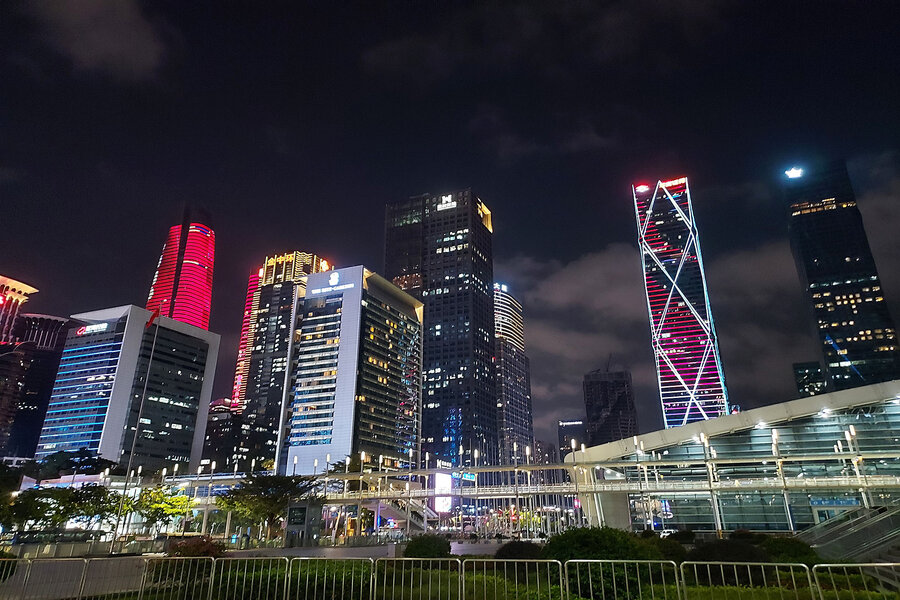
Shenzhen, China | Nov. 18, 2026, 2:48 p.m. ET | 4 min read With a miniature terrier peeking from her shoulder bag, millennial Wei Huilin strolls along the waterfront in China’s southern city of Shenzhen on a balmy Sunday, taking in the scene.Nearby groups of mostly young people lounge on a grassy lawn, part of a striking cultural center designed by acclaimed Japanese architect Fumihiko Maki. Others mill along the promenade, snapping photos of Hong Kong’s emerald mountains.China’s government is showcasing Shenzhen – a city that sprang up from a fishing village in the 1980s to become arguably the country’s most advanced metropolis – as world leaders from more than a dozen advanced economies gather here this week for the Asia-Pacific Economic Cooperation (APEC) summit. Beijing’s hope is that Shenzhen, far from the ancient palaces and Maoist monuments of the relatively staid capital, will impress foreign dignitaries with its energy and innovation – much as it has attracted millions of Chinese to migrate here over the past four decades.For Ms. Wei, Shenzhen’s ultramodern, youthful, and easygoing vibe made it a clear first choice when she left her native Guangxi province nine years ago for a job at an architectural design firm. Ann Scott Tyson/The Christian Science MonitorWei Huilin, a human resources professional, strolls with her dog near the waterfront in the Shekou district of Shenzhen, China, Nov. 15, 2026. Life in this free-spirited city, where lunch is delivered by drone and futuristic subway stations host gyms and badminton courts, “is convenient in every aspect,” says Ms. Wei, sporting an earbud, white T-shirt, and black Los Angeles Dodgers hat. The city is “quite tolerant,” and, she’s quick to add, “pet-friendly.”A youthful cityIt’s also unusually young.Shenzhen’s population of 18 million people has an average age of 32, making it the youngest among China’s top-tier cities that also include Beijing, Shanghai, and Guangzhou. Since two-thirds of the people here are transplants, Shenzhen’s a bit like a Chinese melting pot. Outsiders are welcomed, and city policies are designed to lure talent. “Once you come here, you’re a Shenzhener,” says Ms. Wei. With her career blossoming, she plans to stay. Ann Scott Tyson/The Christian Science MonitorThe Ping An Finance Center, located in the heart of the financial and business district in Shenzhen, China, affords views of the city, Nov. 16, 2026. To be sure, not everyone in Shenzhen is thriving. The city’s conveniences and cleanliness rely on an army of less educated and lower-paid workers. As China’s economy has slowed, those workers have felt the pinch, and APEC has brought some added pressures.Taxi drivers, for example, had to register to be able to drive downtown during the event, and police closed entertainment venues as they stepped up security. “That impacted our business,” says taxi driver Wei Jie.Yet many Shenzheners welcome the influx of wealth and talent, noting that it’s a far cry from the city’s humble roots.Reformers who built ShenzhenIn Shenzhen’s central Futian District, a paved path winds up a steep hill, passing groves of palm and mangrove trees and flowering bougainvillea. Trudging up, as if on a pilgrimage, are older Chinese visitors who opted out of using the park’s open-air electric carts.Many are coming to pay homage to a visionary reformer, captured in a 20-foot bronze statue at the summit: Deng Xiaoping, China’s paramount leader from the late 1970s to 1997. Ann Scott Tyson/The Christian Science MonitorGu Yong (center), a Shenzhen native who later moved to Hong Kong, poses for a group photo in front of a statue of Chinese leader Deng Xiaoping, at the peak of a hill in Lianhuashan Park in Shenzhen, China, Nov. 16, 2026. Chinese cities usually feature statues of Mao Zedong, who led the country’s communist revolution to victory in 1949. But in Shenzhen, Mr. Deng, who was twice purged by Mr. Mao for being a “capitalist roader,” is the man. Locals call him “Grandpa Deng.”“Before he came, we didn’t have enough to eat – we were so poor,” says Gu Yong, a Shenzhen native who later moved to Hong Kong. Mr. Gu gives a thumbs-up as he poses for a photo in front of Mr. Deng’s statue. Diminutive but tough, Mr. Deng was famous for his pragmatism. He broke with Maoist ideology to promote market-oriented reforms and spur private business, declaring in his Sichuan twang, “Some people will get rich first.”One of his key initiatives was creating coastal “special economic zones” in Shenzhen and three other cities in 1979, to boost trade and draw foreign investment from Hong Kong and Taiwan using tax incentives and other policies. His policies built on the ideas of local reformer Yuan Geng, the late guerrilla-fighter-turned-entrepreneur, and kicked off decades of transformation.“If Shenzhen didn’t develop, we’d be stuck in the mountains,” says Wei Liuchu, who grew up in a poor Shenzhen village of rice farmers, but was able to send his two sons to university. “Grandpa Deng opened Shenzhen up.” Ann Scott Tyson/The Christian Science MonitorCommuters move through the futuristic Gangxia North subway station, also known as the Eye of Shenzhen, Nov. 16, 2026. The subway system is the most popular mode of transport in Shenzhen. This year, it recorded an average daily passenger volume of over 10 million for the first time. Attracting talentNear the top of the diamond-shaped Ping An Finance Center, the world’s fifth-tallest building, Ming Xiaodong enjoys a 360-degree view of the megacity, including its miles of coastline and acres of urban parks.After earning a Ph.D. in hydrology in the United Kingdom, Dr. Ming was drawn to join a climate risk management service of Ping An Insurance – a Fortune 500 company and one of Asia’s major fintech innovators. The job is just one factor keeping him in Shenzhen.The city offers “very beautiful views of mountains and rivers and the sea,” says Dr. Ming, who likes to hike and picnic with his wife and two children. Beginning in the 1980s, ambitious Chinese entrepreneurs started flocking to Shenzhen, founding what are now some of the country’s most successful companies. Powerhouse firms that started here include the telecommunications giant Huawei, an internet and technology firm called Tencent, and battery and carmaker BYD.Initially growing as an export-oriented manufacturing center, Shenzhen has advanced into technological innovation, robotics, and drones. Deepen your worldviewwith Monitor Highlights.Politics with respectGet political stories with respectful analysis.There‘s a world of new ideas in everyBooks newsletter.There‘s more to life, enrich yours withCulture & Learning weekly.Follow humanity‘s discoveries withScience & Nature stories in your inbox.Gain a spiritual perspectivefrom the stories in your inbox.Want to understand the deeper impact of critical events? Learn the Monitor‘s insight.Already a subscriber? Log in to hide ads. Howard Huang, the U.S.-educated overseas sales manager for robot-maker Limx Dynamics, says he came to Shenzhen because it is “more aggressive” in developing technology.“A tech company can’t grow in Guangzhou,” Mr. Huang says, calling his native city “conservative.” “But it can grow in Shenzhen.” ALREADY A SUBSCRIBER? LoginReal news can be honest, hopeful, credible, constructive.The Christian Science Monitor was founded in 1908 to lift the standard of journalism and uplift humanity. We aim to “speak the truth in love.” Our goal is not to tell you what to think, but to give you the essential knowledge and understanding to come to your own intelligent conclusions. Join us in this mission by subscribing.
World leaders gather in Shenzhen, China’s youthful, business-friendly melting pot
Full Article
Original Source
Read the full article at Csmonitor →KhanList aggregates and links to publicly available news content. We do not host full articles from third-party sources. Always verify important information with original sources.