
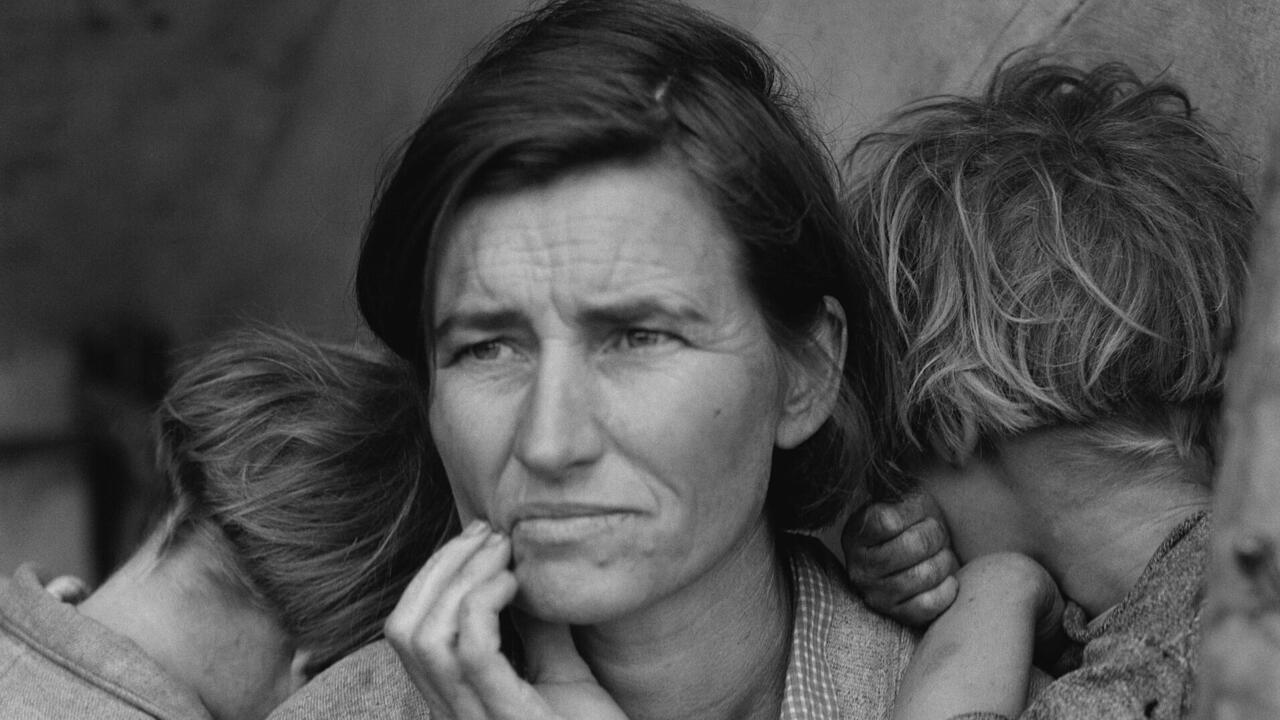
As France marks 200 years since inventor Nicéphore Niépce took the world’s oldest surviving photograph, RFI looks back at photos that changed our view of history – or even history itself. Here we tell the story of how a portrait of an unnamed woman came to represent the suffering of a nation in Dorothea Lange’s Migrant Mother, and what the iconic picture left out. A woman and clustered to her, three children. Hers is the only face you see fully. She gazes not at you but beyond, to the side, absorbed in private concern. The furrows on her forehead and grime on their frayed clothes spell hardship. Is she wondering what they’ll eat, where they’ll sleep, how they’ll survive? Taken in early 1936 with the Great Depression biting, Migrant Mother quickly became emblematic of the suffering of American workers. The portrait, so tightly framed the setting is indistinguishable, is almost allegorical. It invites comparisons to a Madonna and Child. Dorothea Lange, a documentary photographer whose career was based on capturing the real and the specific, sometimes objected to the way the shot overshadowed the rest of her work. “As you look at the photograph of the migrant mother, you may well say to yourself: ‘How many times have I seen this one?’ It is used and published over and over, all around the world, year after year, somewhat to my embarrassment for I am not a ‘one-picture photographer’,” she wrote in 1960. The image stood out immediately. One of seven shots Lange took of the same family at a roadside camp for farm workers in Nipomo, California, it was published alone, alongside an emotive editorial. “This remarkable photograph,” read the 11 March 1936 edition of the San Francisco News, “epitomises the human side of one of California’s oldest and gravest problems” – the plight of migrant labourers. In the woman’s face lies “the tragedy of lives lived in squalor and fear, on terms that mock the American dream”. Already she had become an archetype: a symbol for the lives of the many, despite – or indeed because of – so little being known about her own. Dorothea Lange did not identify the woman in her most famous photograph, which became an emblem of rural America. © Library of Congress, public domain Portraits of poverty Uncharacteristically for Lange, who typically spent time getting to know her subjects, she took just a few minutes to get her most famous shot. According to the account Lange gave a photography magazine in 1960, she met the family by chance at the end of an assignment for the US government. It was the era of the New Deal, the massive programme of public investment and reform that President Franklin D Roosevelt hoped would propel the United States out of depression and lay the foundations of a fairer future. State-funded projects included dispatching writers and photographers to capture stories of rural poverty that would help convince the rest of the country of the urgency of relieving it. Lange, a portrait-turned-street photographer who had already taken striking images of the Depression’s human toll, was hired to photograph migrant farm labourers in California in the winter of 1936. It had been a gruelling project, Lange recounts, and she had packed up her equipment and was driving home in the rain when she happened to pass a sign pointing to a pea pickers’ camp. She got 20 miles down the highway before impulse made her turn back. “I was following instinct, not reason; I drove into that wet and soggy camp and parked my car like a homing pigeon. I saw and approached the hungry and desperate mother, as if drawn by a magnet.” Dorothea Lange took seven shots of the family in their shelter at a farm workers' camp near Nipomo, California. © Library of Congress, public domain A window into the hidden lives of Afghan women cut off from society The woman was 32, she recalled learning, and had seven children. “I do not remember how I explained my presence or my camera to her, but I do remember she asked me no questions,” the photographer said. “I did not ask her name or her history.” Lange’s photos show her getting closer to the woman and her children, at one point capturing her as she breastfeeds. The woman faces the camera, but her eyes are mostly averted – whether by choice or on Lange’s directions are unclear. “There she sat in that lean-to tent with her children huddled around her, and seemed to know that my pictures might help her, and so she helped me,” Lange wrote. “There was a sort of equality about it.” The crop had frozen in the ground and everyone in the camp was similarly destitute, she remembered. “But I did not approach the tents and shelters of other stranded pea pickers. It was not necessary; I knew I had recorded the essence of my assignment.” Photo of an era It wasn’t long before Lange’s photos from that day were credited with real-world change. One early press account said her report alerted state officials to the suffering at Nipomo, prompting them to send emergency aid. Only her timely arrival, the San Francisco News wrote on 9 March, “saved [the labourers] from starvation”. Later, the picture that would come to be known as Migrant Mother was said to have helped American workers in a broader sense. It prompted a flurry of press interest in the stories of people displaced by the Depression and, like the writings of John Steinbeck, came to define the era for generations to come – arguably even more powerfully than written accounts. Other pictures of the family were published to illustrate news stories about emergency aid arriving at the Nipomo camp. © Library of Congress, public domain How exiled photographer Ernest Cole captured apartheid’s human toll “When Dorothea took that picture, that was the ultimate,” said Roy Stryker, the head of the government programme that produced tens of thousands of photographs, including Lange’s. “To me, it was the picture of Farm Security. The others were marvellous but that was special.” The image became one of the most widely reproduced photos in history. In the years after Lange took it, it appeared in magazines, on book covers, as posters, in textbooks of history and of photography, and on a US postage stamp. For decades, none of them included the name of the woman who looks out from it. Beyond the frame She was called Florence Owens Thompson, and she was pictured with her four daughters – Viola, Ruby, Katherine and Norma – aged between 12 and just under a year. Her identity did not become known until 1978, 13 years after Lange’s death, when she spoke to a local reporter to voice her objections to the photograph. “I didn’t get anything out of it,” Thompson said. “I wish she hadn’t taken my picture.” In her telling, Lange indicated the photos weren’t for publication. “She said she wouldn’t sell the pictures,” Thompson said. (In fact, the US government holds the copyright.) “She said she’d send me a copy. She never did.” Thompson also revealed something that cast the portrait in a new light: she was not white, as had been assumed, but Native American. Born Florence Leona Christie in Indian Territory in Oklahoma, she belonged to the Cherokee nation. Would newspaper editors of the 1930s still have dubbed her the face of rural America if they had known she wasn’t white? Would white audiences? This image is one of two that Dorothea Lange took of Florence Owens Thompson but did not submit to the US government with her other pictures. © Dorothea Lange Archives at Oakland Museum of California, public domain Women photographers 'rebel against cult of male genius' Other details were misrepresented too. The family weren’t recent migrants to California but had lived there for several years; they didn’t live in the camp but had only stopped because their car had broken down, and by the time government aid arrived there they had already moved on. But no question they were poor, Thompson said, and travelled the state seeking any work there was. “We just existed,” she told another interviewer. “We survived, let’s put it that way.” Thompson’s children later spoke of her shame at being associated with deprivation, as well as her strength of character. Their accounts paint a picture of a determined and capable woman, far from the helpless victim some saw in Lange’s photo. Look again: is she weighed down by the children surrounding her, or has Lange captured her bearing them up, a pillar of maternal might? Thompson died in 1983 at the age of 80. A 1979 picture shows her surrounded by the same three daughters. This time, the women are dressed in pristine white, facing the camera and smiling – except for Thompson herself. Her striking face meets the camera head on, but her eyes are narrowed, her expression hard to read. Perhaps she is wary of appearing in another photograph; or perhaps she is, finally, in control. In 2026, France marks 200 years since inventor Nicéphore Niépce took the world’s oldest known surviving photograph. In celebration of two centuries of photography, Radio France International presents World in Frames: a series of 18 iconic images chosen by each of RFI’s language services to explore how photos have shaped the way we understand our world. Find all episodes on our website and YouTube channel, starting 14 September.
World in Frames: RFI traces the stories behind the world's most famous photos
Full Article
Original Source
Read the full article at Rfi →KhanList aggregates and links to publicly available news content. We do not host full articles from third-party sources. Always verify important information with original sources.