
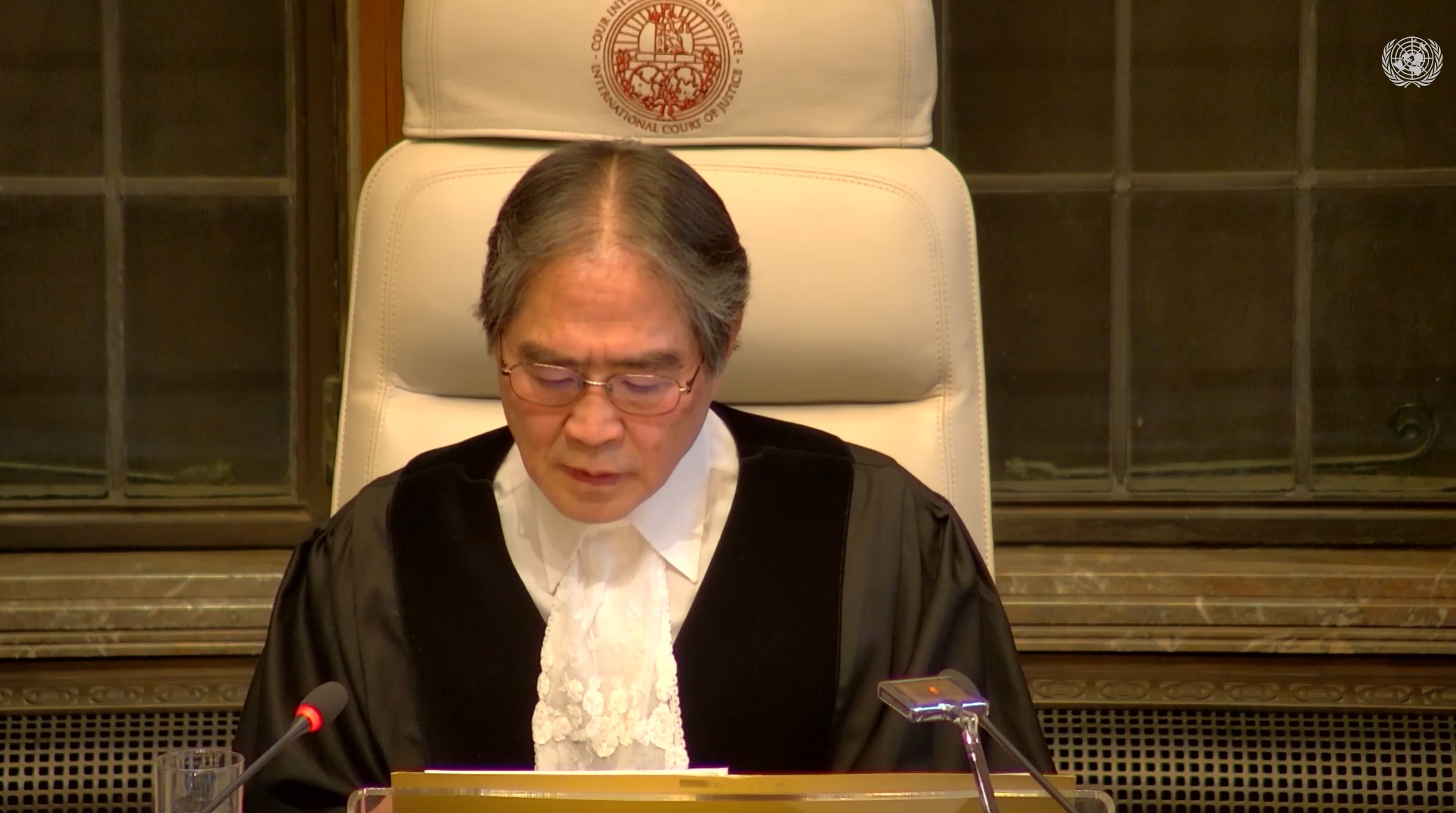
The International Court of Justice (ICJ) ruled on Thursday that Myanmar violated the 1948 Genocide Convention over atrocities committed against the Rohingya Muslim minority, delivering a landmark judgment in a case that has taken seven years to reach a conclusion. The court found, by nine votes to six, that “Myanmar has committed genocide against the Rohingya group in Northern Rakhine state,” said ICJ President Yuji Iwasawa. Iwasawa confirmed that the court found Myanmar guilty of breaching the Genocide Convention, and that the “only reasonable inference” from evidence of Myanmar’s atrocities was an intent to destroy a “substantial part” of the Rohingya population. He added that Myanmar acted with “genocidal intent.” The ruling by the United Nations’ highest court in The Hague, Netherlands, establishes Myanmar’s responsibility under international law for the military’s campaign against the Rohingya in 2017, which forced more than 700,000 people to flee to neighbouring Bangladesh. The ruling is final and cannot be appealed. The judgment marks a major legal victory for the Rohingya, who have spent years seeking accountability for mass killings, sexual violence, and the destruction of hundreds of villages during military operations in northern Rakhine State. The case was brought by The Gambia, a small West African nation, in November 2019, accusing Myanmar of violating its obligations under the Genocide Convention, which requires states to prevent and punish genocide. The military operations began in August 2017 following attacks by Rohingya militants on security posts in northern Rakhine State. Myanmar’s armed forces, then commanded by Min Aung Hlaing, who has since assumed the presidency, responded with a sweeping campaign that UN investigators later found involved widespread and systematic atrocities against civilians. Displaced Rohingya refugees from Rakhine State rest near Ukhia, near the border between Bangladesh and Myanmar, as they flee violence on September 4, 2017 (Photo: AFP) Survivors described soldiers killing entire families, raping women and girls, and setting fire to villages, forcing hundreds of thousands of Rohingya to escape across the border. A UN fact-finding mission subsequently concluded that Myanmar’s military leaders should be investigated and prosecuted for genocide, crimes against humanity and war crimes. Myanmar has consistently rejected allegations of genocide, maintaining that its military operations were a legitimate response to attacks by Rohingya insurgents. In December 2019, Aung San Suu Kyi, then Myanmar’s civilian leader, personally travelled to The Hague to defend the country before the ICJ. She argued that the military operations had taken place in the context of an internal armed conflict and disputed allegations that Myanmar had acted with genocidal intent. Her appearance before the court attracted international criticism and marked a dramatic reversal for the Nobel Peace Prize laureate, who had once been celebrated worldwide as a champion of democracy and human rights. In January 2020, the ICJ ordered Myanmar to take provisional measures to protect the Rohingya from acts prohibited under the Genocide Convention and to preserve evidence of alleged atrocities. The proceedings continued after Myanmar’s military seized power in February 2021, overthrowing Suu Kyi’s elected government and plunging the country into a nationwide civil war. In July 2022, the court rejected Myanmar’s preliminary objections to its jurisdiction and the admissibility of the case, allowing the proceedings to move forward. The court subsequently examined written evidence and legal arguments from both sides before reaching its judgment. Rohingya refugees wait to hear the ICJ verdict in Cox’s Bazar, Bangladesh, on November 19 (Photo: Voice of Arakan News) Unlike the International Criminal Court (ICC), which prosecutes individuals accused of international crimes, the ICJ determines the legal responsibility of states. Its judgment therefore concerns Myanmar’s obligations under international law rather than the individual criminal liability of military commanders, including Min Aung Hlaing, who led the armed forces during the 2017 campaign and subsequently seized power in the 2021 coup. The ruling is legally binding on Myanmar as a state, meaning its obligations extend beyond the current military leadership to any future government. The Gambia sought recognition of Myanmar’s responsibility for the atrocities and guarantees against their recurrence; dignified return of the Rohingya to their land; and reparations for victims. The court found that Myanmar failed to prevent genocide, investigate and punish those responsible, and comply with its 2020 order to preserve evidence of atrocities. It ordered Myanmar to ensure the safe, voluntary, and dignified return of displaced Rohingya, facilitate family reunification, and compensate victims. Myanmar must also report to the ICJ within two years on measures taken to provide restitution and compensation. The amount and arrangements for compensation will be determined in subsequent proceedings. The judgment raises questions about how its findings can be enforced. Although ICJ judgments are binding, the court has no independent enforcement mechanism. A failure to comply can be brought before the UN Security Council, where political divisions among major powers may complicate further action. However, according to Maria Elena Vignoli from Human Rights Watch, rulings by the ICJ are highly authoritative and will likely influence other ongoing cases, including at the ICC. “It is likely, as it’s happened in the past, that both the International Criminal Court and domestic courts that will deal with cases related to these crimes will look to the assessment and analysis brought by the ICJ,” she said. For the Rohingya, the ruling comes amid continuing uncertainty over their future. More than one million Rohingya refugees remain in Bangladesh, many living in overcrowded camps around Cox’s Bazar, with little prospect of returning safely to Myanmar. Conditions in Rakhine State have deteriorated further as fighting between Myanmar’s military and the Arakan Army, an ethnic Rakhine armed organisation, has transformed control of much of the region. The conflict has exposed Rohingya communities to renewed violence, displacement, and severe restrictions on humanitarian assistance. While the ICJ ruling establishes Myanmar’s international legal responsibility, it does not automatically result in the prosecution of individual perpetrators, compensation for survivors, or the safe return of refugees.
World court rules Myanmar responsible for genocide against Rohingya
Full Article
Original Source
Read the full article at Myanmar-now →KhanList aggregates and links to publicly available news content. We do not host full articles from third-party sources. Always verify important information with original sources.