
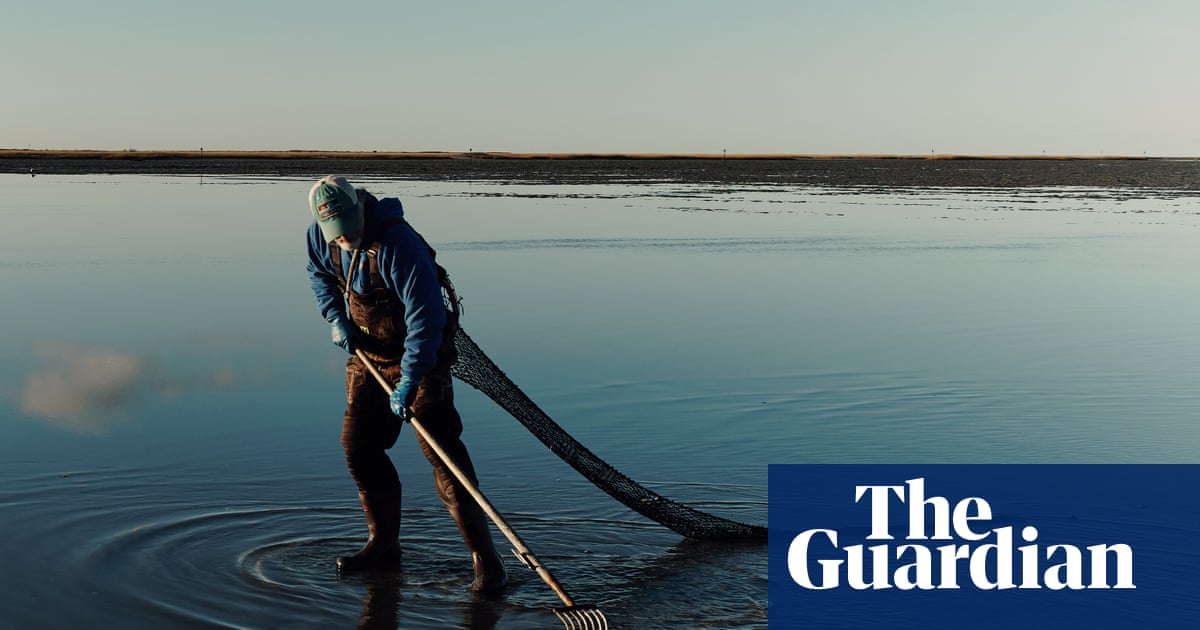
Shellfish harvester Ernie Eldredge is on the hunt for clams, ankle-deep in water amid a landscape that’s almost desert-like in the wake of the receding tide. He runs his rake through fine white sand again and again without hearing the faint “clink” of its tines hitting a shell.Eldredge just shrugs and moves on to the next spot. These tidal flats, perched on the elbow of Cape Cod in Chatham, Massachusetts, are constantly changing. Recent fall winds have carried a lot more sand into the area, and Eldredge thinks the clams he was finding over the summer may have moved on.About an hour into raking, the net cast over his shoulder slowly filling with the hard-shell clams that locals call quahogs, Eldredge raises his fist, clutching something new: another clam, about the same size and shape as the smaller quahogs you might get in a pasta dish. But unlike a quahog, which only has ridges running horizontally on its shell, this one also has ridges running vertically, creating a cross-hatched pattern under a dramatic black-and-white speckle.This is a Manila clam, a native of the Indo-Pacific region and an invasive species that only arrived on Cape Cod and in the north-east US over the last few years. Without harvesters like Eldredge, local researchers might have missed its arrival – and with it, the chance to study how it may potentially reshape this ever-shifting place.A Manila clam, with vertical and horizontal lines, below a non-invasive clam, which has only horizontal lines.Connecting the dotsNobody yet knows how the Manila clam got here, but researchers have their suspicions. “There’s a reason they are one of the most widely cultured [shellfish] species in the world,” said Owen Nichols, the director of marine fisheries research at the Center for Coastal Studies in Provincetown, at the very tip of Cape Cod.Manila clams are notoriously tasty, known for being sweeter than hard clams. (The single clam Eldredge found, which I steamed for dinner the following night, had less of a quahog’s minerality, with a richer flavor I’d place closer to shrimp or lobster.) Their adaptability – they can grow in fine sand, rocky sediment and marshes, thrive in subtropical waters and even survive ice-covered winter waters – also makes them a popular choice for shellfish farming. So while it’s possible that these clams may have been introduced accidentally, “a lot of us guess that somebody went all Johnny Appleseed and threw it in a few places”, Nichols said.Carolyn Tepolt, an associate scientist at the Woods Hole Oceanographic Institution (WHOI) who studies marine invasions, said this clam has “been on our watch list for a while”. It began spreading eastward in the late 1800s, likely brought by immigrants from Asia to Hawaii and western North America. By the 1970s, it was introduced intentionally around Europe to replace native clams dwindling from overfishing and pollution. In the decades that followed, both accidentally and intentionally, the clam became established across the northern hemisphere, as far north as British Columbia and south as coastal Tunisia. Only later did biologists realize that the Manila clam can sometimes outcompete native shellfish, alter local ecosystems and spread diseases into native populations.The east coast was this clam’s “last stop”, said Nichols. Though researchers have found dead shells and the occasional living clam from New York to New England since the 1980s, these were assumed to be dinner remnants or escaped bait, since Manila clams can be used to catch recreational fish like striped bass.Over the last few years, however, shellfish harvesters noticed something had changed. Eldredge caught his first Manila clam in 2023, shortly after he retired from fishing full-time. Through that season, they kept turning up in his rake – usually not more than one or two at a time – but consistently enough that he decided to send a picture of his find to Nichols.The fisher and the scientist had collaborated for nearly 15 years, studying how to deter seals from stealing out of Eldredge’s nets, and it became habit for Eldredge to reach out when he saw something new on the water. “It’s pretty normal for me to get a text with zero context – just a picture of a creature from the fishermen I work with and a question mark or an emoji,” Nichols said.The strange clam looked familiar, but it wasn’t until Nichols found it in a seashell book gifted by his mother that he realized where he’d last seen it. It was a Manila clam, which he’d been served in a pasta dish while visiting the Pacific north-west.Shellfish harvester Ernie Eldredge caught his first Manila clam in 2023, shortly after he retired from fishing full-time. Photograph: Tony Luong/The GuardianEldredge fills his net with the hard-shell clams that locals call quahogs on a recent morning. Around the same time, Rachel Hutchinson, a shellfish researcher in the Sea Grant program at WHOI, started getting reports from the Chatham shellfish constable – the person responsible for issuing permits and managing local resources – of Manila clams in other harvesters’ wares. In 2025, Nichols got another text, from fisher Dave Seitler. He had found the clams dozens of miles away from Eldredge, in Wellfleet. (If Cape Cod is a flexing arm with Chatham at the elbow and Provincetown at the fingertips, Wellfleet is somewhere along the wrist.)Over the next few summers, reports kept rolling in, and the clam trackers began to track each other down. Nichols connected with Williams College researcher Jim Carlton, considered one of the founders of invasive species science. Carlton helped link the Cape-based researchers with scientists in Boston, who had started finding live Manila clams in Boston harbor. The researchers began analyzing reports on the app iNaturalist, where users post pictures of unfamiliar creatures and community members respond, suggesting potential species. Manila clams were appearing there, too.In May, Nichols, Hutchinson and researchers from across the north-east published a journal article officially documenting a breeding population of Manila clams along the Massachusetts coastline.Subhed: Now what?The big question, now, is what happens next. It’s front of mind for both Seitler and Eldredge, who see these clams differently. Seitler is skeptical that they’ll be anything more than a short-lived boom, as he saw with blood clams, a south Atlantic species likely pushed north by climate change; Seitler fished them for a few years to supply Asian markets before they became uncommon again, possibly due to fishing pressure.He’d rather farm Manila clams, which could provide a reliable alternative to the largely oyster-only aquaculture in his area. “If something terrible happened to our oysters, like a disease, we would have another fallback species,” Seitler said.Eldredge finds the Manila clam worrying. “Any invasive species, you don’t know what it’ll do to the natural product that’s around here,” he said. Disease is on his mind, too. He pointed out that when the town seeds native quahogs, to help maintain the fishery, they screen the baby clams extensively to ensure they don’t introduce diseases. The invasive clams, of course, have gone through no such testing.A Manila clam caught by Eldredge seen on a recent morning. Indeed, the Manila clam can be a disease vector: in the late 1990s, Manila clams planted in the Mediterranean from the Pacific north-west brought with them the parasite Perkinsus, which spread to and killed native carpet clams.These clams also move around sand in the top layer of sediment, potentially displacing native species, and their filter feeding could change the availability of food and nutrients in the water around them. In the lagoon around Venice, Italy, Manila clams have become so dominant that some research has argued that they now, essentially, control how the ecosystem works.Given that her research focuses on green crabs, another invasive species that destroys important seagrass habitats, Tepolt, of WHOI, also wondered whether Manila clams might boost a fellow invader by providing green crabs an additional food source – or if Manila clams might take advantage of space created when these crabs eat native quahogs.Despite all of these unknowns, there is a major difference between the Manila clam’s arrival on the east coast compared with anywhere else. The collaboration between harvesters and scientists functions as an early warning that the clams here. “You don’t usually catch an invasive species coming in right at the brink,” said Hutchinson.As a result, scientists can now do the kind of research that’s often impossible years into an invasion. This includes genetic studies by the Center for Coastal Studies to see whether they can pinpoint where these clams might have come from, research that would be difficult if enough time had passed to allow multiple introductions from different places.For his part, Eldredge hopes the new partnerships that fisherfolk and scientists are building can help ease long-held resentments. “Fishermen and scientists, sometimes it’s like oil and water,” he said. “We haven’t in the past really trusted science because it’s worked against us. But that seems to be changing.”This history of mistrust likely grew from decades of overfishing, which meant that fisheries science often led managers to limit the amount of fish harvesters could catch. But Eldredge said it was also because fishers saw researchers use fishing equipment incorrectly for their work – without consulting the experts pulling in nets just feet away – or treating the ocean like a laboratory experiment, rather than a complicated natural system. For example, he remembers researchers who always did population surveys on the same date, ignoring the fact that migratory fish will behave differently depending on seasonal changes.Scientists, too, have needed to learn to give credence to a type of knowledge that falls outside of classical definitions of science. “One of these guys would call me and say: ‘My seagull is three days late,’ and I would be like, what does that mean?” Hutchinson said. “And he knows that means the herring are not going to run yet. In science, it’s not the kind of information we’re used to trusting.”Now that the word is out, a growing group of harvesters are keeping their science and management partners updated; over the summer, the Chatham shellfish constable was receiving daily reports. The hope is that this growing trust will benefit everyone. Scientists won’t be caught on the back foot if something changes, and fishers can take an active role in protecting the ecosystem their livelihood relies upon.“[Fishers] are out there every day, and when they see something that looks just a little bit off, it may be something you or I wouldn’t have noticed,” Hutchinson added. “They really are our science eyes on the ground.”Eldredge hopes the new partnerships that fisherfolk and scientists are building can help ease long-held resentments.A major element of science is noticing patterns in observations. As he scratches his way across Chatham’s sandy flats, Eldredge lays out the changes that he’s watched ebb and flow across this place like tides. “This all used to be deep water,” he said, sweeping his arm across the landscape; a broken barrier beach, in the 1990s, brought in fresh sand and began building these vast sand flats. A few years ago, a shift in the harbor brought in razor clams, which lasted a good few years; before that, it was surf clams, which thrived for a brief, lucrative season. When his daughters were in high school, an influx of fresh sand brought with it soft-shell clams (known as “steamers”) that local kids spent the summer digging and selling. “You’re looking at a bunch of kids’ college funds,” Eldredge said. “They went to school on steamers.”Near the end of our time, we find signs of another Manila clam – this one empty, leaving only that distinctive crosshatched shell behind. Something else, a crab or seabird, has noticed this new arrival as well. I clutch the shell and the living clam, destined for my kitchen, the whole ride back.When we reach the dock, Eldredge laughs to see them cupped in my hands like precious cargo. Though he’s encouraged by the scientific interest around the new arrival, he’s also hesitant to recommend people harvest or eat them. “If you do find a market, then people are going to want to keep them around because they want to make money from them,” he said. “I’d just as soon eliminate them.”
Working in Cape Cod’s waters, he saw a unusual clam. It was the start of an invasion
Full Article
Original Source
Read the full article at Theguardian →KhanList aggregates and links to publicly available news content. We do not host full articles from third-party sources. Always verify important information with original sources.