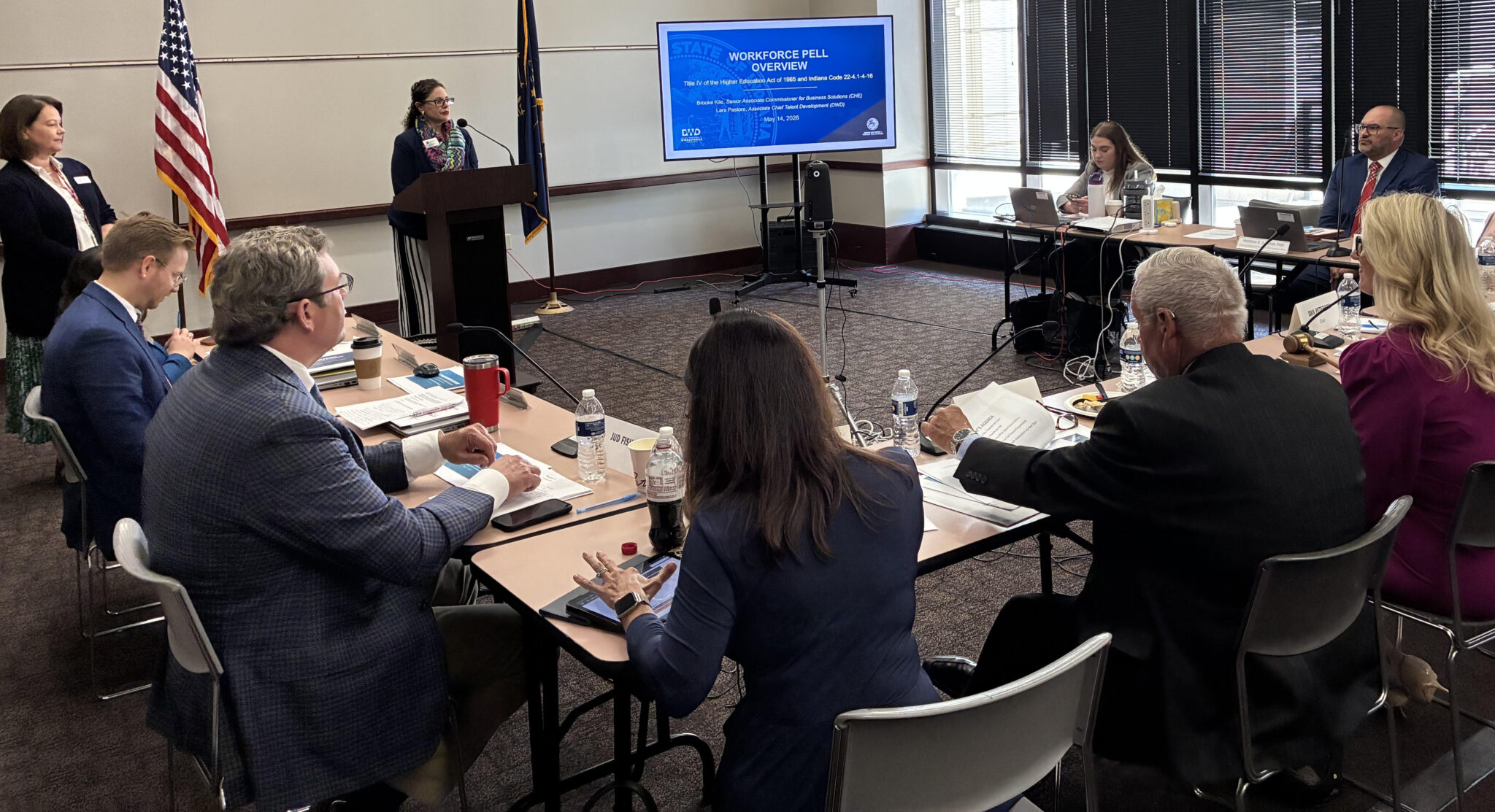
Education Indiana’s higher education agency will work with Ivy Tech Community College, Vincennes University to pilot grants Hoosiers who wish to earn an industry credential in lieu of attending college will soon gain access to federal financial aid. The U.S. Department of Education is finalizing rules for the forthcoming Workforce Pell Grants, an extension of the federal need-based financial aid originally intended for college students. The grants do not need to be repaid, making them a popular option for undergraduate students to offset tuition expenses. Congress authorized an extension of those grants to include high school graduates working toward certain short-term, in-demand industry credentials through legislation dubbed the “One Big Beautiful Bill Act” last year, with the goal of credentialing more low-income students who intend to enter the workforce quickly. Indiana’s plans for program The Indiana Commission for Higher Education is working with Ivy Tech Community College and Vincennes University to act as pilot institutions. While rules are not final, the current version of the Department of Education’s rule restricts Workforce Pell Grants to 8-14 week credential programs where at least 70% of students complete their training and find a job within a year of completion. It is up to states to define which programs meet the federal legislation’s “high-skill, high-wage and in-demand” requirements to qualify for the grants. As of now, Indiana is expected to prioritize credentials in advanced manufacturing, building and construction trades, health and life sciences, information technology and business services, and transportation and logistics, according to Brooke Kile, the state agency’s senior associate commission for business solutions. Kile presented an outline of the program to the commission Thursday ahead of a public comment period on Indiana’s approach to Workforce Pell Grants. Public comment will open once federal rules are final and Gov. Mike Braun has reviewed and approved state rules, possibly in July. The grants will not be available to high school students seeking credentials prior to graduation. Instead, students must obtain a high school diploma or its equivalent and demonstrate financial need through the Free Application for Federal Student Aid, or FAFSA, to qualify for Workforce Pell Grants. Only Title IV colleges and universities authorized by the Department of Education can participate, though colleges may partner with ineligible providers for up to 25% of training. Programs must also demonstrate high earnings and flexibility for graduates to stack their credentials should they desire to continue their education. Renewal sought of college performance funding The Commission for Higher Education, meanwhile, is looking to revive outcomes-based performance funding for colleges and universities in the state’s next biennial budget. Indiana revised its formula for the outcomes-based funding in 2023, but lawmakers didn’t fund the formula in the current biennial budget due to the state’s financial outlook when they wrote the budget last year. The formula uses 13 metrics to reward colleges and universities for positive outcomes including low-income youth and adult enrollment, on-time completion, retention and research investment, though the formula looks different for each institution. No new incentive dollars for Indiana colleges, but performance tracking continues In the past, performance funding in Indiana ranged from 1% to 9% of higher education funding. Cody Robinson, deputy chief financial officer for the Commission on Higher Education, said stakeholders informed the commission the current formula is confusing, “does not move the needle” and “does not focus enough on outcomes.” The commission opened a public comment period Thursday on how it should proceed with performance funding — in an invitation for lawmakers, industry leaders and higher education officials to guide the commission’s approach to performance funding in the next two-year state budget. While the commission awaits feedback, Robinson said it intends to focus on earned credentials, align credentials with state priorities and tailor metrics to each campus as it prepares a formula for the 2027 legislative session. “I was disappointed when we did not fund it at all last year,” said Mike Alley, the owner of Indianapolis-based Patriot Investments and at-large member on the commission. Alley called himself a “strong advocate” of outcomes-based performance funding. Criticisms of the model highlight poor execution, inconsistency and the commission’s inability to demonstrate the value of outcomes-based performance funding to lawmakers, he said. “There’s a lot that can go wrong, but one of the biggest challenges that we’ve had is we’ve lacked consistency in our metrics,” Alley said. “Whenever you continually change the metrics, then that does cause confusion and puts the institutions in such a position that they don’t know what they need to work toward and what’s important.” The commission expects to finalize its formula recommendation by the end of summer. Public comment closes July 3. GET THE MORNING HEADLINES.
Workforce Pell Grants: Financial aid coming for low-income Hoosiers pursuing industry credentials
Full Article
Original Source
Read the full article at Indianacapitalchronicle →KhanList aggregates and links to publicly available news content. We do not host full articles from third-party sources. Always verify important information with original sources.