
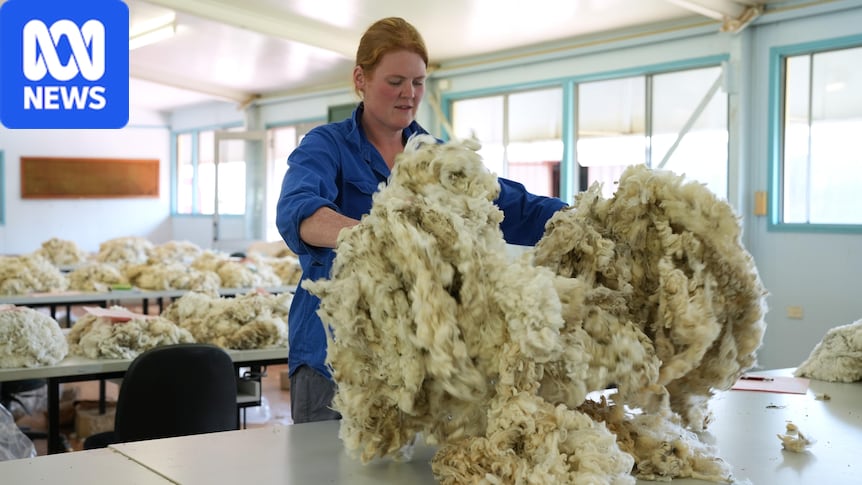
After four weeks of study in a classroom that is anything but typical, a motley crew of outback students have received their wool stencil.Shearers, stock agents, wool handlers and wool producers have learnt how to categorise wool in terms of colour, strand, fineness, texture and style.It is an essential skill in the shearing shed."Today, they're doing their final exam," Anna Ingold, a wool classing teacher from TAFE NSW said."They get a 3-kilogram bag of wool with smaller pieces in it that they have to sort by uniformity in regards to micron length and strength, and find any faults within the wool."The number of wool classers in Queensland has effectively doubled. (ABC Rural: Crispian Yeomans)Wool quality retained amid trade shortageAustralia produces 25 per cent of the world's wool, which is sold at auction in Sydney, Melbourne and Fremantle near Perth before being mostly shipped overseas for processing.But different qualities can fetch different prices, which is why a classer is needed to categorise the shorn wool.Skye Agar says she wishes industries would use wool more. (ABC Rural: Crispian Yeomans)Wool producer Skye Agar, whose family won champion flock fleece at the Brisbane Ekka this year, drove seven hours from Barbara Plains Station, near Wyandra, for the training at Longreach.She said understanding the processing and pricing of wool was "enlightening"."It's just really good knowledge to have being a wool grower [to understand] the whole process after shearing," she said."Because as a grower, usually your job is just to get the sheep to the shed and then away from the shed."A wool-classing cohort has completed its final exam after a decade without a pathway. (ABC Rural: Crispian Yeomans)Queensland shearer David Grant said wool classing was non-negotiable because without someone to grade the wool, it could not be sold."Occasionally you'll get a bit of a hiccup at work and you'll lose a classer or something, once the classer has gone out of the job, the job just stops."Mr Grant said he decided to learn wool classing as a "backup" after decades in the industry.'Bare minimum' but industry recoveringLongreach grazier Mike Pratt, who also chairs the Queensland Wool Technical Advisory Group (WoolTAG), organised the training to meet a wool trade shortage.He said there has not been a wool classing "pathway" in Queensland since 2013."The industry has operated on the bare minimum, that is, if a classer gets sick, it's almost impossible to find a replacement," Mr Pratt said.Mike Pratt says the training was organised with help from the Queensland government and TAFE NSW. (ABC Rural: Crispian Yeomans)He said Queensland needed "about 10" more classers and only had 12 shearing contractors operating in the state, or "down from a hundred when wool was king"."Wool is bringing rewards for those people [still] in the industry, like a good clip would average $3,000 a bale, which is potentially double what it would have five years ago," he said."So we're looking pretty good, and we need to make sure it's sustainable and make sure we've got the right workforce coming through for this wool harvesting industry."Wool has faced stiff competition from synthetics and cotton, particularly as the wool industry has historically marketed merino to high-end fashion markets overseas.The market has been relatively strong lately but has declined by $2 a kilogram since the new financial year, after a dramatic $7 rise since 2025 that reinvigorated the industry.But Ms Agar said wool was a "brilliant" fibre and "incredibly versatile"."It's great for extreme activewear because its incredibly antibacterial and it's a natural fibre, so it's good to wear and it keeps you warm and cool," she said."I just wish people, industry would use it more."The 15 graduates will need to lodge accreditation with the Australian Wool Exchange before they can begin using their new skills in shearing sheds across the country.
Wool trade shortage sees producers, shearers become wool classers
Full Article
Original Source
Read the full article at Abc →KhanList aggregates and links to publicly available news content. We do not host full articles from third-party sources. Always verify important information with original sources.