
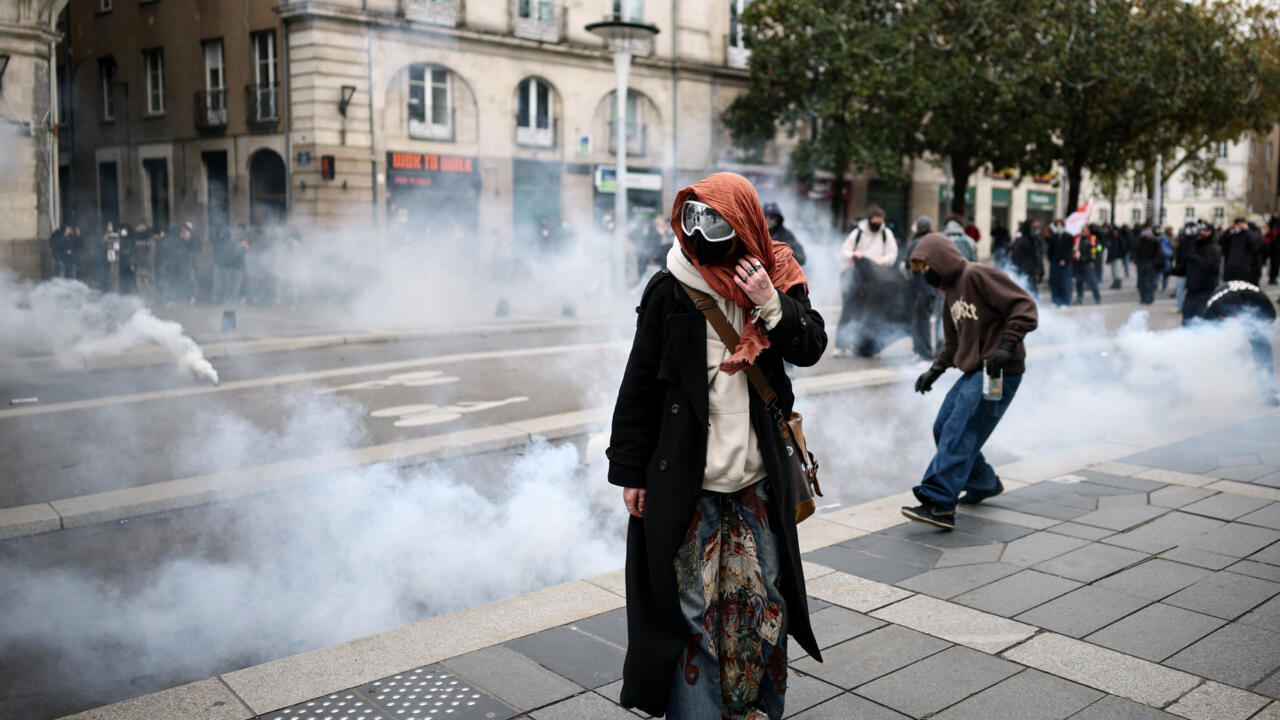
Thousands of women in France have reported unusually painful periods, heavy bleeding and disrupted menstrual cycles after being exposed to tear gas during the country's recent protests, prompting calls for an investigation into its possible effects on reproductive health. Issued on: 15/11/2026 - 11:14 3 min Reading time The reports have been collected by Lacrymos de Sang ("Tear gas of blood"), a collective of activists and health workers which launched an appeal for testimonies about a month ago. "I really wanted the public to be better informed about the health problems linked to exposure to tear gas," said its founder, Eva-Luna Tholance. "Very quickly, it got a bit out of hand and we received more than 10,000 testimonies." Women who responded have described experiencing painful periods, unusual bleeding and disrupted cycles after exposure to tear gas, which police have used to disperse protestors during the recent demonstrations over poor school conditions and the soaring cost of living. One woman, Laurie, said she was subjected to "about six hours" of tear gas exposure during the 17 October protest in Paris. Despite the fact she was taking the contraceptive pill continuously, which blocked her menstrual cycle, she experienced painful bleeding after returning home. "By the end of the demonstration, the pain had really intensified," she told RFI. "When I got home that evening, I was doubled over. I started having extremely heavy bleeding – after an hour, I had to change my sanitary pad." French lawyers to sue interior minister over 'mutilation' of young protesters Possible health risks Scientists say there is currently insufficient evidence to establish a direct, causal link between tear gas exposure and menstrual disorders because too few scientific studies have been carried out on the subject. "Women have long been ignored in science, all the toxicology studies carried out in the 1980s and 1990s were exclusively on male animal models," said Solenne Rougeux, a scientist working with the collective. It is only since the 2010s, she says, that researchers have been required to study the female model in order to publish in a scientific journal. "Yet even now, many researchers still find taking the menstrual cycle into account a nuisance... it introduces far too many additional variables which they believe would skew scientific results." She and other researchers with the collective are therefore examining their own theories involving exposure to CS, the synthetic chemical compound found in tear gas. One hypothesis is that CS may affect the thyroid, which plays an important role in regulating hormones. "One of the derivatives of CS is cyanide and when cyanide breaks down in the body it creates a molecule called thiocyanate – a hormone disruptor that directly affects the thyroid," Tholance explains. "So that could be one line of explanation." Another possibility is that CS activates a pain receptor, TRPA1, also found in the lining of the uterus and vagina, potentially triggering severe pain. Experiments with paid menstrual leave, but no consensus on making it French law Calls for further research When contacted by France TV, the Interior Ministry said the reported menstrual symptoms could be linked to stress, but Rougeux said this was not enough to explain hormonal reactions. The impact on health of exposure to tear gas was previously studied in the United States, following the 2020 Black Lives Matter protests in Portland. A study involving 2,200 protestors found that 900 of them reported abnormal menstrual cycles, including intense cramping and increased bleeding after being exposed to tear gas. The Lacrymos de Sang collective hopes its findings will encourage further scientific research and a reassessment of the use of tear gas. Tholance is calling for authorities to apply the precautionary principle and stop using the chemical irritant altogether. "We have strong warning signs that call for measures to protect the civilian population against potential health problems that could have long-term consequences." France Info reported that Interior Minister Laurent Nunez said on 2 November that he had "no knowledge of the harmful nature" of tear gas and would not suspend its use "as a matter of precaution". This article drew on interviews from this report in French by Baptiste Coulon.
Women in France report painful periods after exposure to tear gas at protests
Full Article
Original Source
Read the full article at Rfi →KhanList aggregates and links to publicly available news content. We do not host full articles from third-party sources. Always verify important information with original sources.