
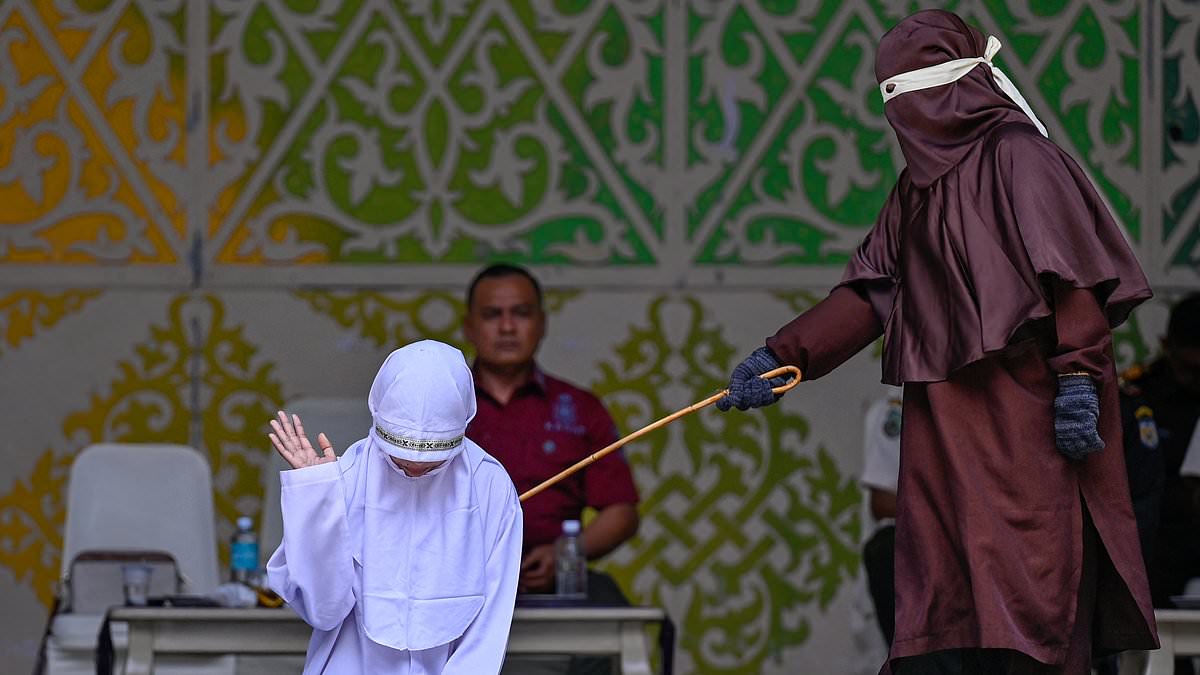
A woman has collapsed after being lashed for having sex outside marriage, a violation of Sharia law in Indonesia. Photos from Banda Aceh, the capital of an Indonesian province that is the only one to apply Islamic law in practice, showed medical and Sharia officers crowding around a woman following her punishment. She was publicly punished for having sex outside marriage, a punishment that can get violators of the law up to 100 lashes of a cane. Alongside her, a man was brought to his knees from the sheer pain of the thrashing he received. He was punished for committing adultery, also a crime under Sharia law in the Aceh province. They were among the eight people sentenced by the Banda Aceh Syar'iyah Court, who handed them up to 100 lashes each for violating various Islamic laws. A small crowd had gathered to watch the punishments, which took place on a public stage in the city. Ruthless officers, also known as 'algojos', use rattan sticks to flog them in front of Islamic court officials and curious onlookers in a gruesome spectacle condemned by human rights groups.Dressed in dark robes that shroud them from head to toe, and their faces concealed by cloaks to maintain anonymity, the algojos are there to inflict pain with every strike. A woman is caned after being convicted of violating Aceh's Islamic law prohibiting sex outside marriage in Banda Aceh on on October 15, 2026 Medical personnel and Sharia officers attend to a female convict who collapsed on the stage during a public caning session in Banda Aceh, Indonesia, on October 15, 2026 Caning is used to punish a wide range of offences, including gambling, drinking alcohol, homosexual acts and having sexual relations outside marriage. The public nature of canings in Aceh is intended to shame as well as inflict pain on people found to have violated Sharia law.It is common for convicts to faint, with pictures and videos often showing them being carried out on a stretcher after they receive their violent punishment. Canings are often staged outside mosques or in community squares, with crowds watching and often documenting the event on their mobile phones. Indonesia is the world's largest Muslim-majority country but officially recognises six religions as well as indigenous beliefs. Human rights groups say the humiliation adds to the cruelty and causes lasting psychological damage.Amnesty International and Human Rights Watch have repeatedly condemned the practice, saying it violates Indonesia's constitution and its obligations under international law. Usman Hamid, the Executive Director of Amnesty International Indonesia, previously said: 'Such behaviour might be considered inappropriate because social media is viewed by people of various age groups, including children.'But is it a crime that warrants imprisonment or even caning? That would be excessive.'Amnesty previously said: 'Caning contravenes Indonesia's constitution and is in clear violation of international human rights law and standards.'It constitutes a cruel, inhuman and degrading punishment and can amount to torture in violation of the UN Convention against Torture and other international covenants, to which Indonesia is a State Party.' A woman reacts as she is caned after being convicted of violating Aceh's Islamic law prohibiting sex outside marriage in Banda Aceh on on October 15, 2026 Officers and medical personnel assist a weakened convict after undergoing a public caning sentence in Banda Aceh, Indonesia, on October 15, 2026 A convict grimacing in visible pain during a public caning session in Banda Aceh, Indonesia, on October 15, 2026 Local officials have defended the practice as a deterrent and as part of the province's identity, while critics warn it has negatively affected Indonesia's human rights reputation and inflicted lasting trauma on those who endure it. The practice also has wide support among Aceh's mostly Muslim population.More than 90 per cent of the 255 million people who live in Indonesia describe themselves as Muslim, but the vast majority practise a moderate form of the faith.Sharia law in Aceh was introduced in 2002, with further provisions added the following year, after it was granted special autonomy in 2001, an attempt by the central government to quell a long-running separatist insurgency.As part of that deal, Aceh won the right to be the only Indonesian province to use Islamic Sharia law as its legal code.Among the measures introduced in 2003 was a ban on a person being alone with someone of the opposite sex who is neither a spouse nor a relative.The law also set out punishment for sex crimes, unmarried people engaging in displays of affection, people found guilty of adultery and under-age sex.Religious police in Aceh have been known to target Muslim women without head scarves or those wearing tight clothes, and people drinking alcohol or gambling.Men and women have collapsed in pain due to the severity of their injuries, and people can be caned for something as innocent as standing too close to a partner in public or being seen alone with someone they are not married to.Over the past decade, the central government has devolved more power to regional authorities to increase autonomy and speed up development.In 2018, the province began consulting the public on whether it should introduce beheading as a punishment, although Indonesia's central government warned such plans would not be permitted under national law.
Woman collapses after being caned for sex outside marriage in breach of Sharia law in Indonesia
Full Article
Original Source
Read the full article at Dailymail →KhanList aggregates and links to publicly available news content. We do not host full articles from third-party sources. Always verify important information with original sources.