
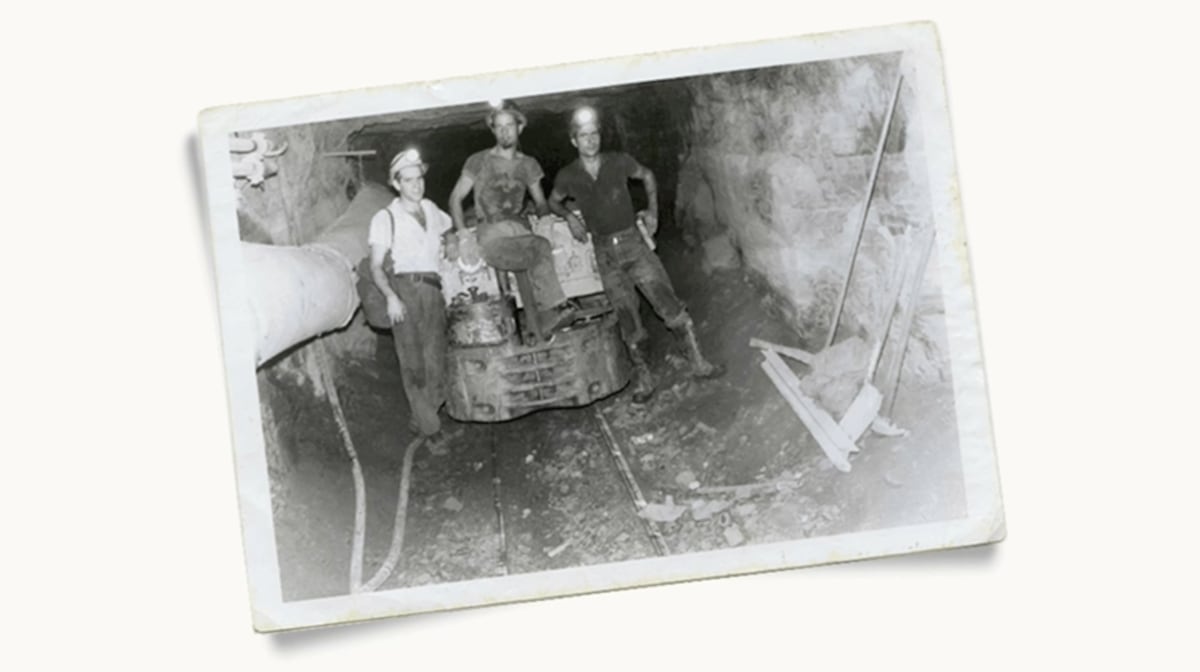
Wittenoom does not appear on road signs. It has been erased. Removed from official maps. No one lives there and visiting it is forbidden. It is a ghost town. Long ago it was a settlement of prefabricated houses with a grocery store, two schools, a nursery, a hospital, a church, a bar, an open-air cinema, tennis courts, soccer and cricket fields and even its own police station. It grew up around a blue asbestos mine so that, in the middle of nowhere, workers and their families could live nearby.It was in Western Australia, in a remote desert area of the Pilbara region. Perth, the nearest major city, was about 870 miles away. Life there was not easy, but miners, many of them European immigrants, agreed to isolate themselves from the world for months or even years in exchange for good pay.It was the 1940s, 1950s and 1960s. Millions left the poorest countries of Europe after World War II in search of economic opportunities. Spaniards migrated mainly to Germany, Switzerland, France, and Belgium. Others crossed the Atlantic to the Americas. A few set off around the world to Australia, where the Franco regime had struck a migration agreement that began in 1958 and sent about 8,000 Spaniards there. The first went to work harvesting sugar cane. Later they worked in construction, tobacco, logging, or mining. They called it Operation Kangaroo.One of the companies looking for labor was Australian Blue Asbestos, a subsidiary of CSR (Colonial Sugar Refining Company), which had operated an asbestos mine in Wittenoom since 1943. Asbestos was a heat‑resistant mineral widely used in many products at the time: pipes, trains, ships, electrical installations… That deposit held vast quantities of crocidolite, known as blue asbestos. The company saw a huge business opportunity and never warned workers that it was dangerous.But it was.Since then, over 2,000 workers and residents of Wittenoom have died — sometimes decades after leaving the town — from diseases linked to asbestos exposure. A silent, treacherous tragedy that many affected people call the “Australian Chernobyl” because of the scale of what happened and the delayed effects it caused.This is the story of what happened there, and of Spanish emigration during those years, told through two families who crossed paths in that lost town: Daniel and María’s family, and Milagros and Ramón’s. Two of their children were born in the same hospital bed surrounded by lizards, red dust, and asbestos. A lot of asbestos.Welcome to Wittenoom, land of opportunity.Chapter 1. Madrid, 1961. A dance that ends in AustraliaMaría Bernal and Daniel Écija met while dancing. She was 20. He had just turned 26. She lived in the building porter’s apartment on Fúcar Street in Madrid’s Literary Quarter; she was a seamstress and cared for her sick father. He had started helping his father with his cab at age nine and had already worked in France and Germany when he met María. She had never had a boyfriend and rarely went out. Her mother tried to protect her from the building’s young gentlemen, eager to court the attractive porter’s daughter. But Daniel was different. He was proper and respectful, tall and handsome.That Saturday, September 16, 1961, María went with a friend to the afternoon dance at the Círculo de Bellas Artes. It was there she met Daniel. They agreed to see each other a few days later. María still remembers the first kiss. Then everything moved fast. He asked her father for her hand — “don’t worry about anything, Vicente, I love your daughter” — and a year later, on September 20, 1962, they married. Four days later they emigrated to Australia.María is now 84. Alzheimer’s has erased many of her memories, but that trip remains vivid: the fear, the nerves, the excitement, the sense of adventure. It was her first time leaving Madrid, her first flight. They carried only a small suitcase between them. Neither spoke a word of English. “I stuck close to my husband, like a little girl,” María says, surrounded by sepia family photos from those years. “But I was proud. I had fallen in love with that man and trusted the future… even though it was so far away. In Spain we had nothing, neither of us.”Two of María’s four children help her reconstruct that history. The eldest, Daniel Écija — named after his father — was born in Wittenoom 63 years ago and is today one of Spain’s best‑known television producers, creator of series such as Médico de familia and Los Serrano. His sister Arantxa, 58, a director and audiovisual producer, is the family’s keeper of memories.When they landed in Australia, someone from the Spanish community met them and took them to an immigrant center, where they stayed for a few days. María recalls they slept in “barracks.” They later traveled to Perth, a city in the country’s industrially growing southwest. New arrivals were assigned from there: many in that area went into construction or factory work; others went to the mines.Blue asbestos had been extracted in Wittenoom since the 1930s. Australian Blue Asbestos, a CSR subsidiary, had taken over the mine in 1943. During the 1940s, 1950s and early 1960s, it operated at full capacity.A friend of Daniel’s who had convinced him to emigrate worked there. He earned a good wage, and Daniel thought it was a good way to save money for his family. María was pregnant — probably from the wedding night.They arrived in Wittenoom and it looked like the set of a western. There were Australian miners, but most people had come from across Europe — especially Italians. There were Greeks, Poles, Irish, and Spaniards. “We met another married couple from Madrid there,” María recalls. “Milagros and Ramón. We quickly became close friends.” Neither family spoke a word of English.Milagros Barroso was from Navamorcuende, a village in Toledo. She was widowed at 22 with a small child, so she went to Madrid to work in domestic service. There she met Ramón de Juan, a driver for a senior official in the Franco regime. He was also a widower with a daughter. They married. He went to work in Germany and first heard of the Australian dream there. He returned to Madrid and, almost without thinking, they all traveled to the other side of the world, with the children each brought into the marriage — Mercedes de Juan and Víctor Calvo — and the first child they had together, José.Víctor, now 72 and living in Madrid, arrived in Australia aged seven in August 1962 and recalls that journey clearly: “We left Málaga and it took us more than 20 days by ship to reach Australia. We passed through the Suez Canal… Phew, how hot it was there. I remember the seasickness. The uncertainty. That feeling of not really knowing where we were going or how we would live. It was fun too, because for a child it was an adventure. My sister Merce turned 11 on the ship. We arrived and they took us to barracks with interpreters, but soon we were left not understanding anything. Spanish emigration at that time was like that: you clung to any opportunity to get by, like those who come to Spain today.”And he still vividly remembers arriving in Wittenoom, six decades later: “The plane was small, propeller‑driven, and it shook a lot. We landed on a strip amid very, very red earth. There was dust everywhere. I had never seen so much dust. They took us to houses made of corrugated iron, wood and asbestos cement. That place was extremely isolated — the desert of deserts. That first image has never left me. There were all sorts of animals: snakes, tarantulas, huge lizards. Everything was so different from Spain it seemed unreal, like a dream.”The family arrived in the town with trunks of warm clothes and shoes they would never wear. Ramón went to work in the mine while Milagros and the children spent their days in that prefabricated, blistering, dusty settlement in a landscape they had never seen.Chapter 2. Wittenoom, 1962–1964. Life at the mineDaniel Écija worked eight‑hour shifts. Ramón de Juan doubled shifts when he could and many days worked 16‑hour stretches. They became inseparable friends, along with their families.“On our father’s first day of work there was an explosion and several people died,” Daniel junior recounts. “I think when he saw all that he wanted to leave as soon as possible, but my mother was pregnant and they had no money, so they stayed a few months.”His sister Arantxa recalls another story their father often told. A piece of asbestos fell on his foot and, strangely, it was a wound that never closed. In one family portrait from that time Daniel has a bandaged foot. They have returned to that photo many times since.“There were hardly any safety measures,” Víctor explains. “There were many accidents and ambulances came all the time. That’s why there was a hospital in the camp.”Men who had arrived alone, without family, lived in tents set up for single workers. María and Milagros did not feel very safe and rarely left home while their husbands were at the mine. “There were prostitutes to serve the workers,” María recalls. “I was pregnant and tried not to go out much until Daniel came back. I waited for him to arrive before going shopping. I was very young, very much a child, and I was afraid.”“My father described Wittenoom as a lawless place,” his son says. “A town with quite primitive life where everything was organized by nationality. There was even kangaroo poaching. They would go at night in jeeps, shine lights on them and kill them, he told us. He went once and never went again. There were also cattle thieves. He said he even once saw the policeman — whom he called the sheriff — selling stolen meat.”There were two schools: one public and one religious. “My brother and I had our first communion there, in short pants and a neat haircut,” Víctor says. “In the morning we went to school and then played among ourselves near the house. We didn’t socialize much with other children.” His sister Mercedes has fond memories of two friends, an Italian and an Australian, and of the nuns: “We were children and children adapt very quickly. I was fine in Wittenoom, content.”They bought everything at the town’s only supermarket. A truck brought supplies every 15 days. “My mother ordered by signs because she never learned English,” Víctor says. She cooked lentils, chickpeas, lots of macaroni, meatballs. Sometimes a friend in Perth sent cured meats from the city. “To have fun we would bathe in nearby pools. There were no televisions in the houses. Every day was the same: my stepfather went to the mine and my mother took care of us. She shopped, cooked, washed clothes by hand… without ever complaining. I never saw her angry.”Milagros, who had not yet turned 30 when she arrived in Wittenoom, is now 95 and lives in Madrid. She remembers the parties some families held at home and how many people still managed to have fun despite the isolation. They did not attend, but they loved the open‑air cinema, set up with white sheets on which films were projected.María and Milagros each had pregnancies in that mining town. Their children were born in the same bed at the same hospital.Milagros gave birth in March 1963 to John Patrick. They named him after Irish friends they had made in the town. Shortly after, in June, María had a difficult delivery. The baby was very large. Forceps were used and she was weak because she had just recovered from a serious kidney infection. The baby would be called Daniel, after his father. The woman remembers enormous lizards entering the room. Later they were told the reptiles were almost allies: they ate the snakes that came to the hospital attracted by the smell of breast milk.Neither family was ever aware they were in a place that was more dangerous beyond the obvious risks of a mine. By then, the company and the authorities already knew blue asbestos was toxic and posed a serious health risk, but no one had told them. And it was everywhere.“It was a highly prized material used for a lot of things: roads, houses, roofs, sockets,” Víctor recalls. “In Wittenoom, a town built from nothing, it had been used a lot. We played with it and unraveled it. We put it in our mouths. When we touched it a fine dust would come off and coat everything. We were surrounded by blue asbestos, but we weren’t afraid. No one warned us.”There is no nationality census that determines how many Spaniards passed through Wittenoom. These two families remember a couple more married couples, but they only stayed a few months of the several decades the mine was at full output. In total around 6,500 men and 500 women worked there between 1943 and 1966, according to a 1992 article in the American Journal of Industrial Medicine that analyzes what happened. Many of them were accompanied by their families.The Écija‑Bernal family left Wittenoom when Daniel was just over a month old. They departed after his baptism, performed by a Polish priest. They still keep the photo Daniel and María sent to her parents with a note on the back: “See, granddad? They baptized me and I didn’t cry at all. I’m eager to meet you, I love you very much.” The date: July 7, 1963. They spent about 10 months in the town.The De Juan‑Barroso family stayed a bit longer: roughly two and a half years between 1962 and 1964. Ramón had a three‑year contract arranged from Spain, but he left early.Both families moved to Perth after Wittenoom. They worked hard, saved, bought a television, a car, a washing machine, and carried on with their lives. The Écija‑Bernal family returned to Madrid in 1966. The De Juan‑Barroso family did so in 1971, although the eldest daughter, Mercedes, had fallen in love and married an Italian, Giuseppe, and stayed in Australia, where she still lives near her four children, 11 grandchildren, and nine great‑grandchildren.No one imagined then that Wittenoom would cross their paths again.Chapter 3. Madrid, 1991. The mesotheliomaLife in Spain went well for Daniel Écija, a self‑made man — steady, a tireless worker, modern, thoughtful and charismatic — whom his family revered. He supported his four children on his driver’s salary. The couple loved each other. They could be described as a reasonably happy family.Until, in 1991, they received a devastating blow.“Your father has a mesothelioma.”“What’s that?”“A very rare and extremely aggressive cancer. In most cases it is related to asbestos exposure. It is almost impossible to treat successfully.”Nine months after that diagnosis, Daniel Écija died. He was 55.The word asbestos echoed in his wife María’s and their children’s minds. They started asking questions. What had their father’s relationship been with asbestos? When? Where? What was the origin of that mysterious, fast‑moving tumor? Google did not exist then, and it was not easy to get information or find answers. But they returned to family albums, to Wittenoom, Australia — the 10 months between 1962 and 1963 their father had spent at a remote mine. But too much time had passed. Or had it?Gradually they learned of the extreme risk faced by everyone who had worked or lived there, that the mine had closed in 1966, and that more than 2,000 people had died from conditions linked to asbestos exposure in Wittenoom: mesothelioma, lung cancer, and complications from diseases such as asbestosis. They also learned deaths can occur decades after inhaling asbestos fibers.The figure authorities accept is over 2,000 deaths related to contamination in Wittenoom. But Melita Markey, CEO of the Asbestos Diseases Society of Australia, qualifies that: “The government stopped counting at 2,000, but now it is estimated the number may be greater than 4,000. And it keeps rising. There are children of public servants who worked in the town, like police or teachers, who are becoming ill now. All these families live with a terrible legacy, thinking that that place may have been a death sentence for their children.”Miners did not know the site’s dangers, but the company and the authorities did. The American Journal of Industrial Medicine article details the process: early warnings about asbestos dust in Wittenoom in 1944; a 1946 diagnosis of asbestosis; a Western Australia Mines Department inspector describing working conditions as “horrific” in 1946; in 1948 a public health doctor, Eric Saint, warned in writing that dust levels were extremely dangerous; and further alerts accumulated in subsequent years.In 1958 another inspector described the situation at the mine as a tragedy. This occurred three years before the Écija and De Juan families arrived. By then numerous severe lung disease cases among workers had already been detected. One of the first mesothelioma diagnoses linked to Wittenoom was reported in the early 1960s.Cases continued to rise. The mine closed in 1966, but it was too late for thousands of people. At closure there were 1,468 men and 421 women living there, according to the medical journal’s census.After the closure legal claims followed. Early suits failed. Those affected formed the Asbestos Diseases Society of Australia in 1979 and gradually won cases and uncovered documents showing the company had known about the mine’s risks for years without taking measures. A judge determined in 1988 that the mining company had acted with a “continuous, conscious and contumacious” disregard for the safety and health of its workers.In 1989 CSR reached an agreement with 200 claimants and paid A$18.3 million ($12.51 million) in compensation. And that was only the beginning, because litigation continued. In total, according to the Australian public broadcaster ABC, CSR has paid tens of millions of dollars to former mine workers and their families.Authorities began promoting Wittenoom’s definitive closure in 1978, but it was gradual. In 2006 they cut electricity and services. A year later it was stripped of town status and its name removed from official maps to discourage sightseers and tourists. The last resident held out until 2022.Sixty years after the mine’s closure those lands remain toxic because of tiny blue asbestos fibers dispersed across the landscape. The area classified as contaminated is vast — about 46,840 hectares. The current struggle is to clean the zone. This year an organization filed a A$1.5 billion ($1.03 billion) claim on behalf of the Banjima, the Indigenous people native to those lands, against the government for contamination of land and water.The government of Western Australia told EL PAÍS by email that it is aware of the “serious public health and safety problem” around Wittenoom and continues working on long‑term options for the area and surrounding lands.Chapter 4. Madrid–Perth, 2026. The screeningsMercedes de Juan stayed in Australia with her husband, Giuseppe. She is now 75 and says by video call from Perth how she gradually learned through the press about Wittenoom’s closure, the mesothelioma cases, the political debate and what had been allowed, and about the more than 2,000 dead.Now, she and her brother John — who returned to live in Australia decades ago with his Spanish wife, Eva — must undergo “the tests.” Each year, like all former Wittenoom residents who want to — and who are increasingly fewer in number — they undergo government‑funded medical exams to check their lungs. The two siblings always go together. “They give us a scan and a lung function test,” Mercedes explains. But in the case of mesothelioma, if something is discovered there is little to be done. The prognosis remains poor. “There have been cases of people who died who never even lived there, who only went on a school outing,” John says. “But we have never lived in fear. Our family has been lucky and, so far, no one has fallen ill from asbestos. My father died in Madrid at 87 after advanced Alzheimer’s disease.”On John’s passport, as on Daniel Écija’s, the place of birth recorded is that small settlement now absent from maps. “That place changed our lives forever,” Daniel says now, beside his mother and his sister Arantxa. “We lost our father, and my mother lost her husband, because of a company that had no qualms about risking its workers’ lives to make money, and because of authorities that failed to stop it. My father, like so many others, was just an emigrant looking for a better life on the other side of the world.”The first time Daniel returned to Australia as an adult a policeman stopped him at the airport checkpoint. It was 1985. His father was still alive and had encouraged him to make the trip. The officer looked at him, lowered his head to the document and then raised his eyes and said: “So, from Wittenoom, huh? A terrifying place.”Sign up for our weekly newsletter to get more English-language news coverage from EL PAÍS USA Edition
Wittenoom: The Spaniards caught up in the ‘Australian Chernobyl’
Full Article
Original Source
Read the full article at English →KhanList aggregates and links to publicly available news content. We do not host full articles from third-party sources. Always verify important information with original sources.