
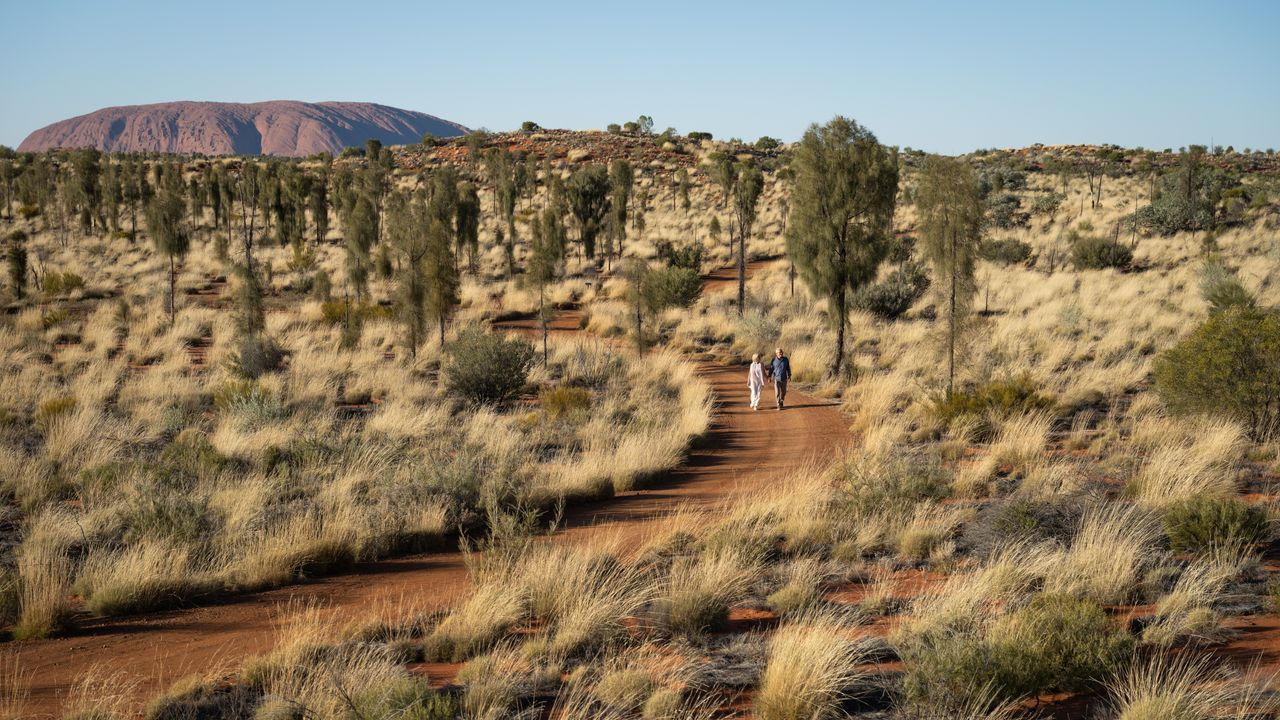
For the first time, a new five-day walking trail invites travelers to experience the destination—and nearby Kata Tjuta—alongside the Indigenous Aṉangu who call it home.It’s shortly after sunrise and I’m standing atop a blazing orange sand dune in Uluṟu-Kata Tjuṯa National Park. The domes of Kata Tjuṯa glow vermillion red and fade to watermelon pink as the sun rises higher. My heartbeat slows and I exhale a long, deep breath. The feeling is familiar: it’s so good to be back here.I last visited Uluṟu, the 550-million-year-old sandstone monolith in the center of Australia, in 2019. I remember feeling similarly overwhelmed by the stillness and a strong sense of the primordiality of this place. And yet, so much about the context of this visit has changed.Equally spiritual to the Aṉangu, and just as ancient as Uluṟu, is Kata Tjuṯa, another giant rock formation and the other headlining attraction of Uluṟu-Kata Tjuṯa National Park. Tourism & Events NT/@75vibes_Sacred to its Traditional Owners, the Indigenous Aṉangu (pronounced ah-na-noo), Uluṟu is more than a rock: It is a living cultural landscape created by ancestral beings during what is called Tjukurpa (pronounced chook-orr-pa), or Creation. Equally spiritual to the Aṉangu, and just as ancient, is Kata Tjuṯa, another giant rock formation and the other headlining attraction of Uluṟu-Kata Tjuṯa National Park, which is situated some 30 miles away by road. Both natural wonders are “places of deep cultural connection,” says Tjiangu “TJ” Thomas, an Aṉangu Traditional Owner of Uluṟu-Kata Tjuṯa National Park and owner of Alatji Tours. “The landscape holds knowledge, history, and authority. For Aṉangu, these living cultural landscapes are connected through Tjukurpa, our lore, which continues to guide how this place is cared for today.”Brett Godfrey, co-owner of Tasmanian Walking Company (TWC), which was founded in Tasmania but now organizes walks in other Australian states, understands this well. In 2015, he had what he calls a life-changing experience when trekking 150 kilometers (93 miles) from the border of South Australia to Uluṟu with his son, alongside Thomas and another Traditional Owner.“One night we camped on a sand dune at the exact spot where TWC’s Camp Two, known as Talliwanu, now sits,” says Godfrey. “There were just four of us under this enormous desert sky, and I remember thinking: Why doesn’t this experience exist for other people?”Guests on the Tasmanian Walking Company’s Uluṟu to Kata Tjuta route stay at low-impact accommodations. VAL / Tas Walking Co.The writer embarked on a multiday walk that was created in close consultation with Aṉangu leaders, as the trail crosses their traditional land. Ben SavageAnd so the seeds for a new trail between the two great rock formations of Uluṟu and Kata Tjuṯa were planted. TWC, in close consultation with Aṉangu leaders, began planning the five-day, 54-kilometer (33.5-mile) hiking experience that would include 38 kilometers (23.5 miles) of fresh trail tracing the footsteps of the Aṉangu, who have walked here for 30,000 years. The chance for any operator to bring in groups of walkers for overnight stays was a landmark first since 1985, the year Uluṟu-Kata Tjuṯa National Park was handed back to the Aṉangu—they also granted TWC permission to place four low-impact glamping camps and lodge structures along the trail. It’s the result of more than a decade of partnership between Godfrey and the community.Now, seven years after my first poignant visit to Uluṟu, I’ve come back to walk the new five-day Uluṟu Kakararra Trail—Kakararra meaning “going east” or “walking east”—with TWC. On day one, we convene at a picnic shelter, with the red silhouette of Uluṟu as our backdrop, to meet our TWC walking guides Ebony Lacy and Marie-Charlotte Redot, before we are joined by Thomas. He meets every TWC walking group at three different points over the five-day adventure, allowing for an Aṉangu connection throughout the experience.Thomas greets us with “palya,” a word that can mean many things: hello, goodbye, welcome, or thank you. “It’s a useful word to know,” says Thomas. “We want people to come here and experience our culture. Palya is a good way to start.” We feel the depth of the welcome on this ancient, Indigenous land, and an awareness that we are not only among the first outsiders to spend the night here in over 40 years, but among the first—ever—to do so at the invitation of the Aṉangu.The walking route is lined by desert oaks and eucalypti, as well as mounds of yellowed spinifex grass. Tourism & Events NT / Ben SavageWe begin by walking down a hill into the Valley of the Winds at Kata Tjuṯa. Mammoth boulders soar above us, and on either side of the path there are mounds of yellowed spinifex grass and mulga trees (a kind of acacia), among desert oaks and eucalypti that seem to sprout straight up from the rocks. Comprised of 36 conglomerate domes, Kata Tjuṯa, meaning “many heads,” is sacred to Aṉangu men who perform gender-specific “men’s business,” such as smoking ceremonies or passing down laws and knowledge to younger generations, at sites here (many of the women’s business sites, where activities related to childbirth and healing take place, are at Uluṟu). Since men’s business is restricted to initiated men only, neither photography nor video by visitors is permitted. We’ll only be allowed to photograph Kata Tjuṯa beginning on day three, when we’ll be far enough to avoid compromising any sacred sites—it’s a notable contrast from my last visit, when tourists unknowingly snapped selfies beside these very rocks.It’s 85 degrees Fahrenheit, unseasonably warm for winter in central Australia, so we stop in a wooded oasis. Redot, who is French and goes by MC in these parts, crouches on the ground and uses a stick to draw in the cayenne-hued dirt. She wants to give us an overview of the geology of the area. This desert was once a sea, she explains, and tectonic plate movements created Uluṟu and Kata Tjuṯa.“Geologists estimate that Uluṟu and Kata Tjuṯa extend between two to four kilometers (1.2 to 2.5 miles) underground,” she says. (Later reading tells me they may actually reach as deep as six kilometers, or 3.7 miles, below the earth’s surface.) The fact that we will walk from one to another is not just a matter of connecting two points of interest; it’s believed that the twin icons are actually linked subterraneanly.“The landscape holds knowledge, history, and authority," says Tjiangu “TJ” Thomas, an Aṉangu Traditional Owner of Uluṟu-Kata Tjuṯa National Park and owner of Alatji Tours. Tourism & Events NT / Ben SavageWhile the Valley of the Winds walk, at only 7.4 kilometers (4.6 miles), is the shortest of the trails we hike over the five-day journey, it’s also the most challenging, with a difficulty rating of 4 out of 5. The other portions of the trail are flat, but they are longer and often made of loose sand. Its name is not for nothing either. As we make our way down the steepest section, the sky darkens, and the air is blowing so hard between the hulking ochre domes, it’s as if I’m pushing through the gales of an urban canyon. When we reach the Karu and Karingaṉa lookouts, to finally take in views over rolling green plains and other domes in the distance, the strenuous effort proves to have been well worth it.At Camp One that first evening, we are all delighted to see what Godfrey meant when he said the structures “float above the desert,” allowing for the “lightest possible footprint.” Here, low-impact doesn’t mean we will be roughing it. My own canvas tent is raised on a platform and furnished with a double bed draped in soft, forest green bamboo linens. There are bedside tables, a coat rack, and a bench on which to lay my duffle, beside awaiting Australian wool blankets.The lodges are known here as wiltja (pronounced wilt-cha), meaning shelter, and each of the three camps along the route is anchored by one. While the wiltja at Camp One is attractive, modern, and comfortable, each wiltja, as we close the distance between ourselves and Uluṟu, becomes progressively larger and more stylish with contemporary sofas, long handmade dining tables with handmade chairs, and Indigenous paintings and crafts created by Central Australian artists and artisans. The wiltjas become the place we gather after many hours spent on our feet for a well-earned cocktail hour, to chat easily about our day over cheese boards.Guides point out native flora, many of which have medicinal or culinary uses for the Aṉangu. Tourism & Events NT/Tourism AustraliaFlowers and insects like butterflies can be seen on Australia’s Uluṟu Walk. Tourism & Events NT / Ben SavageAnd there is much we absorb each day on the Uluṟu-Kata Tjuṯa walk, particularly when it comes to flora and fauna. Our trails are embellished by endearing little songbirds, like honeyeaters, zebra finches, black-faced wood swallows, and tree martins, which flit busily from bush to bush. The surrounding trees, with their pale, paper-like bark, particularly the drought- and fire-resistant eucalypti that regenerate after burning, cast an ethereal aura. There is, too, the sweet scent of the pink and white flowers of desert heath myrtle, and the violet spikes of mulla mulla popping up from the saffron-hued sand.Redot is well-versed in the native flora of the park, earnestly recounting the names of various trees, fruit, and flowers, as well as their medicinal or culinary uses by the Aṉangu. Fingering the spindly leaves and the pea-size fruit of a weeping emu bush, Redot tells me the plant is used in “women’s business” smoking ceremonies to create a sterile environment for new mothers and their newborn babies; the cut leaves infused in water can also be drunk for colds or rubbed on sores and body aches.TWC tour guide Redot displays the fruit of the weeping emu bush. Elizabeth WarkentinWe are fully immersed in the landscape, attuned to its rhythms, by the time Thomas meets us again on day three, this time for dinner followed by a fireside chat at our wiltja.He begins by telling us the story of how TWC’s Godfrey first approached the Aṉangu to do the 150-kilometer walk from South Australia to Uluṟu, which inspired the whole project. Thomas is thrilled that the walk has launched at last, after a 10-year process, and wants people to come from all over the world to “have a good time and get a taste of what it’s like here.”The group, all Australians except for myself and a lone Canadian, pepper the conversation with our questions. One walker wants to know, “How do we move forward [and understand one another better] if so much of Aṉangu culture is private and can’t be shared?”Wildlife along the trail includes smooth knob-tail geckos of Uluṟu. GettyThe violet spikes of mulla mulla pop up from the saffron-hued sand. Tourism & Events NT / Joshua Griffin“We’re doing this now,” says Thomas, motioning to the fire. We accept his generous invitation to continue learning from him.The extent to which Aṉangu have been involved in the Uluṟu-Kata Tjuṯa trail project is itself an important milestone in the changing social attitudes and shifting tourism model in this area, which began around the time the “Uluṟu climb” was banned in 2019. Not so long ago, much of the tourism in the national park revolved around the climbing of Uluṟu. Considered a “rite of passage” for many non-Indigenous Australians since the 1950s, the Uluṟu climb involved scaling the steep 1,141-foot rock by holding on to a low-hanging chain handrail attached to a series of bolted iron poles. This, and the litter and human waste that climbers left behind, was hurtful to the Traditional Owners. It was also a violation of Aṉangu cultural law. Aṉangu have never climbed Uluṟu because it has always been sacred to them. To do so would be akin to desecrating a church, synagogue, or mosque—watching others do so was a long-endured pain.To Thomas, the closure of the climb—which officially ended on October 26, 2019—“marked a moment where respect for our culture became more important than tourism dollars.” To the obstinate climbers who came in the final weeks and days to climb the rock before the act became a crime, Thomas wished he could have spoken to them: “Come out with an open mind and heart and immerse yourself in the culture,” he would have said.This sentiment aptly captures what the new TWC Uluṟu-Kata Tjuṯa Signature Walk is about. Traditional Owners, alongside Parks Australia, with whom they jointly manage the park, have spent years calling for tourism experiences that connect visitors with the Aṉangu and their land rather than “conquering” it, as Godfrey puts it.The chance for any operator to bring groups of walkers for overnight stays in Uluṟuis a landmark first since 1985, the year Uluṟu-Kata Tjuṯa National Park was handed back to the Aṉangu. Tourism & Events NTIn the years leading up to the climbing ban, nearby luxury lodge Longitude 131°, tourism outfits like Voyages at Ayers Rock Resort and the small group tour operator SEIT had already begun offering more meaningful, culturally relevant activities like a dot painting workshop with an Aṉangu painter; a desert garden walk with an Indigenous guide to learn about the local flora and their medicinal and culinary uses; a didgeridoo workshop with an Indigenous didgeridoo player; and a “bush tucker” (native foods eaten by First Nations peoples) experience. The opening of the Uluṟu-Kata Tjuṯa walk promises a yet more immersive way to “slow down and connect with the stories, landscapes and Tjukurpa in the way the Aṉangu intended,” says Thomas.Longitude 131°, a luxury lodge with 16 tented pavilions, is a high-end jumping-off point for travelers embarking on the walk. Tourism & Events NT / Ben SavageOn our penultimate day, we meet Thomas one last time at the base of Uluṟu—but this time he is joined by Ruth, an elder from his community, with whom we walk to the Muṯitjulu Waterhole along a path lined with leafy red river Eucalyptus. The waterhole is small yet dramatic, with boulders surrounding it, and water trickling down between the rocks. With Thomas, Redot, and Ebony taking turns interpreting, Ruth tells us a Tjukurpa story that took place in this very spot. It’s the story of a legendary battle of vengeance between Kuniya, the python woman, and Liru, the poisonous snake man, both ancestral beings whose war left scars on this landscape. As she recounts the legend, Ruth sometimes points to cracks, hollows, and indentations in the rock to emphasize her point. The details of the story are just for us, in this moment: non-Aṉangu people and the noninitiated are not permitted to tell or reshare it.Guests on the Uluṟu-Kata Tjuta five-day walk, which now connects the two Red Centre landmarks. Tourism & Events NT/Tasmania WalWe spend our last evening at the largest and most beautiful of the four wiltjas. Our rooms now boast floor-to-ceiling windows overlooking Uluṟu, and the camp itself features a spa and a plunge pool with a fabulous view of the world’s most famous monolith.From the lookout platform above the wiltja, we take photos and watch the sun dip behind Uluṟu, turning its stone fiery red. It’s a bittersweet moment knowing that tomorrow we will leave this otherworldly place. As Godfrey says, “There’s something deeply humbling about spending days moving through a 500-million-year-old landscape alongside one of the world’s oldest living cultures. It reminds you of what really matters.” I am flooded with the feeling of palya: my desire to say goodbye, and more importantly, thank you, to the Aṉangu who have allowed us into their home.
Witnessing Red-Rock Wonder Uluṟu in a New Light
Full Article
Original Source
Read the full article at Cntraveler →KhanList aggregates and links to publicly available news content. We do not host full articles from third-party sources. Always verify important information with original sources.