
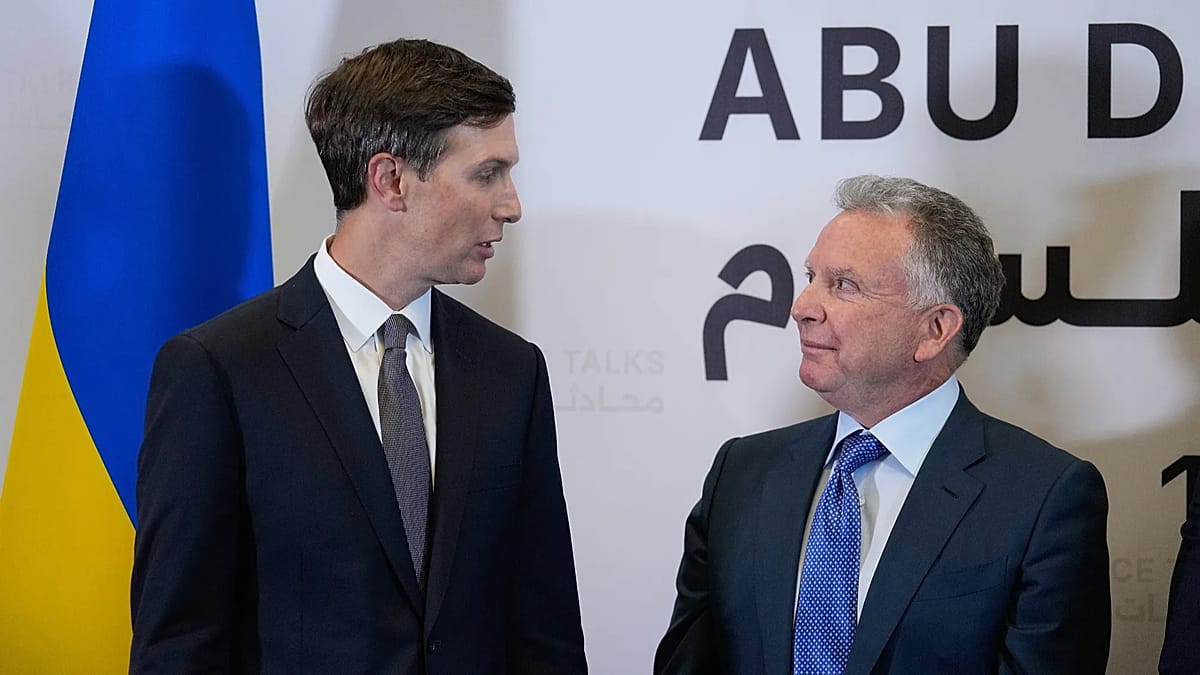
US envoys Steve Witkoff and Jared Kushner arrived in Moscow on Thursday morning for talks with Russian President Vladimir Putin, seeking to build on two days of US-mediated negotiations between Ukraine and Russia in Abu Dhabi that ended without a breakthrough towards ending the war. ADVERTISEMENT ADVERTISEMENT Putin's special representative Kirill Dmitriev welcomed the envoys in a post on X, sharing footage of their arrival at Moscow's Vnukovo Airport. The talks on 10–11 November produced an agreement in principle on a major prisoner-of-war exchange, but left key differences unresolved over territory, post-war security guarantees and Europe's role in the negotiations. Kushner said the meeting with Putin would focus on the outcome of the Abu Dhabi discussions and seek Moscow's "blessing" to bring European representatives into the negotiating process. "We see some openings and some opportunities," Kushner told reporters, adding that the envoys would travel to Dublin afterwards to brief Ukrainian President Volodymyr Zelenskyy. "We've relayed to President Putin directly several times and to his team, that the only way to get this done is to have them by our side. And I think that, they're receptive to it. And I believe that, hopefully tomorrow in Moscow, Steve and I will be successful, and President Putin will give the blessing for that to occur." For Witkoff, who initially led the Trump administration's negotiations with Russia over Ukraine, this marks his tenth visit to Russia since Trump returned to the White House in January 2025. Moscow insists on its terms Russian Foreign Minister Sergei Lavrov said Putin would first receive a briefing from Moscow's delegation to the Abu Dhabi talks before hearing the US envoys' assessment. The Russian president would then decide Moscow's next steps in the negotiations, Lavrov said, adding that Russia's position would remain focused on achieving the objectives of its full-scale invasion of Ukraine. Kremlin aide Vladimir Medinsky, who led Russia's delegation in Abu Dhabi, was more explicit, saying Moscow would only be satisfied once it had secured victory and reached an agreement on its own terms, which would largely translate into Ukraine's capitulation. Medinsky also dismissed the prospect of immediate European participation in the negotiations. "Once they (the Europeans) develop a conscience, they will be able to participate in peace negotiations," he told reporters following the Abu Dhabi talks. Until then, he claimed, European countries were complicit in "a collective deception of the Ukrainian people" and effectively shared responsibility for civilian deaths. The statements suggest Moscow remains unwilling to compromise on its maximalist demands, despite renewed US efforts to negotiate an end to the war. Abu Dhabi talks leave key issues unresolved The negotiations in the UAE marked the first US-mediated trilateral talks between Ukraine and Russia in nine months. Ukraine's chief negotiator Rustem Umerov said the discussions covered steps towards a broader peace agreement and the country's post-war reconstruction. "The first step - to end the war and ensure security guarantees for Ukraine," Umerov wrote on X. Kushner acknowledged that significant differences remained, but suggested that the discussions had identified possible areas of compromise. "Some areas we see places where we can find compromises, others we need to have more discussions, but I think this was a good first step," he told reporters. Zelenskyy, who is in Dublin for meetings with European leaders, said he hoped the US envoys would return from Moscow with concrete proposals. "What's important is that the Americans flew to Putin with specifics. I would very much like them to return to Dublin with specifics," he said, adding that while he remained sceptical, "there is hope".
Witkoff and Kushner arrive in Moscow seeking Putin's 'blessing' to bring Europe into Ukraine peace talks
Full Article
Original Source
Read the full article at Euronews →KhanList aggregates and links to publicly available news content. We do not host full articles from third-party sources. Always verify important information with original sources.