
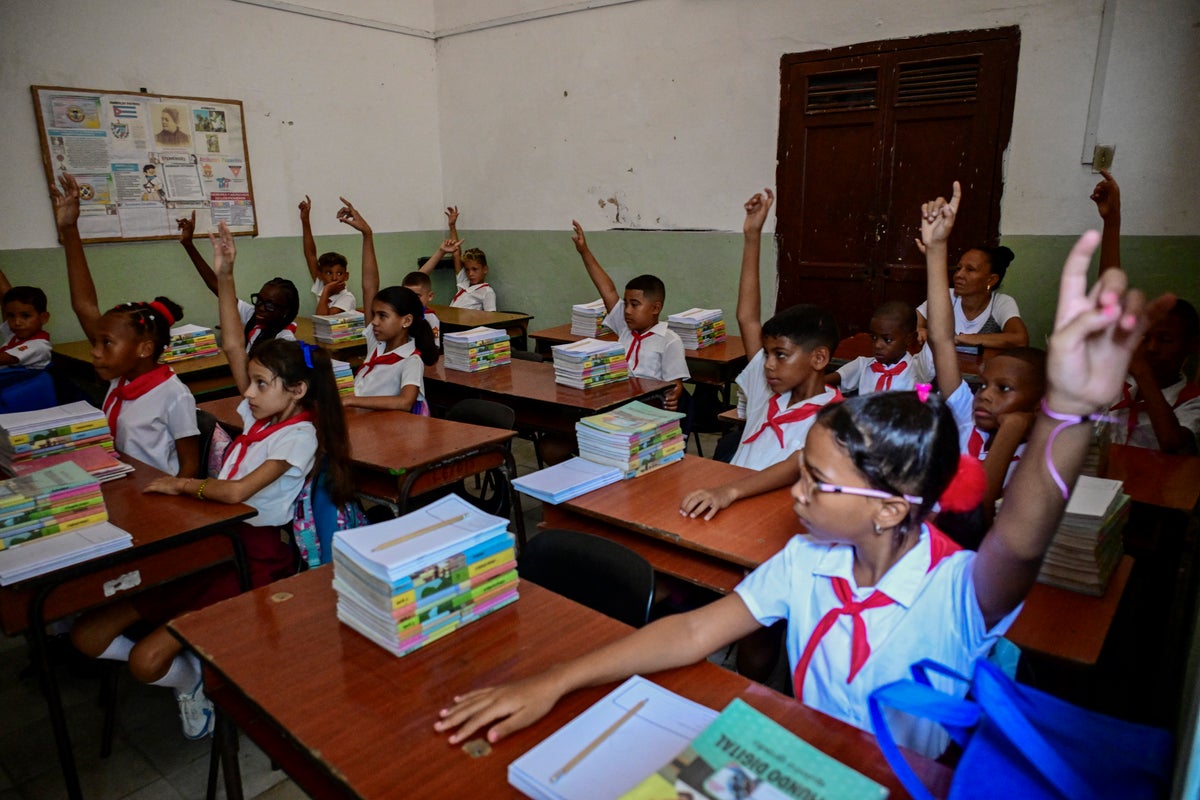
The Barroso family set off at sunrise on Tuesday, hitching a wooden cart to a borrowed horse to take one of their daughters to school on the opening day of classes for many students throughout Cuba.As economic hardship worsens across the island nation, thieves recently stole the family’s horse and slaughtered it for meat, leaving the Barrosos reliant on a borrowed animal because local school buses are no longer running.Critical shortages of fuel, qualified teachers, and student uniforms continue to burden families as the new academic term begins.Over 10,000 schools across the country were scheduled to open on Tuesday, welcoming roughly 1.4 million children alongside more than 135,000 teachers.The island’s education minister acknowledged the severe ongoing challenges, characterizing the return to classrooms as a "heroic act" for a country whose free, universal system of education was long regarded as a crowning achievement of the 1959 revolution.Multiple compounding crises previously forced government officials to end the prior school year in June — a full month ahead of schedule. Conditions have only deteriorated since, with persistent shortages of power, water, and fuel exacerbated by longtime sanctions and an ongoing U.S. oil embargo."This academic year has been the most disastrous one," said Leanete Barroso, a mother of two daughters.Cuban schools lack teachersA severe shortfall of instructors forced the government to deploy over 3,000 teachers from eastern provinces to schools in Havana, as nationwide teacher coverage plummeted to 73% across Cuba. Officials attribute the high number of vacancies to depressed salaries and widespread emigration.Official school uniforms were also largely unavailable at the start of the term, satisfying a mere 12% of total demand at the primary school level (AFP/Getty)Education Minister Naima Trujillo Barreto appealed directly to citizens to help bridge the critical gaps, reaching out to university students, working professionals, and retirees."Everyone is invited — anyone who has something to contribute," she said at a recent news conference. "You might be at home, perhaps retired, and eager to meet a group of children who need lessons in the very subject you know better than anyone else."Meanwhile, parents and private business owners are expected to assist in supplying school lunches, with state media reporting that some facilities have only a 15-day reserve of food.Official school uniforms were also largely unavailable at the start of the term, satisfying a mere 12% of total demand at the primary school level."No workshop can operate without electricity. Without fuel, we cannot transport fabric from one part of the country to another," Trujillo Barreto said. "Without money or the ability to import, no fabric comes in either."She explained that students would be permitted to wear "comfortable clothing" during lessons, though they are still required to tie on their traditional red and blue kerchiefs.Cuba's daily grind takes its tollOn the day before classes commenced, Yurima Izaguirre struggled to pull up last year’s uniform on the youngest of her three children, grimacing as she realized her 7-year-old daughter had nearly outgrown her burgundy skirt."You’re going to suffocate after a while in the classroom," Izaguirre said.While no new uniforms were available for her two daughters, she was able to locate two pairs of shorts for her son.Students queue next to portraits of Cuban revolutionary leaders Argetine Ernesto Guevara and Fidel Castro (AFP/Getty)A sharp rise in consumer prices meant Izaguirre could not afford new shoes for her children. For the first time, she had to buy basic school supplies for all three of them because the government could not provide them.Izaguirre is most concerned about providing daily lunches for her children throughout the school week, marking another unprecedented responsibility for parents.Izaguirre planned to prepare what she and her husband, a lifeguard, could manage to afford: pasta, tuna and mayonnaise: "It has to last."Before the term began, Izaguirre instructed her children to pack small, rechargeable fans, each clearly labeled with their name, to prevent them from sweltering in classrooms where temperatures routinely rise above 90 F (32 C). With daily power cuts often exceeding 20 hours, the family recharges the units at a neighbor's house.The unusually long summer break also created hardship for the family. Transport was unavailable due to the fuel crisis, preventing visits to the zoo, parks, or beach, so Izaguirre arranged simple picnics beneath a shaded tree near their home instead.While her children provide emotional strength, the unrelenting pressure of daily life in Cuba weighs heavily on Izaguirre: "In my head, I think of doing 1,000 things, but I have to keep going for their sake."
Without buses running due to the fuel crisis, 1.4 million students begin school year in Cuba
Full Article
Original Source
Read the full article at Independent →KhanList aggregates and links to publicly available news content. We do not host full articles from third-party sources. Always verify important information with original sources.