
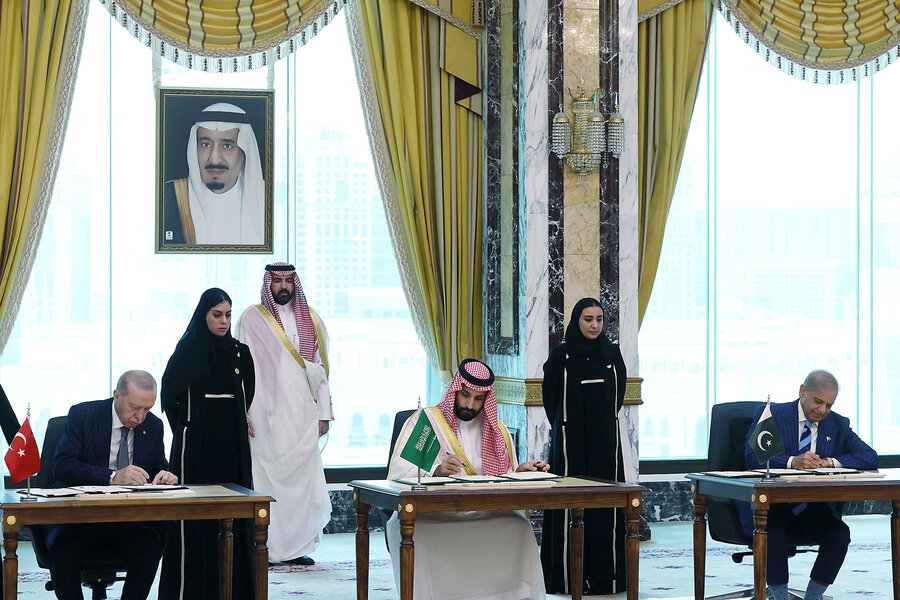
As the U.S.-Iran war grinds to a stalemate, a new alliance is emerging in and around the Middle East.Accelerated by the conflict – but not party to it – this new bloc says it aims to bring stability to a region at war.The new defense and security alliance, between Saudi Arabia, Turkey, and Pakistan, was cemented Friday in Mecca, one of Islam’s holiest cities. The so-called Mecca Joint Defense Agreement includes a NATO member, a nuclear power, and the world’s largest exporter of oil and a leader of the Muslim world. It declares an attack on one as an attack on all, though at least one prominent analyst calls the initiative more symbolic than practical. Why We Wrote This The Saudi-Turkish-Pakistani compact is a response to the prolonged Iran war, an Israel perceived as seeking hegemony, and the failure of other diplomatic initiatives. It also anticipates a reduced U.S. regional posture. Does that help the United States? The Mecca pact might not lead to a new front being opened against Iran, but observers and officials say it signals a deep shift in a region confronting shared threats and preparing for waning U.S. influence in the Middle East.The agreement declares that “any armed attack against any one of the three states shall be regarded as an attack against them all,” underlining security cooperation to act as a “deterrence against any act of aggression.”In an interview on Turkish television on Saturday, Turkish Foreign Minister Hakan Fidan said the agreement is “technically similar to NATO’s Article 5 on collective defense,” but that joint action would depend on a request made by a member state.Under the terms of the pact, if one member is attacked, the alliance would provide intelligence, logistical support, and munitions – and consider the deployment of military units depending on the threat level, according to Mr. Fidan.The alliance, which straddles Europe, the Persian Gulf, and Iran’s eastern and western borders, was formed, multiple Gulf officials say, after efforts to unite Gulf Arab states had until then failed due to internal divisions, despite the shared threat from Iran and its proxies. Murat Cetinmuhurdar/Turkish Presidential Press Office/Reuters Turkish President Recep Tayyip Erdoğan shakes hands with Pakistani Prime Minister Shehbaz Sharif as Saudi Crown Prince Mohammed bin Salman looks on after the three leaders signed a defense and security agreement. Under the arrangement, Saudi Arabia is to import Turkish and Pakistani technology and manufacturing know-how to build up its domestic defense industry, with Saudi Arabia expected to ramp up its production of drones, interceptors, and missiles, say Saudi officials and observers, who spoke on the condition of anonymity to discuss sensitive matters.Turkey and Pakistan, in return, will receive injections of cash for arms purchases. The three are to act as a collective diplomatic bloc, combining their middle-power statuses on the world stage.Message to Iran, IsraelFor Riyadh, creation of the bloc aims to change the calculus of any group considering strikes against Saudi infrastructure or territory.The pact was signed as Iran and its proxies increased their attacks against Saudi energy infrastructure, striking Saudi Aramco oil facilities on the kingdom’s Red Sea and Persian Gulf coasts.Since the signing of the pact on Friday, Saudi, Turkish, and Pakistani officials have gone to great lengths to stress that the alliance is not against one country nor is it inherently antagonistic toward Iran.But the alliance is meant to protect against the expansionist aims and destabilizing activities of any regional power – particularly Iran and Israel.Iran and its “Axis of Resistance” proxies have actively worked to collapse Arab states; in 2015, Iran boasted of having control over four Arab capitals, in Syria, Lebanon, Iraq, and Yemen.Tehran has recently targeted Gulf Arab states’ airports, economies, and residential areas in retaliation for the United States’ and Israel’s military offensive, and, by closing or endangering shared waterways and export routes, is threatening to plunge the region’s economy into a deep recession. The new bloc also rejects what its three members see as Israel attempting to establish regional primacy through military force, demanding the freedom to act against perceived threats anywhere, normalizing ties with Arab states on its terms, and extending its occupied border “buffer zones” in Syria and Lebanon.Gulf states and Turkey have deemed these actions destabilizing to the region and their interests.The pact’s limitsExperts say that the pact’s version of NATO’s Article 5 is more aspirational than practical but is clear in setting out a new way in the Middle East.“I don’t think Turkey will be striking Iran if Iran hits Saudi Arabia tomorrow, and I just don’t see Turkey hitting India if Pakistan is attacked,” says H.A. Hellyer, a senior associate fellow at the Royal United Services Institute in London and the Center for American Progress in Washington. “I think this agreement was very symbolic.”“But I do think it sends a very significant political message to the Iranians and to the Israelis that, ‘we are not interested in your projects in the region,’” Dr. Hellyer says. “And that, ‘we have other, better ways we think that will be much more attractive to the vast majority of countries in the region.’”It is also described as Riyadh’s rebuttal to the Abraham Accords, which normalized diplomatic ties between Israel and Arab states, but which Saudis saw as ignoring their security concerns.For Riyadh, “this alliance is about boosting Saudi Arabia’s defense capacity, increasing its deterrence, and creating a diplomatic bloc that will delegitimize any spoiling actions in the region,” says Saudi geopolitical analyst Aziz Alghashian.“This is not an anti-Iran or an anti-Israel alliance, but Iran and Israel have a choice whether they want to be a spoiler or not.”Shifting U.S. postureThe organic formation of the security bloc is also seen as preparation for a reduced U.S. footprint in the region. Gulf officials take note of the rising support among both Democrats and Republicans to redirect American military and economic support for the Middle East back home stateside.“This trilateral alliance is saying: We still would like to work with the U.S., the U.S. is still undoubtedly the main security provider, but we will have to work with others and take security into our own hands more,” says Mr. Alghashian.Having three major regional U.S. allies iron out their differences and form a security arrangement that is not 100% reliant on an overstretched United States, but still coordinating with Washington, “is good for American interests in the region,” he adds.“We could be talking about the seeds of something that does not come into effect for many years,” Dr. Hellyer says. “But at the very least, it is a very strong political message.”
With Middle East still at war, three regional powers ink a new alliance
Full Article
Original Source
Read the full article at Csmonitor →KhanList aggregates and links to publicly available news content. We do not host full articles from third-party sources. Always verify important information with original sources.