
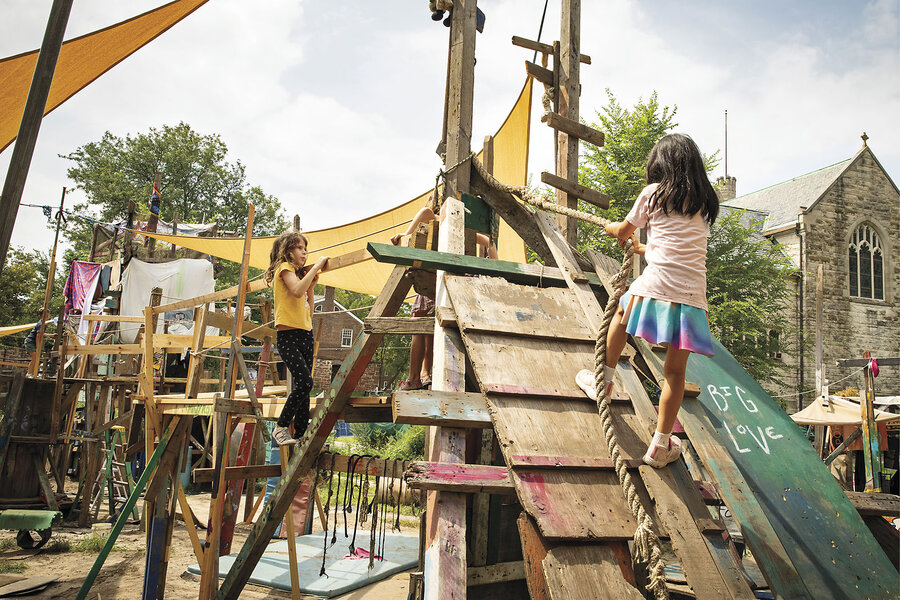
New York | Oct. 28, 2026, 12:17 p.m. ET | 4 min read When Steph Skaff needs a break from emails and grant proposals, she shuts down her computer and looks for something to climb. Fortunately, her makeshift office is on a playground. So she makes her way up a wooden tower, balances across a rickety bridge, and hammers loose nails back into forts – all structures built by children.Ms. Skaff is the executive director of play:groundNYC, a nonprofit that runs a 20,000-square-foot space for children on Governors Island in New York City. The playground, called The Yard, resembles a junkyard where kids are given free rein to saw plywood by hand, romp in mud pits, and nail together structures to climb and jump from. The playground is fenced off from what Ms. Skaff sees as one of the greatest impediments to independent play: parents. Banners separating adults from their children explain the philosophy. “For safety reasons, all adults must be accompanied by their inner child,” one sign reads. “Better a broken bone than a broken spirit,” reads another. The rules embody that old-school concept that independent play helps children to manage risks better. Melanie Stetson Freeman/StaffSteph Skaff talks about The Yard, where children have free play and all structures are built by kids, on Governors Island in New York. “Children in the U.S. are often given a lot of structured activities, and it makes it really hard for kids to know who they are, to trust themselves, to understand what they are capable of, and to build resilience,” she says. On a recent Saturday, children negotiate the terms of their world inside The Yard. They debate which materials to choose for forts, how to stabilize platforms, and who will perform which role.“Have you seen the saw?” shouts 13-year-old Oscar, a New York local balancing atop an 8-foot-tall fort he was building with a friend, complete with a secret hiding spot and two access ladders. Some parents appreciate that, for most of the day, the decision to intervene has been taken away from them.“It’s not even giving you the option to go in, so there’s no pressure to be holding their hand,” says Arien Garber, whose son and daughter frequent The Yard. Ms. Garber credits the space with pushing the limits of what her children believe they can do in what she sees as a relatively safe environment. The playground is supervised by staff members, called playworkers, who do their best not to interfere but are available in case of emergencies. “It’s a place that encourages a little bit of risk, but it’s not death-defying,” says Ms. Garber. “We are fine with a scraped knee.” Melanie Stetson Freeman/StaffCole Taylor, a staff member at The Yard, helps a boy hammer a nail. The staff members are known as "playworkers." Melanie Stetson Freeman/StaffChildren play in The Yard. Creative beginningsMs. Skaff grew up in Perrysburg, Ohio, near Toledo, in the 1980s and ’90s, playing outside largely unsupervised. She remembers roaming the tracks that crisscrossed her neighborhood and jumping out of the path of passing trains just in time – a formative pastime that she acknowledges would be unthinkable today.“It gave me an opportunity as a child to understand my environment, and how I exist within it, what I can do with my own self and my own body,” she says.Ms. Skaff earned a bachelor’s degree in theater from the University of Cincinnati College-Conservatory of Music and a master’s degree in creative writing from Hunter College. She then built a career in the arts, working in development and programming at nonprofits, including the Massachusetts Museum of Contemporary Art. That background still shapes the way Ms. Skaff sees The Yard. Where an adult might see piles of discarded lumber and junk, she sees raw materials for children’s creative work. But those who work alongside Ms. Skaff say her focus remains on what happens when adults relinquish some control.Ms. Skaff “values what is actually happening here, which is young people’s empowerment,” says Rowan Dahlin, a staff member at The Yard, as she steps over a discarded mannequin foot. Melanie Stetson Freeman/StaffRowan Dahlin, one of the playworkers, interacts with children at The Yard. The idea is to let kids play with reasonable risks as the playworkers watch out for safety. Melanie Stetson Freeman/StaffA young girl paints a board at The Yard “What’s the rush?”The Yard has been wildly successful, serving more than 100,000 children since opening a decade ago, with camp waitlists that fill months in advance. But it is only one part of Ms. Skaff’s work. She is trying to carry the principles of adventurous play beyond The Yard and into places where children spend their everyday lives.Ms. Skaff and her team have begun working with six public elementary schools across New York to train teachers and administrators to rethink how they oversee recess, teaching them when to intervene and when to step back and let children take risks.At The Yard, meanwhile, Ms. Skaff has done something that would ordinarily be forbidden: invited the parents in. Since 2025, the nonprofit has held a series of family workshops designed to teach parents to let their children lead play with minimal intervention. Twenty-eight families have participated so far.At one workshop, a facilitator asks parents to think back to a childhood memory of play. They describe riding bikes, playing in sand dunes, and climbing abandoned towers. Although the parents are from three different countries, all the memories are from time spent outdoors and when children were unsupervised. Melanie Stetson Freeman/StaffParents Eboni Cooper (from left), Farnoosh Hashemian, and Avi Stein listen to a workshop led by Yoni Kallai, co-founder of The Yard. Melanie Stetson Freeman/StaffHearts and a peace sign painted by kids decorate a wall at the entrance to The Yard. Ms. Skaff wasn’t surprised. “The most impressive moments of childhood are when [kids] are doing things on their own,” she says. “They are figuring something out for themselves.”It’s a dance between presence and absence that parents everywhere, including Ms. Skaff, mother of a 7-year-old, try to balance. Deepen your worldviewwith Monitor Highlights.Politics with respectGet political stories with respectful analysis.There‘s a world of new ideas in everyBooks newsletter.There‘s more to life, enrich yours withCulture & Learning weekly.Follow humanity‘s discoveries withScience & Nature stories in your inbox.Gain a spiritual perspectivefrom the stories in your inbox.Want to understand the deeper impact of critical events? Learn the Monitor‘s insight.Already a subscriber? Log in to hide ads. On the way to The Yard on a summer morning, Ms. Skaff’s son decides to climb a row of Citi Bike rentals, leaping from one bike to the next instead of walking on the pavement. Ms. Skaff could have reminded him that they were in a hurry, but instead, she slows down to revel in the joyful moment.Her work, she says, has made her more willing to see opportunities through her son’s eyes: “What’s the rush? Why not try climbing what’s in front of me?” ALREADY A SUBSCRIBER? LoginReal news can be honest, hopeful, credible, constructive.The Christian Science Monitor was founded in 1908 to lift the standard of journalism and uplift humanity. We aim to “speak the truth in love.” Our goal is not to tell you what to think, but to give you the essential knowledge and understanding to come to your own intelligent conclusions. Join us in this mission by subscribing.
With hammer and saw, she builds the case for adventurous play
Full Article
Original Source
Read the full article at Csmonitor →KhanList aggregates and links to publicly available news content. We do not host full articles from third-party sources. Always verify important information with original sources.