
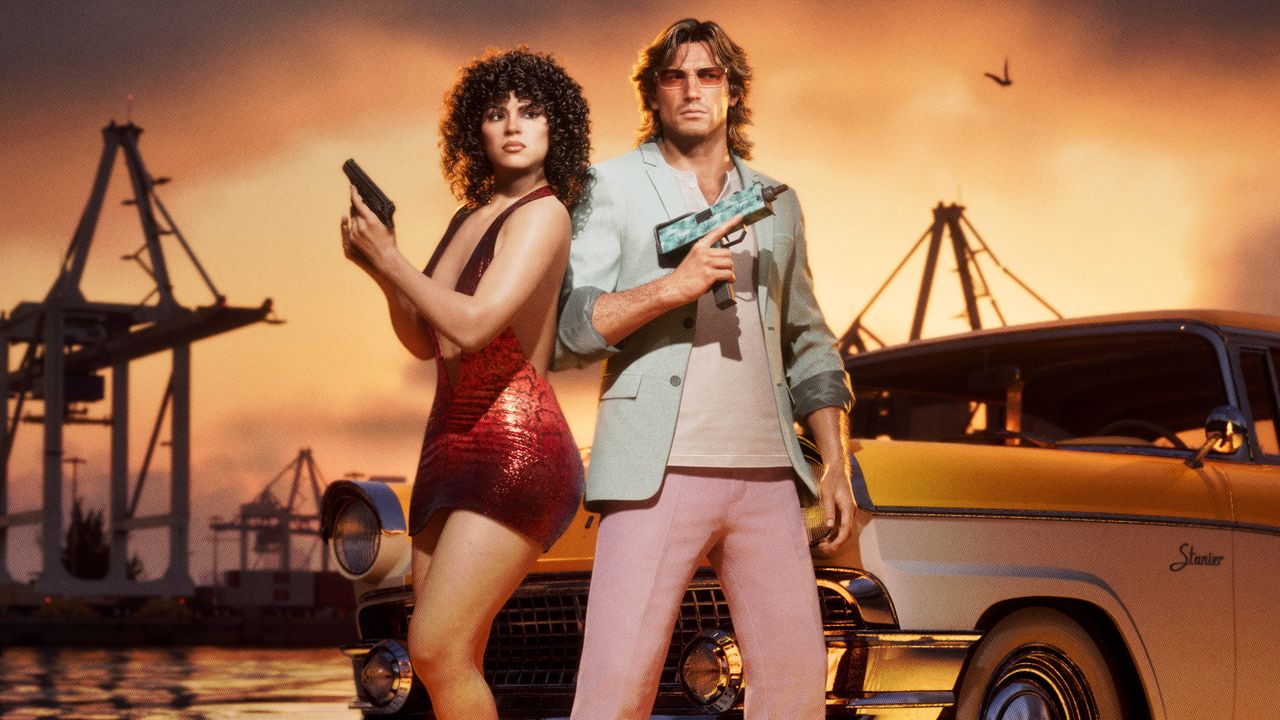
Somewhere in the far north of Leonida, Grand Theft Auto VI’s fictional take on Florida, a robbery is taking place. This much is unsurprising. Crime is baked into the title of the series, which began in 1997 and, despite its thick American accent, is still predominantly made in Scotland. But Jason and Lucia, the young, beautiful Bonnie and Clyde who together share the role of protagonists in GTA VI, are not the ones committing this crime. Rather, a grizzled biker hangs from the second-floor window of a locked bar, throwing valuables down to his accomplice on the street.A thunderstorm has recently rolled through this area and the tarmac steams as sunlight knifes through the clouds. It’s Leonida-muggy. Patches of sweat swell beneath Jason’s arms as he takes in the scene. The bikers notice you watching and ask, politely, considering the circumstances, if you could fuck off. A choice presents itself: clamber back on your stolen motorbike and continue your road trip, or insert yourself into this micro-drama and take a principled stand on behalf of concerned citizens everywhere (then take the loot for yourself, of course).Dozens of impromptu moments like this stud GTA6, a video game that makes you feel like one entity among many rather than the spoiled V.I.P. around whom everything has been artfully arranged. Most video games flatter the player by making them the centre of the virtual universe, the cog on which all the digital clockwork turns. What is extraordinary about Vice City and its surrounding area is how much of the world appears to trundle on without needing your presence or input.These moments are made possible by dozens of interlocking systems built by dozens of discrete teams. An entire Los-Angeles-based team worked on the personalities and behaviors of the thousands of people who inhabit Vice City; the bar’s interior was meticulously set-dressed to suggest the lives and tastes of its proprietors and patrons, while the biker’s dialogue and reactions to your choices were written, cast and performed. The weather, too, is restless: cloud and rain move across the world, dynamically changing light and mood. This tableaux, which only a small percentage of players may ever encounter, has not been staged like a scene in a play but rather cultivated in what amounts to the world’s most expensive Petri dish.Since 1984, when Elite first used procedural generation to conjure an entire galaxy on a computer screen, game designers have learned to produce universes from scant technological resources. But in the era of procedural generation, scale is almost routine; the harder, more costly work is making an expanse feel handmade and coherent. GTA VI manages both, with districts populated by distinct communities and social strata, each shaped by decades of imagined history. It reveals a kind of detail and thoughtfulness that A.I. has yet to reproduce convincingly—and perhaps never will.The game’s lavishness is not only visible in the rain, the sweat and the individual strands of hair falling across Lucia’s shoulders, but also in the hundreds, perhaps thousands, of diversions away from the criminal grind. For example, Jason and Lucia can take time out from planning a heist to compete in illegal street races for prize money, enter dirt-bike scrambles or race stock cars in a stadium. You can become a hunter, choosing a rifle to suit your quarry so as not to ruin its pelt; start drone racing, streaking through abandoned buildings in an FPV headset; or dive for treasure among old shipwrecks, dodging both the circling sharks, and the authorities who want to check your license.A compelling main story runs through the game, with missions that leave room for different approaches: you might play as a careful shooter, aiming to wound rather than kill, or as a less discerning one. The couple, so artfully written and performed, offer vivid points of entry into the world as you guide them from relative poverty towards financial security that, perhaps, might allow them to build a family life beyond crime. But much of the joy comes from straying from the main path.To that end the game makes room for long, meandering drives across the country and peaceful early-morning flights over mountain ranges. You can spend a sleepy afternoon with a scenic view, peering through dollar-a-minute binoculars. Many of these diversions appeared in the studio’s earlier games, but here they feel newly vivid, rendered with extraordinary fidelity. The smaller encounters are just as memorable. Happen upon a possum at night and it might play dead on the tarmac. In a thrift store, you can while away assembling fits worthy of a Ralph Lauren vintage buyer; at a 24-hour nightclub, you can dance until sunrise, before emerging blinking into the dawn while wondering, as Kanye once put it, if they’ve got cabs still. (Of course they do: you can summon one in an instant from your virtual phone).This is lavish game-making on an unprecedented scale. The irony, however, is that GTA VI arrives at a moment when other studios are bleeding staff (if they survive at all) and the cost of making games at anywhere close to this level continues to rise precipitously. In one industry survey published this month, a third of respondents said they had been laid off in the past two years; more than half of those laid off had yet to find new work—a stark picture of the ongoing insecurity across the industry. In the early 2010s, game budgets fell between $30 and $70 million. McKinsey puts the current cost of a blockbuster game production at $200 million to $500 million. At these prices, few can pay to play.Even amid the union-busting allegations (which Rockstar denies; an employment tribunal is ongoing), the company has retained much of its long-serving talent between major releases. That continuity gives it a store of institutional knowledge that is hard to preserve when studios expand and contract around individual projects. Key members of GTA VI’s leadership have worked together for decades. The studio also has a clear commercial advantage over its closest creative peers: Naughty Dog, creator of the Uncharted and The Last of Us series, and CD Projekt Red, creator of The Witcher and Cyberpunk 2077. Their story-led games can dominate a moment, but their stories conclude when the credits roll.After players finished Grand Theft Auto V’s story, by contrast, they could continue to inhabit its world through GTA Online, joining others in an ever-replenishing sandbox of play. A leak of Rockstar data suggested that GTA Online averaged about $9.6 million a week between September 2025 and April 2026—roughly $42 million a month. Rockstar is owned by Take-Two, and there is no evidence that GTA Online’s astonishing revenue was entirely funneled into GTA VI. But a game generating revenue year after year gives its parent a durable source of income, justifying artisanal-style work. These factors make Grand Theft Auto VI’s scale and fidelity exceptionally difficult for any rival to match.That challenge is something even Rockstar’s former leaders have had to reckon with. Leslie Benzies—who for years was one of the three creative leaders on Rockstar projects alongside Sam and Dan Houser (of the trio, only Sam remains at the company)—founded Build a Rocket Boy, which raised more than $300 million before releasing MindsEye. The game’s troubled launch was followed by mass redundancies and, in September 2026, a slide into administration. The lesson seems clear. Money alone cannot buy the infrastructure, expertise and returning audience that have allowed Rockstar to build this world at extraordinary length.In a game filled with enticing luxuries, from expensive shoes to glinting supercars, the visible human hand is, in this dawning age of AI abundance, the rarest luxury of all in Leonida. You can leave the bikers to their robbery: clouds drift on, the tarmac dries. The world keeps its own time. Making that unforced life cohere took years of work across many teams, and required a collective attention to every detail. With budgets rising and studios closing, perhaps no other company could afford such a wager. Leonida is a miracle of craft—and a monument to a form of game-making the wider industry can no longer sustain.
With GTA6, Rockstar Bet $1.5B That Humans Could Make a Better Game Than AI
Full Article
Original Source
Read the full article at Gq →KhanList aggregates and links to publicly available news content. We do not host full articles from third-party sources. Always verify important information with original sources.