
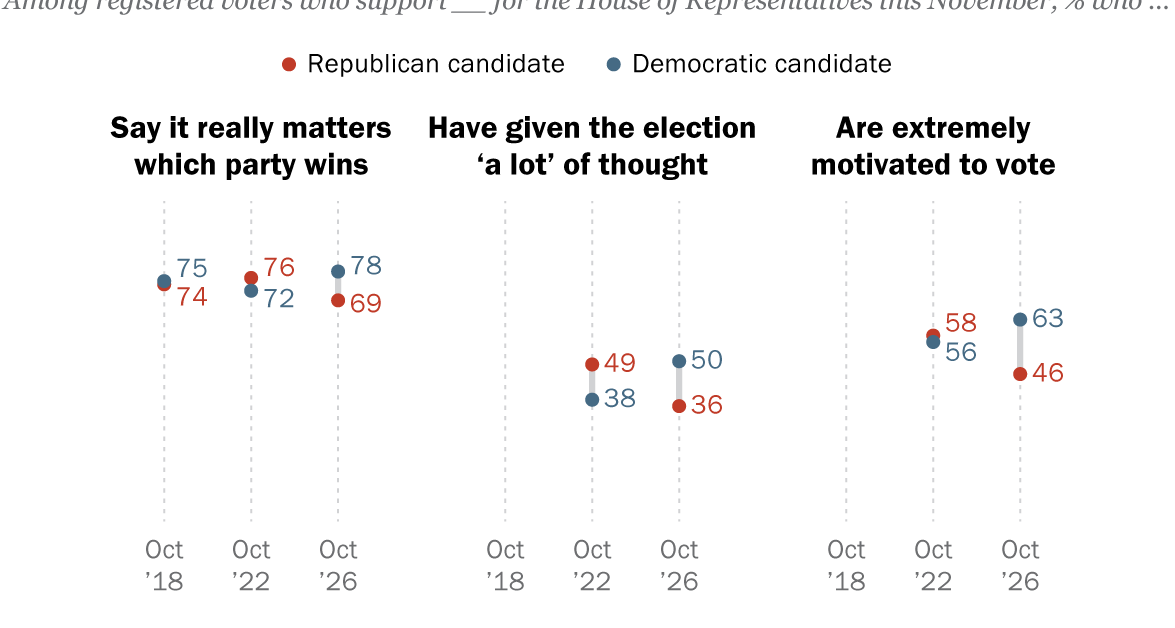
About this research This Pew Research Center analysis examines Americans’ engagement with the upcoming midterm elections, views of the state of the country, and attitudes about the political parties and Donald Trump’s presidency. Why did we do this? Pew Research Center conducts research to help the public, media and decision-makers understand important topics. We have studied Americans’ views of politics and major policy issues for decades. Learn more about Pew Research Center. How did we do this? We surveyed 5,062 U.S. adults, including 3,917 registered voters, from Sept. 28 to Oct. 4, 2026. Everyone who took part in this survey is a member of the Center’s American Trends Panel. The survey represents the views of the full U.S. adult population. Here are the survey questions used for this analysis, the detailed responses and the survey methodology. The 2026 midterm election is taking place amid deep public dissatisfaction with the state of the nation, near-record low approval ratings of President Donald Trump, and growing negativity about national economic conditions and the ongoing conflict with Iran. Against this backdrop, Democratic candidates now hold an 8 percentage point edge over Republican candidates in preferences for the House of Representatives among all registered voters nationally. And while many registered voters will not turn out to vote this fall, Democratic candidates are also buoyed by their supporters’ relatively high levels of engagement and stated motivation to vote when compared with those who are backing Republican candidates. For example: 78% of voters who back their House district’s Democratic candidate say it “really matters” which party wins control of Congress – 9 points higher than the share of Republican backers who say this. In contrast, Republican candidate supporters were 4 points higher on this measure than Democratic supporters at a similar point before the 2022 midterm election. The partisan gap is also wide on other measures of engagement: Democratic supporters are 14 points more likely than Republican supporters to say they have given this year’s election “a lot” of thought and 17 points more likely to say they are “extremely motivated” to vote this year. A new Pew Research Center survey of 5,062 U.S. adults – including 3,917 registered voters – conducted Sept. 28-Oct. 4, 2026, also finds that Donald Trump’s approval rating now stands at 30% – the lowest of his second term. Most voters (63%) consider Trump a factor in their vote for Congress, with far more thinking of their choice as a vote against the president (44%) than for him (19%). As economic ratings turn more negative and concerns about prices rise – particularly for gas and energy – the economy continues to rank as the top voting issue this year, across the political spectrum: 84% of registered voters – including 88% of those who support Democrats and 82% who back Republicans – say it is very important to their vote. The midterm race Democrats currently hold an 8 percentage point edge in national vote preferences, with 44% of all registered voters saying they would support a Democrat for the House if the election were held today and 36% preferring a Republican. Another 5% say they would select a different candidate and 15% say they aren’t sure. Among validated voters – confirmed to have voted in the 2024 election – those who voted for Trump are less consolidated behind GOP candidates (77%) than Kamala Harris’ voters are behind Democratic candidates (87%). The difference is even more pronounced among voters who are disaffected with the party they backed in 2024 – who make up a quarter of each 2024 coalition: 49% of Trump voters who have an unfavorable view of the GOP today support Republican candidates for the House this year. While only 12% say they back Democrats, more than a third say either that they are “not sure” (25%) or prefer “another candidate” (14%). In contrast, Harris voters with a negative view of the Democratic Party are much more solid in their preferences for Democrats this year: 73% say they support Democratic House candidates. In both 2024 coalitions, these disaffected voters are less engaged with the election than those who have positive views of the parties – but that is particularly the case among Trump’s 2024 voters. For instance, just 36% of Trump voters with an unfavorable view of the GOP say the outcome this November really matters. By comparison, 65% of Harris voters with a negative view of the Democratic Party say it does. For more on demographic differences in candidate support, jump to “Midterm Vote Preferences by Race and Ethnicity, Age and Other Demographics” and explore the detailed tables. Trump’s approval rating continues to drop Three-in-ten Americans now say they approve of Trump’s handling of his job as president, while 68% disapprove – down 4 percentage points from July and his lowest approval rating of his second term. Much of this decline in his approval ratings over the course of his term is among Trump’s own 2024 voters – 67% of validated Trump 2024 voters approve of his job performance today while 31% disapprove. At the beginning of his term, 95% approved. Some of the starkest declines have come among Hispanic and younger voters who backed Trump in 2024. For more on Trump’s approval ratings and confidence in his governing and handling of issues, read “Trump’s Approval Rating Drops as Fewer Americans Are Confident in His Handling of the Economy, Other Issues.” Trump is more of a factor in voters’ choices this year than Joe Biden was four years ago. While voters in most recent midterms have tended to be motivated more by opposition to the sitting president than support for him, the current gap is wider than it was four years ago – when 36% of voters saw their vote in opposition to Biden and 19% viewed it as in support of him. Other key findings Satisfaction with the state of the nation has dropped to 39% among Republicans overall (including those who lean to the GOP). This is the lowest of Trump’s second term (down from 65% shortly after he entered office and 54% at the beginning of this year). Overall, 22% of Americans say they are satisfied with the state of the nation, while 77% are dissatisfied. Majorities of voters consider the future of democracy (73%), healthcare (68%), education (62%), immigration (59%) and foreign policy (57%) as important to their vote. As in past elections, immigration is a more central issue for Republican voters (72% say it’s very important) than for Democratic voters (53%) – but Democratic voters see it as a more important issue than they did four years ago. For more on the top issues in the election, read “Economy ranks as top issue in midterms for all voters – but partisans differ over the importance of other issues.” Related: Cost Concerns Dominate as Public’s Economic Ratings Turn More Negative The U.S. military action in Iran remains deeply unpopular, and most Americans think it won’t end soon. A third of Americans approve of how Trump is handling the conflict – down from 37% in March, shortly after it began. About three-quarters of Americans (77%) expect the conflict to last another six months or more. Most voters (61%) say they dislike elected officials who support building data centers in their area; just 8% like this. While dislike is especially widespread among Democratic voters (75% dislike), on balance Republican voters also do not like leaders who support data centers (44% dislike, 14% like). Related: Americans’ Views of Data Centers Have Turned More Negative
With Americans in a Sour Mood, Democratic Voters Are More Engaged in Midterms
Full Article
Original Source
Read the full article at Pewresearch →KhanList aggregates and links to publicly available news content. We do not host full articles from third-party sources. Always verify important information with original sources.