
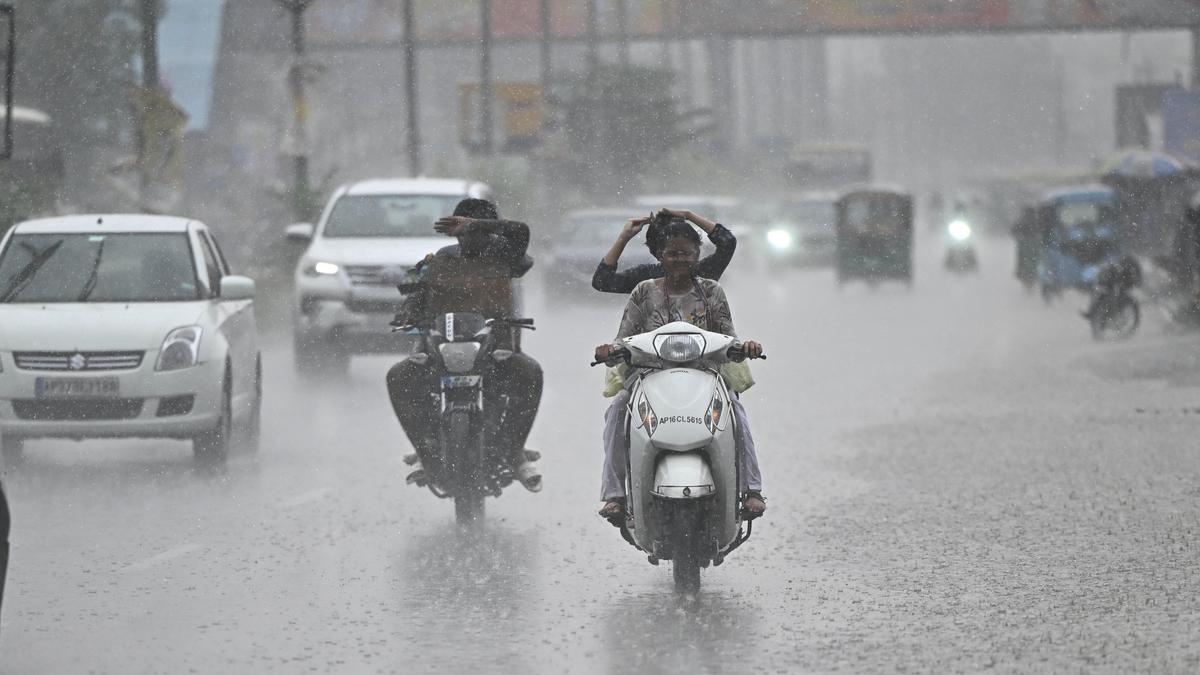
Andhra Pradesh has recorded 255.3 mm of rain this monsoon season, compared with the normal of 442.3 mm between June 1 and September 16. | Photo Credit: File Photo With the Southwest Monsoon nearing its withdrawal phase, Andhra Pradesh has emerged as the country’s third most rainfall-deficient State this season, largely due to prevailing El Niño conditions.According to data from the India Meteorological Department (IMD), of the total 36 States and Union Territories in India, 17 have reported ‘normal’ rainfall, 16 reported ‘deficient’ rainfall, two ‘excess’ and one ‘large excess’, between June 1 and September 16.Meghalaya leads the country in rainfall deficit at 59%, followed by Manipur (43%), and Arunachal Pradesh and Andhra Pradesh (42%). Punjab and Puducherry follow closely, with 40% rainfall deficit.In the Southern Peninsula, comprising Andhra Pradesh, Telangana, Tamil Nadu, Karnataka, Keralam, Lakshadweep and Andaman and Nicobar Islands, Andhra Pradesh reported the steepest rainfall deficit. The State has recorded 255.3 mm of rain so far this monsoon season, compared with the normal of 442.3 mm between June 1 and September 16. The neighbouring Telangana reported a deficit of 20%.IMD experts say this is the second time since 1904 that Andhra Pradesh has reported such a huge rainfall deficit. In 1904, considered a drought year, the rainfall deficit was 44.19%.Usually, Andhra Pradesh receives the maximum of SW monsoon rain in August and September. However, the State reported a whopping 55% deficit in August, as it received only 65.4 mm of rainfall, against the normal of 144.3 mm. Ten of 28 districts in the State reported ‘large deficient’ rainfall last month.The two main factors that contributed to the deficient rainfall in the State, include El Nino conditions and the formation of low-pressure systems near the head of the Bay of Bengal, explains O.P. Sreejith, a scientist at the Climate Research and Services, IMD-Pune.“Multiple low-pressure systems were formed over the Bay of Bengal during the season, but most of them originated in the head of the Bay of Bengal and moved along the monsoon trough,” Mr. Sreejith said.While the IMD had forecast dry weather in September too, the situation improved a bit, thanks to a low-pressure system formed over the Bay of Bengal in the second week. There is another low-pressure zone forming over the Andaman Sea region.Experts hope that this should bring good rainfall to the State.But, in any case, the State’s deficiency will not fall below 35%. “We can expect the deficit percentage to be around 40% or below that, depending on the amount of rainfall we get next week,” Mr. Sreejith added.Cyclone likely over Andaman Sea: expertsWeather experts have said that a low-pressure system is likely to form over the Andaman Sea around September 19 evening, may intensify into a cyclone, the first in this Southwest Monsoon season.According to information, the weather models strongly indicate the possibility of a cyclone forming over the Andaman Sea around September 21, and it may make a landfall near the Odisha coast.According to the bulletin issued by the India Meteorological Department (IMD) on Thursday, September 17, an upper-air cyclonic circulation remained over North Thailand at 8.30 a.m. It is very likely to emerge over the north Andaman Sea on September 18.Under its influence, a low-pressure area is likely to form over the same region on September 19. Thereafter, it is likely to intensify gradually and move west-northwestwards towards the south Odisha-north Andhra Pradesh coasts during subsequent days.Heavy rain is expected in the State from September 19 to 23. Published - September 17, 2026 06:57 pm IST
With 42% deficit rainfall, Andhra Pradesh is third worst-hit State in India this monsoon season
Full Article
Original Source
Read the full article at Thehindu →KhanList aggregates and links to publicly available news content. We do not host full articles from third-party sources. Always verify important information with original sources.