
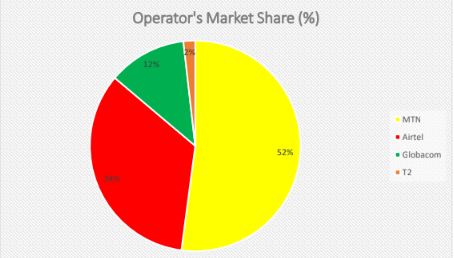
Emma Okonji Nigeria is close to hitting the 200 million active telecom subscribers record, following an improvement in its telecoms subscriber number that reached 197,416,694 with a teledensity of 91.07 per cent as at August 2026, statistics released by the Nigerian Communications Commission (NCC) has revealed. Teledensity, in telecoms parlance, is described as the number of active telephone connections per 100 inhabitants living within an area and is expressed as a percentage figure. According to the statistics, which THISDAY obtained from the website of NCC, as at January 2026, telecoms subscriptions data was 182,225,258 with a teledensity of 84.06 per cent. But there was an improved growth in the number of telecoms subscriptions in February 2026, which increased to 184,603,928, with a teledensity of 85.16 per cent. There was an additional growth in March 2026 to reach 185,718,018, with a teledensity of 85.67 per cent. In April 2026, Nigeria recorded another growth in telecoms subscriptions, which reached 188,009,171, with a teledensity of 86.73 per cent. In May 2026, telecoms subscription number increased again to reach 189,675,650, with a teledensity of 87.50 per cent. The growth trajectory continued in June 2026, as telecoms subscriptions reached 192,232,120, with a teledensity of 88.67 per cent. In July 2026, Nigeria’s telecoms subscription number increased again to 195,108,814, with a teledensity of 90 per cent, before reaching 197,416,694 subscriptions with a teledensity of 91.07 per cent in August 2026. According to NCC’s statistics, the growth in telecoms subscriptions is spurred by MTN Nigeria, which recorded as high as 102,556,735 subscribers on its network, with a clear leading market share of 52.01 per cent as at August 2026, making it the biggest telecoms operator in Nigeria by subscription and network infrastructure expansion. Airtel came next with 67,420,650 subscribers recorded in August 2026, with a market share of 34.19 per cent, making it the second biggest telecoms operator in Nigeria by subscription. Globacom followed with 23,583,253 subscribers as of August 2026, with a market share of 11.96 per cent, making it the third biggest telecoms operator in Nigeria by subscription. Globacom joined Nigeria’s telecoms market two years after MTN and Airtel have rolled out their services across various states of the country. Globacom however commenced its commercial rollout service in 2003 with per second billing system, a development that changed the game in the telecoms sector from per minute to per second billing system, and it has remained operational till date. Next to Globacom, is T2, the last entrant into Nigeria’s telecoms space, which rolled out its commercial services, seven years after MTN and Airtel had rolled out their telecoms’ services in 2001. T2, according to NCC’s statistics, recorded 3,613,801 subscribers with a market share of 1.83 per cent as at August 2026. Recently, the NCC licensed another telecoms operator, known as Swift Telephone Network (STN) that will also offer voice and data services. The latest telecoms operator is expected to roll out its services before the end of 2026, to further boost competition in the telecoms sector. Consistent with Section 89 Subsection 3(d) of the Nigerian Communications Act 2003 (NCA 2003), the NCC is mandated to monitor and report on the state of the Nigerian telecommunications industry, provide statistical analyses and identify industry trends with regard to services, tariffs, operators, technology, subscribers, issues of competition and dominance, among others. with a view to identifying areas where regulatory intervention would be needed. Telecom operators are therefore obligated, under the terms of their licenses, to provide the NCC with such data on a regular basis for analytical review and publishing. Pleased with the growth rate in telecoms subscriptions across all networks, the spokesperson for all the licensed telecom operators in Nigeria, Gbenga Adebayo, attributed the growth in telecoms subscriptions to a clear and unambiguous regulatory oversight of the NCC, which he said, has empowered operators to roll out services even in remote parts of the country, to enhance inclusivity in telecoms operations.
With 197.4m Subscriptions, 91% Teledensity, Nigeria Draws Close to 200m Active Subscribers
Full Article
Original Source
Read the full article at Thisdaylive →KhanList aggregates and links to publicly available news content. We do not host full articles from third-party sources. Always verify important information with original sources.