
In late 2023, Ukraine’s military leadership faced an institutional choice: establish a dedicated branch of the armed forces for unmanned systems or integrate drones into existing branches. Most senior officers I knew opposed the separate force, and their strongest argument was sound within classical doctrine. Each branch of service corresponds to a distinct domain of war: The army fights on land, the navy at sea, the air force in the air. Unmanned systems operate across all of these domains and possess none of their own. No domain, no branch of service. The advocates were mostly newcomers from civilian life, and the opponents were career generals. Within the coordinate system of existing doctrine, the generals were right. The war itself, however, was about to overtake their premise that it unfolds in fixed places. Ukraine created the Unmanned Systems Forces anyway, the first branch of its kind in the world. A force with about 2.5 percent of Ukraine’s military personnel has accounted for roughly a third of Russian losses this past year.That decision reflected a collision of two cultures. People who entered from civilian life built a different culture: continuous experimentation in place of pre-defined standards and protocols, openness to mistakes as the price of learning, and the habit of improving weapons in combat. For career officers, the question was usually one of means: which systems, in what quantity, and for which branch. The real question lies elsewhere: What game are we playing, and how do we imagine it?The decisive dimension of the war in Ukraine is not where forces fight, but how fast each side adapts. A unit that updates its tactics and technology every six weeks does not cancel the firepower of a unit that updates once a year — a slower side can still pay in mass, as Russia does. What the faster unit wins is time: It sets the terms of every exchange for as long as the gap lasts. Mass decides how long a side can continue to pay, and speed determines how much each payment buys. I call this the Time Domain: a competition not for territory but for time itself — the interval between the moment a new capability reaches the front and the point at which the enemy’s answer to it works — won by whoever adapts faster. It is also an answer to the generals: The Unmanned Systems Forces do have a battleground of their own — not a place on the map, but a contest, the one their machines are built to win faster than anyone else.The Origins of This ArgumentWhen Russia launched its full-scale invasion, I returned to Ukraine from Stanford to help its fight. I worked inside Aerorozvidka, the volunteer community that pioneered network-centric warfare in Ukraine and helped create the Delta battlefield management system around a single conviction: push battlefield information outward, to those who act on it, instead of holding it inside headquarters. Later, I advised the first commander of the Unmanned Systems Forces and built the team that created the 412th Brigade “Nemesis.”Throughout this war, Russia has held superiority across every parameter a classical analyst would measure: personnel, artillery, missiles, armor. Under that asymmetry, innovation speed was never an advantage for Ukraine. It was a condition of existence.The best commanders I worked with understood this intuitively: Tactics had to change faster, commanders had to build units differently, and time was the decisive resource. But they had no language to explain it to headquarters, no metric for a manufacturer, no concept to make it a requirement for doctrine. The analytical apparatus of military thought describes who stands where and how much each side has. It has no category for how quickly a force is becoming something else. A Placeless ContestMilitary doctrine treats a domain as the environment in which operations take place, and NATO recognizes five: land, sea, air, cyberspace, and space. Each answers the question of “where.” But consider an ordinary grass field. People can play football, field hockey, and rugby on the same ground. The ground is identical, yet each game has its own team, its own rules, its own way of winning. The field does not define the game — the rules do. The pattern holds here, too: a distinct game with its own objective and rules, one a force wins on its own terms. Cyberspace earned its spot on the list not because it occupies a physical location, but because the contest there follows a logic the older categories never captured. This is what happened with Ukraine’s drone units. On that shared field, they were playing by rules nobody had written down, and they created a new game: a technology race detached from any portion of space, yet decisive in what happens on the ground. That is the game Ukraine built the Unmanned Systems Forces to play. American author Edward Luttwak described the search for a response as inherent in any military interaction: Adversaries constantly work to reverse each other’s moves. Every advantage has an expiry date. The only question is who renews it first. A single metric judges any decision, whether a commander’s, an engineer’s, or a procurement official’s, by how much time it buys before the enemy adapts.None of this will satisfy a reader schooled in classical doctrine, and the objection is worth stating at full strength. Adaptation speed, how it runs, is not an environment but an attribute of every competition — present across all five domains rather than forming a sixth beside them. Cyberspace at least offered networks and hardware to stand in for terrain. But terrain was never what earned cyberspace its place — a lattice that rebuilds itself daily makes poor geography. NATO’s own doctrine has moved the same way: Since 2022, it has defined an “operational domain” not as a piece of the physical world but as “a specified sphere of capabilities and activities that can be applied within an engagement space” — the environment shapes each one, but none equals it. What makes this a domain of war, and not the truism that innovation matters everywhere, is the prize.What adversaries contest in each defines every category: ground, sea lanes, the air, the flow of information, orbit. Logistics, command, and morale run through all five and adversaries attack them in each, yet no one classifies them as domains, because none of them is a prize — they are a way to play for prizes that lie elsewhere. Adaptation speed, taken alone, is also a way of playing. Time is not. The interval between a move and the enemy’s working answer is measurable. A force spends it, and it compounds, and no other domain holds it as its objective. The defender who trades space for time buys hours inside a fixed set of tactics and systems. The real contest, instead, concerns the weeks it takes to keep that set ahead of the enemy’s. A prize needs an owner, and an operational category is that assignment of responsibility, carrying its own doctrine, command, and budget. Treat the contest for time as an attribute of the others, and it becomes everyone’s concern and no one’s mission. Treat it as distinct, and command charges someone with winning it. Ukraine already has.That is what the label buys in practice: a mandate and a frame. The Unmanned Systems Forces exist to win time. This operational sphere gives them an objective of their own on the battlefield, a way of measuring it, and their own means of pursuing it. Every decision the force makes — what to buy, how to train, how to fight — stands or falls on whether it wins time.Tempo and operational speed describe how fast you execute within an existing framework of tactics and systems. The Time Domain is the contest over how fast the framework itself changes. That its prize plays out within the other domains does not place it above them: Air superiority registers on the ground, and no one denies that the air is its own contest. John Boyd taught that victory belongs to whoever operates inside the opponent’s decision cycle. The war in Ukraine has extended his insight from the individual engagement to the entire military organism, from observation through engineering and production, and back into combat.The window between a new system appearing at the front and an effective enemy counter sometimes lasts only weeks. That compression is what is new. Armies have always adapted, and every advantage has always expired. But while a cycle spanning years could leave the branches fighting in each domain a cycle measured in weeks cannot: The interval itself becomes the contest, and a contest needs an owner on the battlefield.Russia plays this game, too, and sometimes plays it well. It was first to field jam-proof fiber-optic drones at scale, using them to devastating effect around Kursk and forcing Ukraine into a catch-up cycle of its own. Russia had no branch then, but it had Rubicon, a defense-ministry center that runs developers, staff officers, and operators in one loop, following logic similar to that of the Combat Hub. The lead it won lasted months. By April 2025, Ukraine had more than 20 certified fiber-optic models from 11 producers, and the race was on again. Moscow then followed Ukraine’s logic to the end: In December 2024, Putin ordered a branch of his own, and by late 2025 Russia’s Unmanned Systems Forces were operational, down to the name. The adversary copied the form because it works — proof that anyone can win a round, but the victor is whoever owns the form.Nor is the game confined to our theater. In the Red Sea, the Houthis escalated within months from drones and land-attack cruise missiles to anti-ship cruise and ballistic missiles with far shorter reaction times, and the U.S. Navy rewrote its tactics as they did. By the end of 2025, U.S. Central Command had fielded a one-way attack drone of its own, modeled, in its own words, on Iran’s Shahed. When the world’s most powerful military copies its adversary’s weapon to close an adaptation gap, the Time Domain is no longer a Ukrainian curiosity. War on the Rocks Membership Newsletters. Podcasts. Analysis. Exclusive members-only dispatches, premium shows like The Russia Contingency with Michael Kofman, and expert analysis of the conflicts shaping national security. The Combat Hub: Ukraine’s New Type of Combat UnitThe clearest place to see this game institutionalized is the 412th Brigade “Nemesis” — the example I know best. It grew out of a project centered on a single system — a strike copter whose first models carried about six kilograms over 10 kilometers, and whose latest versions can reach nearly 100. In the project’s first seven months, 47 crews flew over 950 combat sorties and destroyed more than 520 targets, including over 360 pieces of equipment valued at $308 million. The price was 107 airframes lost, worth about $3.2 million — roughly a hundred dollars of destroyed Russian equipment for every dollar of airframe lost. These figures come from the project’s own flight records rather than from any public dataset. I use them as primary material.In December 2023, the project spun off a separate experimental battalion, and the clearest gain was temporal: The loop between manufacturer and frontline shortened. In under two years, the battalion grew into a regiment and then a brigade. Its structure now includes a dedicated technology and innovation unit. Its analytical section studies everything from sortie rates to munitions effectiveness, and its academy trains pilots and engineers at its own base. This is a new type of combat unit, with its own research, production, and school, whose product is the speed of its own evolution as much as any individual strike.The pattern extends beyond one brigade and one branch. Lasar’s Group, a Ukrainian National Guard unit credited with destroying $12 billion worth of Russian equipment, built the same architecture from a different starting point: It began in 2022 as a volunteer team building its first drones at its own expense, without state funding. No one ordered this design into being. It emerged on its own, evolved independently, and reproduces itself because it solves a real problem of war.I call this architecture the Combat Hub: combat operations, analytics, research and development, and production fused under a single command as parallel, continuous processes feeding one another. Combat elements generate data with every mission, analysts turn this data into hypotheses, engineers turn hypotheses into systems, production and training return them to the fight, and the cycle begins again. It runs on three horizons simultaneously: daily fixes, so the unit is sharper the next night; iterations every six weeks, so the next batch is better; and bigger changes every six months, so the next generation is stronger.The Combat Hub matters beyond Ukraine. Militaries adapt under fire in every war, but tactical lessons usually die with rotation unless an institution captures them. RAND researchers studying Ukraine found that its adaptation runs largely on informal networks and recommended formal structures to capture what those networks learn. Without such institutions, as a Modern War Institute study put it, the mechanism is fragile. The Combat Hub answers both: It makes the cycle institutional, able to survive the loss of any individual, and repeatable, so a team can reproduce it. If the Time Domain is real, this is the force structure that competes in it.What This Means for NATO and the United StatesThere are reasonable warnings against treating Ukraine’s improvised innovation as a model, and I agree with many of them. The lesson of the Time Domain is different: The prize is time, and adaptation speed is how it is won — a dimension of military power that Western institutions today neither measure nor deliberately build.Planning should acquire a temporal axis. Alongside positions and force ratios, staff should track how long each unit, friendly or enemy, needs to move from identifying a new adversary tactic to fielding a countermeasure.Procurement should buy adaptation cycles rather than systems. A platform’s capability begins expiring on the day of delivery, but what endures is a team’s capacity to renew it faster than the enemy adapts. This means favoring modular systems that crews can update within a week over monolithic ones that take years to modify, and turning direct feedback loops between frontline operators and manufacturers into a contractual standard rather than a wartime improvisation.Training should develop adaptability rather than rehearse scenarios. A unit should first master its craft under ideal conditions, then validate it against known countermeasures, and then train continuously against opposition whose form it cannot predict: the only honest simulation of an enemy who is also innovating.Force structure should make room for the new player. The deepest lesson of the Unmanned Systems Forces concerns more than drones: A genuinely new game requires a dedicated player, a formation whose organizing purpose is to win time.Why that player is a branch that organizes around unmanned systems, not an innovation command sitting across the existing ones, follows from the machines themselves. A crewed platform iterates over a decade or more. Software-defined, attritable systems iterate in weeks — and note what groups them together. A sea drone and an air drone operate in different physical environments, yet they share far more with each other — including how militaries procure them and how fast they adapt — than a sea drone shares with the crewed warship beside it. They cluster by adaptation cycle, not by environment: The organizing axis of the new branch is time, not terrain. An innovation command spanning the existing branches would write the standards and move the money, and it would still be the attribute solution, for one reason: It does not fight. The cycle begins with a sortie, not a requirement, and the formation that loses the drones and learns from each should own this prize. Unit-level hubs can grow in any branch — Lasar’s Group is the proof — but only a branch gives them standards, a school, a procurement channel, and a budget line that survive their founder. That budget line is where the cost objection bites. It is a political decision, a share of the pot like any other. What allies should look at is the machine around the line — that is where Ukraine did something new. It routes most drone money by effect rather than by organizational chart: Units earn points for strikes Delta verifies and spend them on drones, whatever branch they belong to, and brigades order directly from manufacturers through a marketplace built to carry 70 percent of drone procurement in 2026. A classical branch displaces its own size in someone else’s budget. A branch funded this way displaces far less, because results pay for the machine around it.The fair objection is whether a force born of existential improvisation can travel to larger and calmer militaries. It can, precisely because it is not the improvisation but the institution that replaces the need for it. Ukraine’s speed came from conditions no ally should wish to import, and a large peacetime force needs the conversion more, not less: The greater its size and maturity, the greater its inertia, and the less it can rely on desperation to shake its tactics loose. The mechanism is not converting the whole force but insulating a small part of it: a bounded enclave, Ukraine’s two percent, that operates under different rules of procurement and tolerance of failure than the bureaucracy around it — and answers to them because of what a branch has and a program does not: a legal existence, a budget line of its own, and a chief at the table when officials divide the money. The West knows this move — the U.S. Defense Innovation Unit exists to iterate outside standard acquisition. The Combat Hub extends that approach from buying technology to fighting with it, risking two percent to buy the other 98 percent the time in which to change.There is a payoff beyond battlefield efficiency: The Time Domain generates its own logic of deterrence. Classical deterrence rests on what an aggressor can count — divisions, platforms, stockpiles — and modern intelligence tracks them well. But an inventory is a snapshot. Against a slow defender, the snapshot holds. Against a defender who adapts faster than the aggressor himself, it expires. He cannot inspect an adaptation cycle the way he counts tanks, but he can gauge whether a society runs one: whether its industry, its command, and its people change faster than his own. The cycle itself is not something to photograph, but its machinery is. An aggressor can see the hubs: brigades with their own engineers and schools, a marketplace where units order drones from the producer in days, a monthly leaderboard of which units destroyed the most and what they bought with the points. He can also see the institution: a branch parliament written into law, a commander with a budget line and a seat at the table, and monthly reports that publish what the branch struck and at what cost per hit. None of this is a weapon — all of it shows how fast the weapons will change, and that someone owns the evolution. Whether that visible capacity deters as reliably as a visible arsenal is a hypothesis this war has only begun to test.There is a precedent for deterrence by expected innovation rather than by inventory: the Strategic Defense Initiative, which never became a system. In March 1983, U.S. President Ronald Reagan asked American scientists “to give us the means of rendering these nuclear weapons impotent and obsolete,” and the asking was the weapon. Mikhail Gorbachev’s own scientists told him it would not work for decades, yet the Politburo funded space-weapon programs of its own. Gorbachev shelved a plan for a Soviet Strategic Defense Initiative, and at Reykjavik he staked the negotiation on stopping a program his advisers called infeasible. What America had built did not deter Moscow — what it believed America could build did. Obsolescence was the threat then too, and it moved an adversary before a single interceptor existed.What the war has shown is narrower: A snapshot-based plan failed by its second month. Arsenals deter by their size. An adaptation machine makes size a wasting asset, but whether that deters is the question. What it threatens is not punishment but obsolescence — the prospect that the advantage an aggressor spent years accumulating begins to expire on the first day of the war. If that is right, no stockpile resolves it, because the answer is not procurement but speed.Deterrence theory adds a warning here. Prospect theory, which Jack Levy brought into international relations, holds that leaders gamble hardest when they expect to lose: A closing window moves a government more than an open one. Dale Copeland’s The Origins of Major War reads 1914 that way. The German General Staff watched Russia’s railways advance toward completion in 1916 and chose war in 1914, while it still believed it could win. A defender who is visibly gaining speed can therefore provoke as well as deter. The man who throws the rock knows that tomorrow brings the spear, and he may throw today for that reason. The answer is not to hide the machine but to have it running before the aggressor looks. A window that has closed deters. A window that is closing invites. That is the case for building this capacity before the war rather than during it.A final lesson reaches beyond military institutions altogether. Ukraine’s speed of adaptation rests on foundations no ministry could build by decree: a command structure that decentralizes enough to fold businesses, volunteers, and communities into one network; dispersed infrastructure and small local producers that survive strikes and repair drones on site; fast-scaling defense startups; and a population engaged in its own defense. These are attributes of a society rather than of an army.I will not pretend this soil is easy to replicate. Ukraine’s self-organization grew from the Maidan generation, from the horizontal networks and trust that 2014 forged, and from a habit of acting without waiting for the state. The Combat Hub answers only the institutional half of this. The societal half is not a matter of force structure at all. Whether a nation can grow its deeper capacity for self-organization before a crisis, instead of only discovering it in the midst of one, is the larger question, and I leave it open: no single branch settles it.The argument I heard in Kyiv in 2023, that without a domain there can be no force, is still circulating in other capitals. It deserves a serious answer, and this is mine. The Time Domain proposes a different logic: build the capacity to adapt to the next conflict faster than the adversary, and let that capacity — visible, institutional, expensive to outrun — deter the way stockpiles once did. Speed wins time, and time is the new security. War forced Ukraine to learn this under fire. Its allies can still learn it in advance, at a far lower price: as deterrence before the next war, rather than adaptation in the middle of one. The moment has a calendar. Europe is writing its next seven-year budget, with defense as one of its largest new lines, and building a security architecture that now has Ukraine inside it. NATO is rewriting its capability targets. A domain gets its owner in documents like these, or it stays everyone’s concern and no one’s mission.Oleksiy Honcharuk served as prime minister of Ukraine from 2019 to 2020, as the youngest head of government in the country’s history. He advised the first commander of Ukraine’s Unmanned Systems Forces and chairs the Supervisory Board of Aerorozvidka, the non-governmental organization that stood at the origins of the Delta battlefield management system.Honcharuk is a Bernard and Susan Liautaud visiting fellow at Stanford’s Freeman Spogli Institute, a distinguished fellow at the Atlantic Council’s Eurasia Center, and a senior visiting fellow at the London School of Economics. His work focuses on the intersection of defense policy and emerging military technologies.Since 2025, he has been co-founder and chairman of the board of UFORCE, a British-Ukrainian defense technology company that integrates battlefield-proven autonomous systems.Image: General Staff of the Armed Forces of Ukraine via Wikimedia Commons
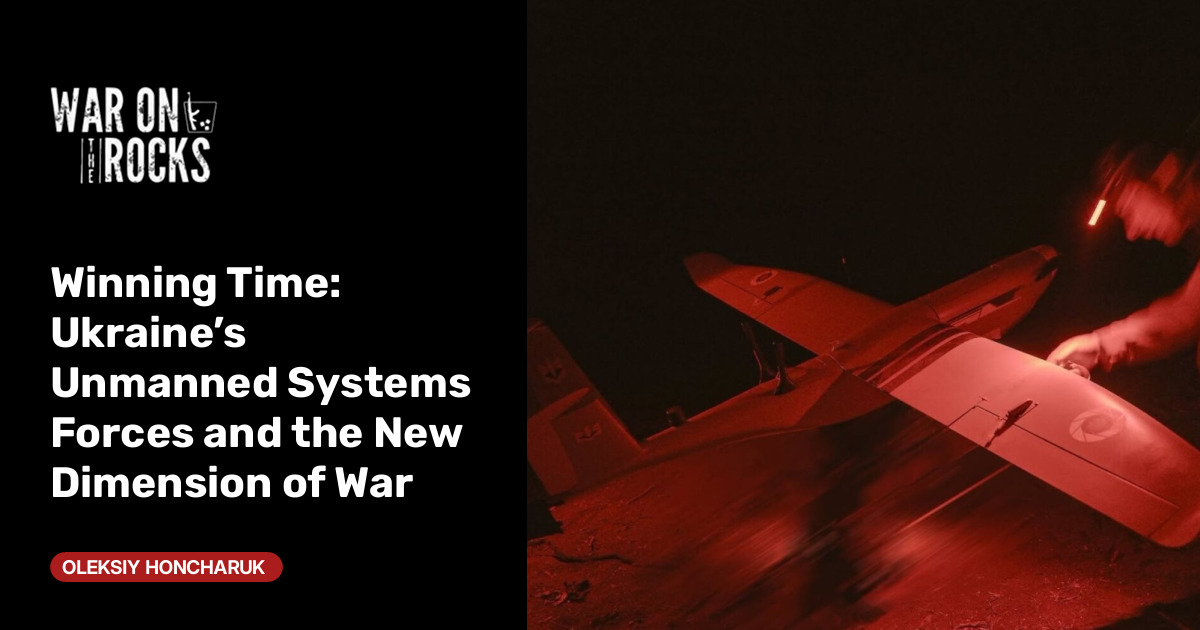
Winning Time: Ukraine’s Unmanned Systems Forces and the New Dimension of War
Full Article
Original Source
Read the full article at Warontherocks →KhanList aggregates and links to publicly available news content. We do not host full articles from third-party sources. Always verify important information with original sources.