
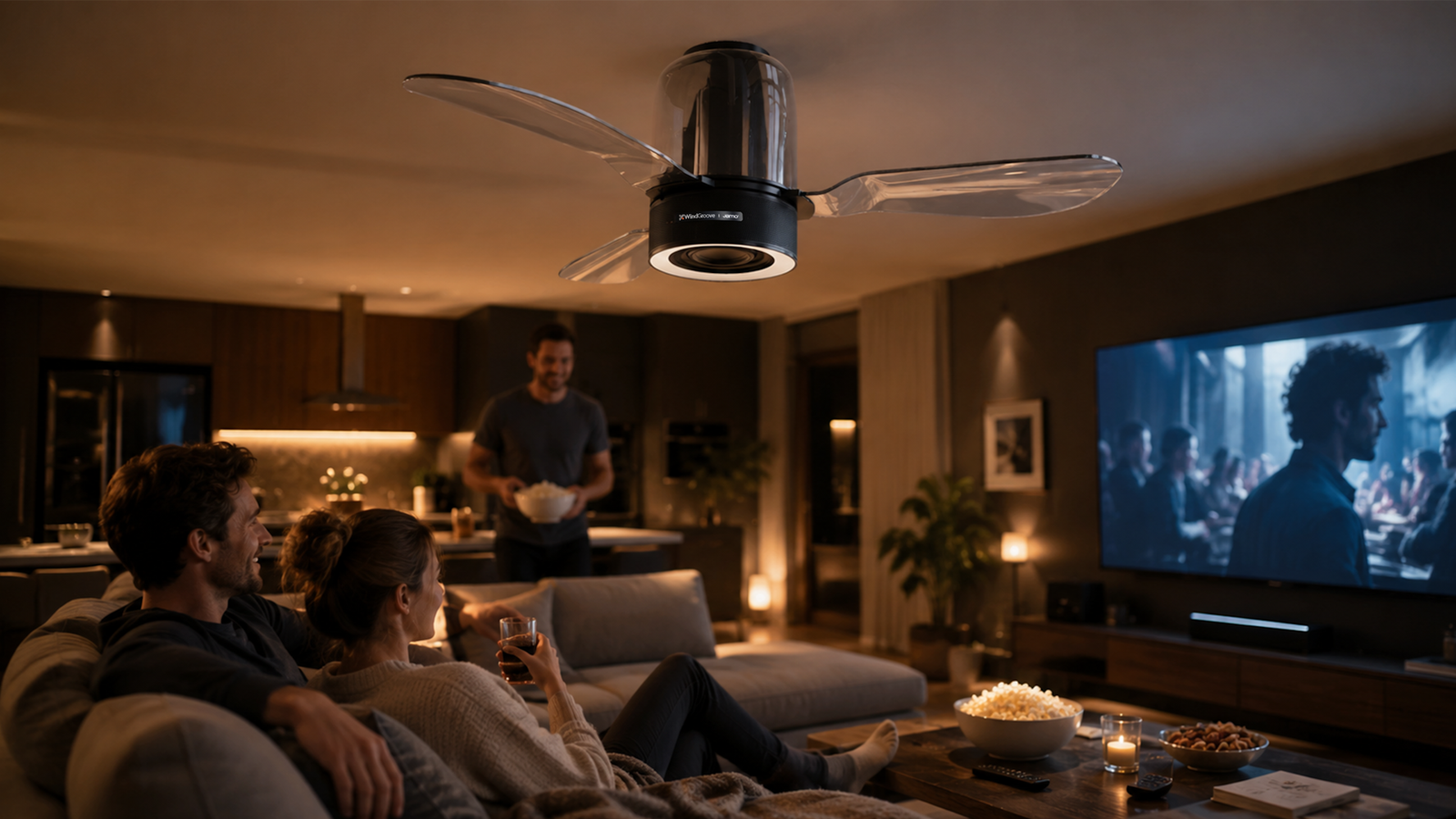
Published Sep 16, 2026, 9:45 AM EDT The below articles are sponsored by one of our partners. Product choices and opinions expressed are from the sponsor and do not reflect the views of the XDA editorial staff. Walk into most smart homes today, and you'll find a lot of stuff: a speaker on the shelf, a smart lamp in the corner, an overhead fan, maybe a light strip behind the TV. Every device promises to make life easier, and individually, most do. But add them all up, and you get a room full of gadgets, each needing its own app, its own place to sit, and its own cable or battery. That's the tension at the heart of how home technology has grown over the past decade. Just adding another product has become the industry's answer to making homes smarter. It works, up to a point, until you start running out of space and patience. But WindGroove's AirFi One attempts to help solve this problem. Why more devices aren’t the same as a smarter home WindGroove AirFi One ceiling fan speaker Dimensions 48-inch diameter Weight 10 kg Audio Jamo-tuned, 45Hz to 20kHz frequency response, DSP processing Connectivity App, remote and voice/smart home control, Bluetooth Speakers 1 x woofer, plus 2 x mid-high drivers WindGroove AirFi One brings airflow, sound, and light together in a single ceiling-mounted system. Instead of separate fans, speakers and lamps, one unit handles all three, tuned with Jamo acoustics, six-speed airflow and dimmable LED lighting. Save custom combinations for different moments, from a quiet evening to a movie night, and control everything through the app, a remote or voice. This device is a cleaner way to fit sound, air and light into any room. There's a difference between a home with a lot of technology in it and a home that actually feels smart to live in. The first is a collection of separate purchases. The second is a space where the technology gets out of the way and just works. WindGroove is trying to close this gap with its first product, the AirFi One. Rather than adding one more device to the pile, WindGroove has combined sound, airflow, and light into a single ceiling-based system. The company calls this new category a Ceiling Vibe System, and it's a useful way to think about what makes the AirFi One different from a regular ceiling fan with a speaker bolted on. It's also a reasonable response to a fairly common complaint about connected homes: that the more gadgets you own, the more work it takes to keep them all coordinated. Different apps, different remotes, and different firmware update schedules add friction that cancels out much of the convenience each device was supposed to bring. A system that handles airflow, sound, and light doesn't remove that friction entirely, but it does mean there's one place to manage three things that used to be handled separately. The ceiling has been sitting there unused Most rooms treat the ceiling as dead space. It holds a light fixture and maybe a fan, and that's it. Everything else, speakers, lamps, and diffusers, gets crammed beside furniture or squeezed into corners at floor level. WindGroove's pitch is that this is a missed opportunity. A ceiling is already centered in the room, already has power running to it, and already has a clear line to every corner of the space. Instead of treating it as a location to hang a single-purpose fixture, the AirFi One uses it as the delivery point for airflow, sound, and light. The room doesn't gain another object; it gains a source that everything else quietly plugs into. What's actually inside the AirFi One Credit: WindGroove It's easy for a product like this to turn into a list of specs, but the parts only matter because of what they let the AirFi One do in a real room. On the audio side, WindGroove worked with Jamo on acoustic tuning, and the system covers a frequency range from 45Hz to 20kHz, with digital signal processing handling the finer details. In practice, that means the AirFi One is built to produce reasonably deep bass and clear vocals without a subwoofer or bookshelf speakers taking up space elsewhere in the room. Since the sound comes from above and spreads outward, it fills a room more evenly than a single speaker sitting in one corner, and you don’t have to find room for it on a shelf or console. Airflow is handled by a motor capable of up to 4,621 CFM across six speeds, with forward and reverse operation for different seasons. WindGroove says the unit stays under 32dB of noise, even under full load, which matters more than the raw airflow number. A fan that moves a lot of air but drowns out conversation, or the music playing through the same unit, defeats the point of combining these functions in the first place. Credit: WindGroove The lighting is a 15W LED setup rated at roughly 1,200 lumens, with dimming from 10 to 100 percent and a choice of warm, natural, or cool color temperatures. There's also RGB lighting that can sync to whatever is playing through the audio system, with six preset modes to choose from. None of these pieces is trying to be the standout feature on its own. The point of the AirFi One is that the sound, air, and light are managed together. There's also a design argument for putting the speakers in the ceiling rather than on a shelf or a TV stand. Sound coming from a single point at floor or table height tends to feel localized, like it's coming from one object rather than filling the room. Firing sound down and outward from a central ceiling position spreads it more evenly across the space, and it means there's no speaker cabinet competing for attention with the rest of the room's furniture. For anyone who has tried to fit a soundbar, a pair of bookshelf speakers, and a floor lamp into a small living room, the appeal of not having to find space for any of it is fairly easy to understand. Living with one system instead of three The practical difference shows up in how you actually use the device day to day. Instead of turning on a fan, then a lamp, then a speaker, and adjusting each one separately, the AirFi One lets you save combinations of airflow, lighting, and audio as a single setting. WindGroove gives a few examples of what that might look like in practice: a relax mode for winding down in the evening, a movie mode that dims the lights and adjusts the sound, and a party mode built around the RGB lighting and music sync. Control happens through an app, a physical remote, or voice and smart home integration, so there's no single point of failure if your phone is across the room. If you have more than one AirFi One installed, WindGroove says the units can link over Bluetooth for synchronized playback across a home, or run independently, so each room keeps its own settings. Installation is also worth mentioning, since it's often the part that deters people from ceiling-mounted tech. WindGroove built the AirFi One around a pre-assembled structure, aimed at making it something an installer can put in without treating it as a custom job every time. A different way to think about the upgrade Credit: WindGroove The easiest way to misread the AirFi One is to treat it as a ceiling fan that happens to play music, or a speaker that happens to move air. That framing undersells what WindGroove is actually going for. The company isn't trying to improve on the ceiling fan. It's trying to replace the idea that airflow, sound, and light in a room need to come from three different products. Whether that idea takes hold will come down to how it feels in a real room rather than how it reads on a feature list. But the underlying logic is sound: most people don't actually want more devices to manage. They want the ones they have to work better together, and to stop taking up so much visual and mental space while doing it. WindGroove recently showcased the AirFi One at CEDIA Expo 2026, ahead of its wider release. For anyone tired of a living room that looks like a showroom for smart home gadgets, it's a product worth keeping an eye on. Use code XDA15 for a discount on your AirFi One purchase — limited to 72 hours.
WindGroove’s AirFi One could turn your ceiling into a smart home hub
Full Article
Original Source
Read the full article at Xda-developers →KhanList aggregates and links to publicly available news content. We do not host full articles from third-party sources. Always verify important information with original sources.