
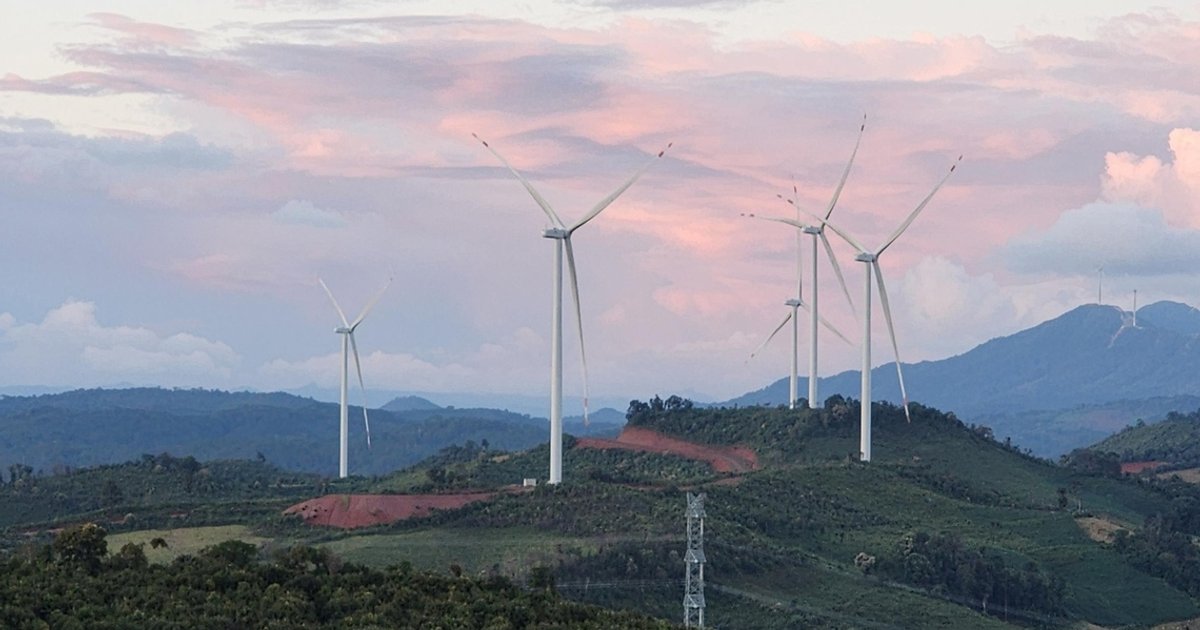
Sekong province, Laos – The massive wind turbines tower over local villages, their blades rotating like giant fans on mountain ridges in Laos’ south-eastern Sekong province, generating electricity with every turn.The 133 wind turbines have transformed the quiet rural landscape and helped Laos cement its reputation as the “Battery of Asia”, as the country adds wind power to its renewable energy mix, alongside hydropower and solar.The project is testament not only to the potential of renewable energy to meet the region’s power needs. Its backers also hope it will mark a milestone in accelerating the creation of the much-discussed but long-delayed ASEAN Power Grid.Connecting the region’s rapidly growing economies through a grid that can efficiently transmit electricity across borders will boost energy security and speed up investment and integration of green energy, said the Asian Development Bank (ADB).The bank said the aim is to create a fully integrated regional grid by 2045.Local villager Amy Saychai, 19, said she did not know the purpose of the wind turbines, only that “they look nice”. But she is happy with the benefits the project has brought, including better roads.About 1,600m above sea level, you can hear and feel the force of the wind on any given day.The Monsoon Wind Power project in Laos’ south-eastern Sekong province has brought many benefits, including more jobs and better roads for Laotians. ST PHOTO: MAY WONGThe Monsoon Wind Power project initiated by Impact Electrons Siam, a Thai clean energy and digital infrastructure developer, is South-east Asia’s largest wind farm and the first cross-border renewable energy project in Asia.The US$950 million (S$1.2 billion) project, funded by a consortium of international and regional financial institutions including ADB, became operational in August 2025 after 27 months of construction.With a capacity of 600MW, enough to power more than one million homes, the project has been supplying clean energy to neighbouring Vietnam. Over its 25-year operational life, it is expected to help avoid about 33 million tonnes of greenhouse gas emissions.That is equivalent to removing about seven million cars from the road for a year.“If we have surplus, we want to support the ASEAN Power Grid through our existing system to Thailand, Malaysia, Singapore as well,” said Narut Boakajorn, general manager of Monsoon Wind Power.The transmission of electricity through the wind farm project beyond Vietnam is possible in the near future, he added.Powering the regionThe 11-member South-east Asian grouping has been trying to accelerate the adoption of the ASEAN Power Grid, particularly after the US-Israel attacks on Iran in February disrupted global oil supplies.The memorandum of understanding for the grid was signed in 2007 and implemented in 2009. The initiative began with bilateral power connections and has since expanded to sub-regional interconnections involving Singapore, Malaysia, Thailand and Laos.Progress has been slow, despite the benefits of connecting power grids and facilitating the flow of affordable electricity across a region with a combined population of more than 680 million people.The growth potential is considerable. Electricity demand across ASEAN is rising by about 4% a year, requiring substantial investment in power generation and transmission grids.At present, the region has a multitude of national grids, some more modern than others, with relatively few cross-border interconnections. The exception is the Greater Mekong sub-region, where Thailand, Laos and Vietnam already have established electricity trading links. Most nations in the region remain dependent on costly fossil fuels for power generation, despite wind, solar and battery storage offering increasingly competitive, less polluting alternatives.The region also has abundant wind and solar resources.There are signs of progress. Singapore and Malaysia are progressively expanding their grid interconnections, while Singapore’s Energy Market Authority has awarded conditional approvals for 9.25 gigawatts of low-carbon electricity imports from Australia, Cambodia, Indonesia, Malaysia and Vietnam.Such investments can help unlock billions of dollars in green energy projects. As countries diversify their energy sources, wind power offers an additional avenue of supply.“Wind is free, so of course we should harness it,” said Shanny Campbell, country director for Laos at ADB.She said wind power in Laos is at its best during the dry season, when hydropower generation tends to taper off. “So in terms of complementing the power mix, it’s fantastic,” she added.Shanny Campbell, country director for Laos at the Asian Development Bank, says wind power in Laos is at its best during the dry season, when hydropower generation tends to taper off. ST PHOTO: MAY WONGNarut of Monsoon Wind Power said the Laos wind project could serve as a model for similar projects elsewhere in the region.“Our project is in Laos but we are selling our electricity to Vietnam, which is showing that we as an ASEAN community can achieve the ASEAN Power Grid,” he said.“Our project can demonstrate that effort. If we have the right structure, if we have the collaboration between ASEAN nations, we can have more sustainable energy collaboration,” he added.Narut Boakajorn, general manager of the Monsoon Wind Power project, says the initiative could serve as a model for similar projects elsewhere in the region. ST PHOTO: MAY WONGADB said it is working with development partners to mobilise financing to help realise the grouping’s 2045 vision of a regional power grid.Scott Roberts, country director for Vietnam at ADB, said the Monsoon Wind Power project showcases how cross-border technical challenges can be overcome and how governments can coordinate their power development plans through collaboration built on trust and political will.“It’s easier for countries to plan alone, it’s harder for them to plan jointly. We are delighted to see that there is momentum around this and that momentum builds year after year as test cases like Monsoon Wind come to market,” he said.Shobhakar Dhakal, a professor at the Faculty of Climate Change and Sustainability at the Asian Institute of Technology in Thailand, described the Monsoon Wind Power project as a “milestone in the region”.He said such a model should be scaled up across the region, beyond the existing bilateral agreement between Laos and Vietnam.“Over-reliance on bilateral mechanisms has potential to bring energy security implications for both countries in times of trouble such as global energy disruptions, friction in bilateral relations between participating countries and the unfair market protection campaigns,” Dhakal warned.“We have seen that individual countries often try to cope with the global energy crisis fallout by a protectionist approach. Additionally, there are ample examples that the energy trade and the energy reliance have been weaponised to achieve other political or strategic objectives,” he added.For instance, on Oct 24, Indonesia began cutting natural gas supplies to Singapore by 31 billion British thermal units a day, prioritising its domestic energy needs.Most of Singapore’s electricity is generated using natural gas, and a significant amount of gas is imported through pipelines from Indonesia. Singapore’s Prime Minister Lawrence Wong said on Oct 25 that he expects all parties to honour their commitments made under commercial contracts.Without referring to the Indonesia-Singapore incident, Dhakal stressed the need for bilateral and multilateral power trade agreements to be “adequately backed by robust regional or bilateral regulatory provisions and a regional framework that provides a fair level of protection to survive the rough tide”.Mirza Sadaqat Huda, a senior research fellow at ODI Global’s Climate and Sustainability Programme Singapore and an associate fellow at the ISEAS – Yusof Ishak Institute, said protectionist energy measures may complicate the development of the APG.“Continued dialogue, predictable long-term agreements and regional dispute resolution mechanisms will be important in maintaining confidence among trading partners and sustaining regional energy cooperation,” he said.Beyond energy Aside from providing clean energy, the Monsoon Wind Power project has brought other benefits. Roads have improved in local communities, and at least 1,600 jobs have been created, more than 1,000 of which have gone to Laotians.Villager Sunsamone Saypanya, 42, found a stable job as a construction worker with the project.He now earns US$10 (S$13) a day, up from US$6 a day when he did odd jobs.“We benefit a lot. One of the benefits is how they helped develop our livelihoods,” he said.Local villager Sunsamone Saypanya benefited from the Monsoon Wind Power project when he found a stable job as a construction worker there and saw his income increase. ST PHOTO: MAY WONGAs part of a community development initiative, the Monsoon Wind Power project distributes coffee seedlings to villagers, encouraging them to grow coffee instead of rice, which can involve slash-and-burn farming that pollutes the environment.“It will bring more income and improve living conditions,” Sunsamone added.A local villager studying coffee beans grown under the community programme initiated by the Monsoon Wind Power project. ST PHOTO: MAY WONGADB said the community programme has an annual budget of US$1.1 million for education, healthcare, agriculture and infrastructure improvements in surrounding villages. It has benefited about 2,800 households, or almost 16,000 residents.As the first wind farm in Laos, the Monsoon Wind Power project has also avoided the need to relocate any village, despite occupying 25ha of land with its wind turbines.Villager Amy Saychai says she is happy with the benefits the project has brought, including better roads. ST PHOTO: MAY WONGVillager Amy hopes the project will continue to bring more benefits. She even suggested the wind farm might attract tourists to her little-known village. “This creates a new landmark attraction. Some areas in the past were inaccessible. But with better roads now, people can come and enjoy the view.”
Wind of change: Laos project shows promise of connecting S-E Asia to green power
Full Article
Original Source
Read the full article at Straitstimes →KhanList aggregates and links to publicly available news content. We do not host full articles from third-party sources. Always verify important information with original sources.