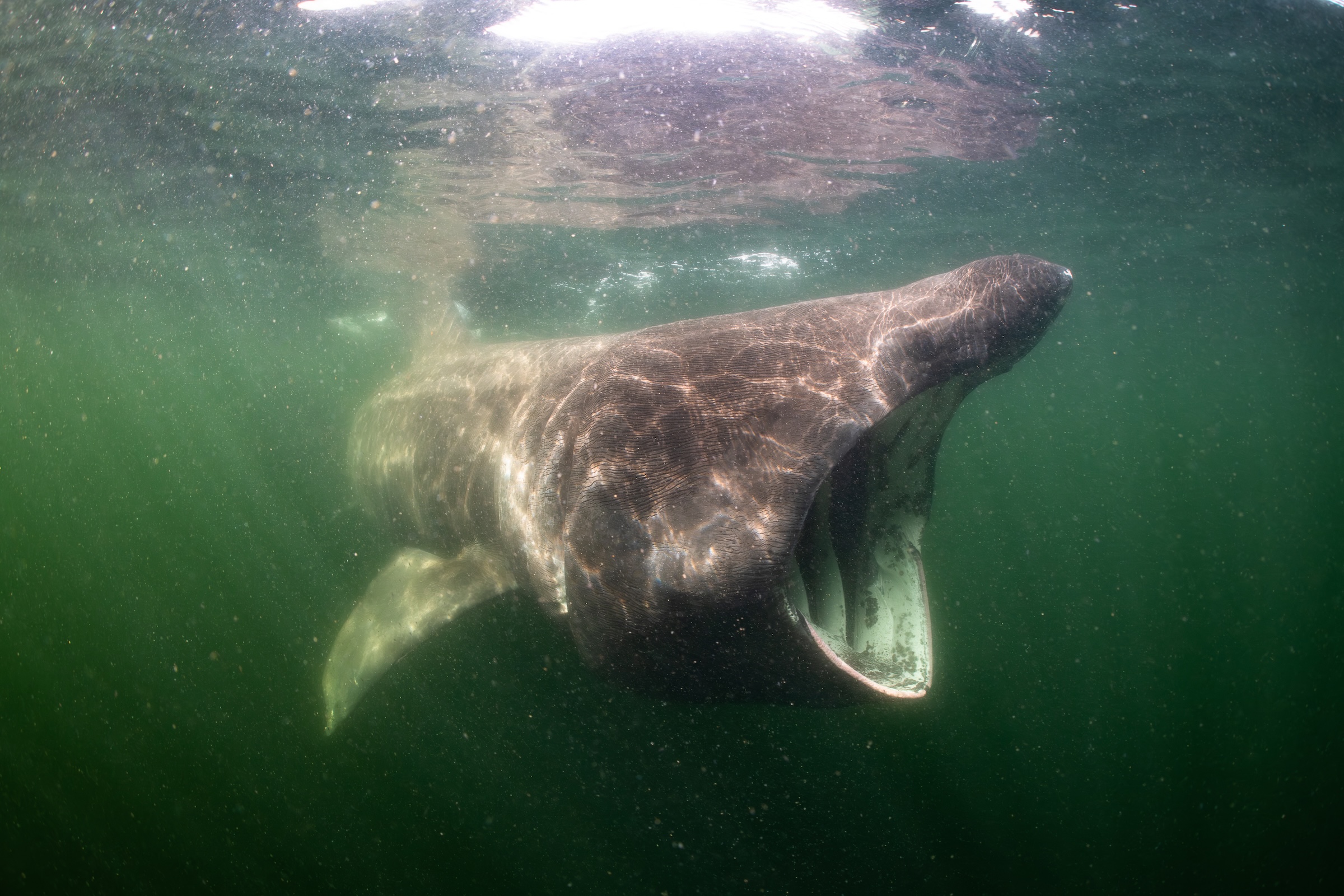
Dogger Bank is a vast, shallow sandbank in the North Sea that was once among the most productive marine nurseries in Europe, prompting experts to call it the ecological heart of the North Sea.While much of Dogger Bank has been protected for its unique seabed habitat, destructive industrial activities like oil and gas extraction as well as fishing practices like bottom trawling have continued, even in the protected zones.Now, conservationists have notched a win with a recent court ruling that curtails bottom trawling in Dogger Bank.However, they say the threats continue, notably in the form of major wind farm developments rising in a protected area. In the North Sea, the vast, shallow sandbank known as Dogger Bank was once among the most productive marine nurseries in Europe. The area stretches across U.K., Dutch, German and Danish waters, and is home to a vast array of marine life, including sharks, rays, dolphins, long-lived shellfish, anemones, corals, sand eels, and seabirds, prompting experts to call it the ecological heart of the North Sea. While much of Dogger Bank has been protected for its unique seabed habitat, destructive industrial activities like oil and gas extraction as well as fishing practices like bottom trawling have continued, even in the protected zones. Now, conservationists have notched a win with a recent court ruling that curtails bottom trawling in the Dutch protected section of Dogger Bank. But they say the threats continue, notably in the form of major wind farm developments rising in the U.K. protected section. A major difficulty in protecting a place as large as Dogger Bank, which spans 18,765 square kilometers (7,245 square miles), is that it’s divided into three separate marine protected areas (MPAs) managed by three different countries. The German section of Dogger Bank was the first to be protected, as a Natura 2000 site under the European Union’s Habitats Directive, in 2007. The Dutch section followed in 2009, and the U.K. section in 2012. Since then, the U.K. has left the EU and now manages its Dogger Bank Special Area of Conservation (SAC) as part of its own network of protected areas. (The Danish section of Dogger Bank remains unprotected.) A common hermit crab (Pagurus bernhardus), one of the species that lives in Dogger Bank and is highly affected by trawling. Image courtesy of Oscar Bos. These protections, approaching two decades old, have remained mostly on paper. However, a major conservation milestone came in June 2022 when the U.K. government, facing legal pressure from NGOs, banned bottom trawling in the entire U.K. Dogger Bank SAC. The fishing technique involves dragging heavy nets across the seafloor that destroy habitat and scoop up marine life indiscriminately. A European regulation that entered into force in November 2025 established no-trawling zones in about 28% of the Dutch SAC and about 53% of the German SAC. Now, the Netherlands is further tightening controls on trawling in its protected area after sustained legal pressure from a coalition of environmental organizations. In December 2024, the NGO coalition sued the Dutch government, claiming it had failed to comply with the EU Habitats Directive by granting trawlers what amounted to a free pass within the protected area. After hearing the case, on May 11 this year the District Court of The Hague ruled that Dutch bottom trawlers will now need to obtain a permit and conduct an appropriate environmental assessment that proves trawling will not harm marine life before they can fish in the Dutch Dogger Bank SAC, as required by the Habitats Directive. For Emilie Reuchlin, director of the Netherlands-based Doggerland Foundation, one of the NGOs behind the lawsuit, the legal victory is bittersweet. “I think ultimately, it should not depend on civil society and small, underfunded NGOs to do lawsuits,” she told Mongabay in an interview. “It’s really a responsibility of the government to put the proper measures in place to protect ecosystems. Now it seems almost like you need lawsuits to make sure that any measures are taken.” Geert Meun, chief executive of VisNed, an association that represents the interests of Dutch trawlers, and executive committee member of the North Sea Advisory Council (NSAC), a stakeholder organization that provides advice on the management of fisheries in the North Sea, told Mongabay in an emailed statement that he considers the Dutch court decision legally questionable since it impacts the EU Common Fisheries Policy (CFP), which is the legal and regulatory framework for managing European fishing fleets and conserving marine resources. “A Dutch court cannot decide on matters that fall under the CFP. The jurisdiction of the Dutch court is therefore limited,” Meun wrote. “It is now conceivable that Dutch fishermen may not obtain such a specific permit and therefore may no longer be allowed to fish in the Dutch part of the Dogger Bank, while fishermen from other countries are not bound by this decision of a Dutch court and may continue fishing there. This is a clear example of legal inequality.” Even so, the ruling sets a significant legal precedent for marine protected areas in Europe. John Condon, a senior lawyer at U.K.-based legal charity ClientEarth, another NGO behind the lawsuit, told Mongabay in an email that “the ruling has significant implications, since it shows the duties under the Habitats Directive in the marine environment (specifically in the EEZ) are not optional — but are binding and create positive duties on governments to act.” The Dutch court’s ruling was bolstered on May 21 when the EU’s General Court ruled in a separate case that EU law does give individual countries the right to restrict damaging practices in vulnerable marine areas like Dogger Bank under the CFP. New pressures in an already degraded ecosystem Nevertheless, the Dutch government is appealing the court decision and seeking a preliminary injunction that would allow permit-free trawl fishing to continue in its part of Dogger Bank. Meanwhile, a lawsuit to halt bottom trawling in the entire German SAC is ongoing. On the U.K. side, the trawling ban should allow ecological functions and biodiversity to start recovering, as they have done in other marine ecosystems where similar bans have been implemented. However, this kind of recovery takes time, especially in areas like Dogger Bank that are already degraded from decades of intense industrial activity, including most recently wind energy development. Four years after the U.K. banned trawling in its protected section of Dogger Bank, one of the world’s largest offshore wind farms is being built there. More than 100 of 277 planned turbines have already been installed in a 1,425-km2 (550-mi2) area comprising the Dogger Bank Wind Farm. Plans are now advancing to install up to 113 more turbines across an additional 262-km2 (101-mi2) area within the U.K. Dogger Bank SAC, directly adjacent to the Dutch Dogger Bank SAC. When complete, the entire farm is expected to generate 5.1 gigawatts of electricity, enough to power nearly 6 million U.K. homes. The project’s developer, a joint venture between Norwegian energy company Equinor and U.K.-based SSE Renewables, declined to comment on the potential ecological impact of this project on the protected and already degraded sandbank. “The problem is that it’s not just a wind turbine. There’s hundreds of them, and they’re huge,” Reuchlin said. “Now, some of them are over 15 meters [49 feet] in diameter. They’re up over 200 meters [656 feet] tall. It’s like a big, big industrial area. You have continuous noise, you have continuous pollution.” In addition, German multinational energy company RWE has two wind farm sites in planning stages and one under construction inside the U.K.’s SAC. Developers sometimes point to the colonization of turbine foundations by invertebrates as an ecological benefit, but Reuchlin rejected that framing. “A wind park is not a protected area, and it should have no place inside a protected area, if you really look at the ecology, and also if you look at the legislation.” The rules for trawling in the U.K. Dogger Bank SAC may be clear, but the same cannot be said for wind farms. “There isn’t a hard, fast rule in the U.K., of no activity such as wind farms happening within an MPA,” Sarah Blanchard, a marine protected areas adviser at the UK government’s Joint Nature Conservation Committee, told Mongabay in an interview. “But whenever there has been any plan or project or, say, these wind farms being established, they do have to go through quite rigorous assessments to review the impacts.” SSE Renewables’ own preliminary environmental information report (PEIR) for the planned addition to its Dogger Bank Wind Farm, published in June 2025, identifies a wide range of seabed impacts. Among them are permanent habitat loss and alteration from the turbine foundations. The company’s mitigation commitments include promises to produce mitigation plans and to minimize seabed disturbance where practicable. Reuchlin said she’s not reassured by this. The project, she said, would further modify Dogger Bank’s habitat, harm threatened species, and disturb ecological processes. And while she said wind farms are necessary to address climate change, so are effective and recovering ecosystems and protected areas. “We cannot fix the climate crisis by increasing the biodiversity crisis,” she said. The Doggerland Foundation wrote a letter to the U.K. government in 2023 urging it to halt the development of further wind farms in Dogger Bank, but Reuchlin said her group received no response. There are currently no wind farm development plans in the Dutch, German or Danish sectors of Dogger Bank. Construction of a turbine at the Dogger Bank Wind Farm in U.K. waters. Image courtesy of Menno de Boer / the Doggerland Foundation. What recovery could look like Amid the legal battles and development plans, the Doggerland Foundation has begun to map what the restoration of Dogger Bank might look like. Central to its vision is reintroducing the horse mussel (Modiolus modiolus), a shellfish that’s been largely eliminated from Dogger Bank by trawling. As so-called ecosystem engineers that can live up to 50 years, horse mussels once formed dense reefs across the North Sea’s sandbanks, stabilizing the seabed and creating the structural complexity that supports many other species, from polychaete worms and juvenile fish, to the sharks and rays that once patrolled Dogger Bank in numbers. If people rebuild the horse mussel population, reduce the pressures, and give the area time, Reuchlin said, there are signs Dogger Bank can recover. “We’ve seen areas that hadn’t been trawled for many years and we saw with our own eyes, wow, there’s still corals growing here. There’s still big anemones, there’s sponges, there’s that kind of life on the seabed. We saw ray and shark eggs. So fish are still using it as a nursery, as a spawning ground,” she said, describing expeditions to the U.K. SAC. “So you really can almost taste the potential. And it’s so easy. We could just choose not to hand out all these permits anymore to keep building, keep trawling, keep drilling. If we just stop that, I think, it’s the biggest thing we can do.” Dogger Bank hosts a diverse seabed ecosystem. Here, marine sponges thrive alongside soft corals called dead man’s fingers (Alcyonium digitatum), anemones, and shellfish. Image courtesy of Oscar Bos. Banner image: A basking shark (Cetorhinus maximus), an endangered species that uses Dogger Bank as a critical seasonal feeding ground and nursery. Image courtesy of Joost van Uffelen. How to ‘flip’ a paper park: Success in the North Sea carries lessons FEEDBACK: Use this form to send a message to the editor of this post. If you want to post a public comment, you can do that at the bottom of the page. Credits Topics
Wind farms join bottom trawlers and oil rigs in a protected North Sea sandbank
Full Article
Original Source
Read the full article at News →KhanList aggregates and links to publicly available news content. We do not host full articles from third-party sources. Always verify important information with original sources.