
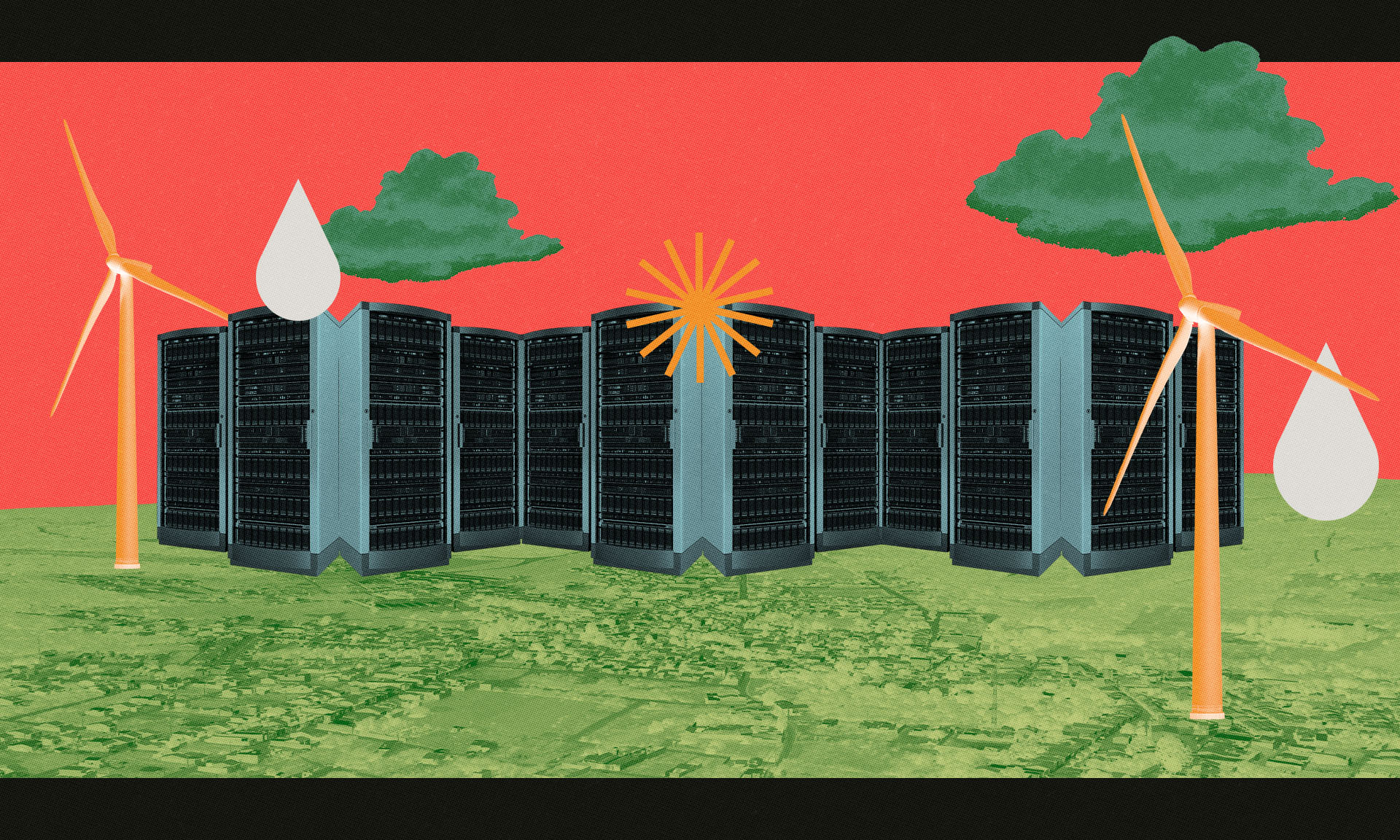
The energy firm Serena filed 12 requests to build data centers in a remote town of only 11,000 people already affected by wind farms in Brazil.The project sits in a protected area, stressing the waters of the Itaparica Lagoon, local fishers and Quilombola communities.Tech firms in Brazil are exploiting a lack of specific regulations and renewable power surplus to plan data centers without undergoing environmental licensing. GENTIO DO OURO, Brazil — From the main square in Gentio do Ouro, in northern Bahia state, you’ll see what appears in almost every small Brazilian town: The city hall, a bank branch, a bandstand and a sign with the town’s name. What distinguishes this landscape is on the horizon: Regardless of which direction you look, you’ll see giant windmills used to generate energy. The town was put on the wind turbine map more than 15 years ago, and now has 28 active wind farms, according to data from the Energy Transition Observatory. The turbines, however, don’t make Gentio do Ouro, on the outskirts of the beautiful landscapes of the Chapada Diamantina mountains, a sustainable hub. In the main square, a sculpture of a gold nugget is a nod to mining, an activity that runs strong in the region. And yet another outside influence is gaining traction: A plan to make this peaceful town a data center backyard. Similar to factories, these facilities process everything that is done on the internet — using lots of energy, benefiting few people, hiring even less and bringing about a new wave of environmental impacts. Although it has only 11,000 citizens, Gentio do Ouro is targeted by 12 requests to connect data centers to the energy grid. At the front of this race are the same companies that filled the region with wind turbines, impacting threatened biomes and even disturbing the sleep of the wind farms’ neighbors. One of the main streets in Gentio do Ouro. In the background, wind turbines. Image by Thomas Bauer/Intercept Brasil and Mongabay. The data center boom in Brazil’s Northeast was sparked by the energy surplus from renewable sources in the region. At first sight, it might appear positive. Experts, however, warn that these new facilities are discouraging investments in transmission networks that could bring energy to where it is truly needed — like street lighting, electric cars or replacing coal-fired electricity. Instead, the turbines that disturb the residents of Gentio do Ouro may end up serving only to meet the excessive demands of data centers, which are only likely to grow with the development of artificial intelligence. The project in Gentio do Ouro is led by Serena, a renewable energy company that operates wind farms in the region. The first data center has already been built — a small unit inside the Assuruá Wind Complex — and two others have been authorized, according to documents accessed by Intercept Brasil. Serena also requested authorization from the Ministry of Energy and Mines to install at least another nine data centers in the town. According to Brazil’s independent energy grid operator, ONS, the company received a favorable response, but did not follow through with the process within the deadline — which does not necessarily mean it gave up on the idea. The company’s plans include small data centers, hosted inside containers and focused on data processing — different from hyperscale facilities, such as the one being built by TikTok in the state of Ceará. But, despite being smaller, the projects in Gentio do Ouro, when put together, could reach 270 MW in capacity — equivalent to a large data center. Serena’s press office was reached for comment, but the company did not reply by publication. Gentio do Ouro is only one of many locations where renewable energy companies are bringing the AI development boom. An exclusive analysis by Mongabay and The Intercept Brasil found that the renewable energy sector accounts for six out of 10 requests to connect data centers to the power grid submitted by December 2025. Like Gentio do Ouro, many of the municipalities sought after by these companies are home to traditional communities, such as Quilombolas or Indigenous groups. This analysis found that 78% of municipalities planning to install data centers have at least one protected territory or a territory under study. Turning a lemon into lemonade The energy surplus in Brazil is a threat to the power sector’s profits. Today, this electricity is being wasted because, if it was added to the grid, it could unbalance it, leading to blackouts. To avoid an overload, ONS forces firms to turn off generation, leading to losses. A study shows that curtailment, the technical name given to this process, has caused the energy sector to lose 3,2 billion reais ($618 million) in the first six months of 2025. This is where data centers come into the picture: Voracious energy consumers, they enable companies to reduce losses. The strategy has earned the support from governments, because it helps put an end to businesses’ complaints. “Data centers interest us because they are consumers of lots of energy,” said Paulo Guimarães, president-director of the Bahia state investment agency, Bahiainvest, in an interview with newspaper A Tarde. The municipality of Gentio do Ouro, in northern Bahia state. Image by Thomas Bauer/Intercept Brasil and Mongabay. Serena also doesn’t hide its objectives. When requesting the Ministry of Energy and Mines speed up the authorization process for the data centers it wants to connect near its wind farms in Gentio do Ouro, the company argued that “the project is strategically positioned in a region of electricity generation surplus, favoring a more efficient use of transmission infrastructure”. “We could direct this energy surplus to actions and initiatives that effectively contribute to combatting socioenvironmental crises,” said Julia Catão Dias, a lawyer, activist and researcher who has been studying the arrival of data centers to Brazil over the last few years. While the plan to transform Gentio do Ouro into a data center backyard moves forward, many local residents struggle without power. This is the case for Valmir Pereira de Carvalho, who lives in the village of Santo Inácio, one of the town’s districts. “During the rainy season, when it thunders, there are times where we go three days [without power],” he said. The region where Carvalho lives holds treasures. A 10-minute walk among the rocks leads to an archaeological site registered in Brazil’s Institute of Historic and Artistic Heritage, IPHAN. There, Carvalho points out reddish cave paintings. In the municipality of Gentio do Ouro, more than 234 locations have been recognized as archaeological sites. Valmir Carvalho shows an archaeological site with cave paintings located behind his house in the village of Santo Inácio, in the district of Gentio do Ouro. Image by Thomas Bauer/Intercept Brasil and Mongabay. In the 2010s, Carvalho worked for renewable energy companies surveying archaeological sites that could be impacted by the turbines. “We captured 22,000 historical artifacts. There were arrowheads, a scraper, a horse’s hoof, a ceramic vessel, a pipe, and an intact hearth,” he said. Nothing stayed in the region. “Everything is in São Paulo. It was supposed to have stayed here,” Carvalho said, holding the only record of this heritage he still has access to: A brochure featuring faded photos of archaeological sites produced by an environmental consulting firm. Similar to what happened to the archaeological findings, very little of the progress from the evolution of technology promised to Gentio do Ouro stays with the “wind neighbors,” as the communities that live close to wind farms are called. The energy produced in the region already benefits the outskirts of São Paulo. In November 2025, Serena announced a partnership with NextStream to supply the company’s data centers, including one in Tamboré, in the metropolitan region of São Paulo. Contracts to provide the energy produced in Bahia were also signed with Scala Data Centers, the firm behind the AI City project in Eldorado do Sul, in southern Brazil, and with Odata, a data center developer that, in early August, became partners with Serena in three wind farms in Bahia that are not even operating yet, according to information submitted to the Brazilian antitrust authority. Community hall in Santo Inácio, whose renovation was funded by Serena. Image by Thomas Bauer/Intercept Brasil and Mongabay. But in Carvalho’s home, things seem the same. Although he acknowledges the village has seen improvements in the last few years — including the renovation of a multi-sport court and a party hall funded by Serena —, he complains that, recently, he paid 400 reais ($77) on an energy bill for a three-person household that does not have air conditioning or electric water heating. “If they distributed it for us, so we didn’t have to pay for energy, I would see it as a very good thing,” he said. A Quilombo in between There’s a gap in the narrative that data centers are coming to Gentio do Ouro only to use up the energy surplus. With an oversupply, it would be expected that companies would stop increasing power generation. Serena itself has publicly declared that it is time to hit the brakes on investment because of curtailments. However, the company is in the final stage of obtaining licenses for Complexo Assuruá VI, which includes the installation of at least 91 new wind turbines in Gentio do Ouro. This example reflects the risk of a vicious cycle: Data center installations are stimulating the construction of new wind farms, which will attract more data centers, perpetuating the unbridled proliferation of turbines throughout Brazil. Last year, the former Environmental and Climate Change minister Marina Silva had already alerted about the issue, saying that the intensive energy use in data processing “makes new sources become even more sought after.” At that time, the Environmental Ministry was in discussions with other ministries about how to protect Brazil from an “unsustainable pressure” related to the topic. In a statement, the ministry said it “continues to focus on this issue within its agenda for future sector policies.” The ministry further noted that data centers “are subject to the country’s existing environmental regulatory framework, including the National Water Resources Policy, the National Solid Waste Policy, and the National Environment Policy.” Read the full statement in Portuguese. In Gentio do Ouro, the Assuruá VI complex will take up an area of 8 square kilometers (3 square miles) in a hilly area close to the BR-330 highway. Just a few kilometers from there, sits the Pacheco Quilombo Remnant Community, territory that received a certification from the Palmares Cultural Foundation in 2018 and now awaits the title from Incra, Brazil’s land reform agency. The main street of the Pacheco Quilombo Remnant Community in Gentio do Ouro. Image by Thomas Bauer/The Intercept Brasil and Mongabay. A dirt road cuts through the community from one end to the other. Houses sit side-by-side, and all residents are related on some level. In the middle of the community, a recently renovated square houses the old local school, currently deactivated due to a lack of students and serving as the headquarters of the residents’ association. From there, you hear a constant background noise: The incessant sound of the wind turbines’ rotation. Initially, Serena proposed that the Assuruá VI complex cut through the middle of the Quilombo’s territory. The firm tried to get the community to sign a term authorizing the project, promising to pay a sum for the installation plus a monthly fee, but the residents refused. The Pacheco Quilombo Remnant Community in Gentio do Ouro. Image by Thomas Bauer/The Intercept Brasil and Mongabay. They made this decision after community leaders reached out to Comissão Pastoral da Terra (CPT) to analyze the contract and see if there were any loopholes. Connected to the Catholic Church, the organization works in the defense of rural workers and traditional communities. “By default, the contracts are terrible in every aspect: Judicially, financially and politically,” said Carivaldo Ferreira dos Santos, an agent and researcher with CPT-Bahia who assisted the community. Serena was persistent in the negotiations. “Their interest was so big that they brought many proposals,” Damares Teixeira, secretary at the residents’ association, told Mongabay and Intercept Brasil. After five months of back and forth, with countless modifications, the company gave them an ultimatum. The community then got together and voted not to sign the contract. One of the people who voted against signing was Elexandra Torres Peixoto, the association’s treasurer. She said the community will be impacted anyhow by the complex’s expansion, but making a deal with Serena would have brought the wind turbines’ impacts closer to their homes. Today, there are already turbines installed in the Pacheco territory, but they are in a region that the Quilombola leader calls “the other side”. Peixoto refers to the opposite margins of the BR-330 highway, which divides the Pacheco territory, where Engie, the French energy giant, has a wind farm. As part of the environmental licensing process for that farm, the company conducted an anthropological study on the remnant Quilombola community, including interviews. The research became a book, but according to residents, only one copy stayed with the community. In addition to the book, residents also received the renovation of the small square in the middle of the village. Engie stated that copies of the book and a video documentary were distributed at an event and that it was unaware of “any potential limitation on access to the publication and will make additional copies available to the community.” The disturbances caused by the wind turbines go beyond the nonstop noise and began during the installation of the towers. Although the towers currently sit in the part of the territory that doesn’t have houses, the controlled explosions used to open paths resulted in cracks in houses on the opposite side of the highway, villager Valdenir Alves de Souza said. Issues persisted after the complex began operating, since the wind farm sits on land where many locals have their farms. “My father plants cassava in the back of these towers,” Eloísa Cerqueira, president of the Pacheco Residents Association, said. “Because of the noise, the caititu [a type of small wild hog] left their habitats and destroyed the entire farm.” She said she took the case to Engie representatives, but “they laughed.” Regarding the impact on small-scale farms, Engie said it had found no records of such issues in its complaint channels or among field teams. Read the full response in Portuguese here. Valdenir Alves de Souza shows portraits of his family and ancestors in the community’s oldest house, which has stood there for 250 years. Image by Thomas Bauer/Intercept Brasil and Mongabay. Coming in without asking for permission Although the majority of the residents of Gentio do Ouro likely don’t know, there is already a data center operating in the town. Since it is connected to an electrical substation located within the wind farm complex, it’s only visible in aerial views or satellite images. The project takes up less than 1 hectare (2.5 acres), is composed of six modules and was installed between July 2023 and July 2024 . Soon, other data centers may join this facility, since Serena has already secured authorizations from Inema, Bahia’s state environmental authority, to clear the land, opening space for two new projects. Each of them is expected to take up an area of 5 hectares (12.4 acres), formerly covered by native Caatinga vegetation. What all these projects have in common is that they didn’t undergo environmental licensing, a more rigorous procedure than an authorization to clear vegetation and manage wildlife. The same applies to the other nine data centers Serena plans to build in Gentio do Ouro. Among the documents submitted by the company for the new data centers’ authorization process is a letter from Inema declaring that licensing isn’t required, exempting the company from submitting its projects for environmental impact assessments. This occurred, because, at the time the requests were made, the agency didn’t yet have specific regulations for data center operations, according to Jefferson Araújo and Marcelo Guimarães Costa, staff members at Inema’s Infrastructure, Energy, and Tourism Coordination unit. A decree regulating the permit requirements of this type of infrastructure was only approved by the agency in February 2026 and applies solely to projects submitted from that date onward. In Bahia, the size of data centers will be determined based on the area occupied in hectares. Projects covering less than 10 hectares (24.7 acres) will be classified as small-scale and subject to unified licensing in a single stage. The three Serena data centers already authorized by Inema have a combined area exceeding that threshold, which would classify them as medium-sized projects. However, because the authorization process was split into three parts, the company would avoid more rigorous licensing, even under the rules of the new decree. Inema confirmed in a statement that Serena holds a declaration of non-applicability regarding the other two data centers, but that the expansion has not yet taken place. The agency further stated that the currently operating data center uses water from “duly permitted” artesian wells, but that the company is “decommissioning said data center to install a new facility, switching the equipment cooling technology to a closed-loop system using refrigerant fluids.” Read the full response in Portuguese. The data center complex, which is being developed without an impact assessment, is located within the environmental protection area of the Itaparica Lagoon, a 24-kilometer-long (14.9-mile) body of water upon which local communities rely on for fishing. “It is a lagoon that requires attention because it is a fragile body of water, despite its size. It is a floodplain area,” said Roberto Rivelino, the environmental and sustainable development secretary of Xique-Xique (a city neighboring Gentio do Ouro) and a member of the São Francisco River Basin Committee. Water and energy used by data centers are the most critical aspects of their environmental footprint and inversely related: Data centers that use less water consume more energy. Power demand for cooling is also affected by outdoor temperatures, a key factor to consider when planning to install data centers in Brazil’s Northeast, where temperatures tend to be higher. The municipality of Gentio do Ouro, in northern Bahia. Wherever you look, you see wind turbines on the horizon. Image by Thomas Bauer/Intercept Brasil and Mongabay. “During hot periods, higher ambient temperatures can reduce the effectiveness of dry heat rejection and need higher fan power, higher compressor power, or other mechanical cooling support to maintain the required coolant temperature”, U.S. researchers from the University of California, Riverside, the University of Texas at Arlington, and the California Institute of Technology wrote in a May 2026 research paper. But anyone who views the arrival of data centers solely through the lens of energy risks repeating the arguments made by renewable energy companies, according to Rárisson Sampaio, a lawyer and consultant advising the Institute for Socioeconomic Studies on socio-environmental issues and the energy transition. “If you frame the arrival of this type of project solely in terms of energy, the debate is already flawed, because you have to look at the entire cumulative picture — water usage, territorial impact,” he said. “None of that is taken into account, because it is viewed merely as a bargaining chip for the [energy] sector.” Paying the price for ‘progress’ None of the residents Mongabay and Intercept Brasil met in Gentio do Ouro had heard about the arrival of the data centers. “It’s the first time I’ve encountered that word, and knowing that it’s already been authorized for a site near us worries me a lot,” Teixeira, a Quilombola leader, said. “Technology is good, but it often causes harm, too.” Part of the skepticism comes from the residents’ own experience with the wind industry, which promised a lot to the municipalities but delivered little. “Gentio do Ouro was supposed to be a dream city today — a princess. Yet, that is not what we see,” said Claudia Oliveira, a municipal councilwoman and member of the Pacheco community, referring to the promises that accompanied the arrival of wind farms in 2009. “Today, the municipality suffers various setbacks due to a lack of organization, guidance, and planning,” Oliveira said. One of the most pressing issues, according to her, is the lack of opportunities for young people and the lack of investment in training to enable local workers to take on roles in these ventures. As is the case with data centers, wind power projects generate jobs during construction but require few workers once operations begin. The economic impact on municipalities is, therefore, temporary. The expansion of facilities or the construction of a new wind farm fills the city with workers, mostly outsiders. When the construction is finished, they leave. But the impact of those waves of migration can last. The directors of the Association of Pacheco Quilombo Remnant Community. From left to right: Damares Teixeira, Elexandra Torres Peixoto, and Eloísa Cerqueira. Image by Thomas Bauer/Intercept Brasil and Mongabay. This is felt, for instance, in the local real estate market. The arrival of workers drives up the demand for housing in Gentio do Ouro downtown. Consequently, rents that used to cost 500 reais ($96) soar to 2,000 reais ($385). The problem is that prices do not return to previous levels once outsiders leave. This inflationary trend extends to purchases at supermarkets and restaurants, according to locals. “When the company was here, the price of everything went up. They left, but it remained [expensive] for us, which ended up complicating things,” Teixeira said. With the possible expansion from Assuruá VI, they expect another inflation wave. “If the expansion comes, certainly more people will come from outside because there is no skilled labor,” said Oliveira, who also complains that the city’s increase in tax revenue collection during those waves didn’t turn into investments for the population. The wind farm setups are subsidized through a combination of tax incentives and exemptions on both federal and state levels and public-sector subsidized financing. In May last year, Sudene, the Northeast development agency, released an investment of 8.6 million reais ($1.7 million) for the implementation of four plants within Serena’s Assuruá V Complex, which had already received 556.4 million reais ($107 million) in credit from Sudene. Meanwhile, in municipalities like Gentio do Ouro, the numbers don’t add up. According to data from the Bahia State Court of Auditors, the city collected 27.3 million reais ($5.2 million) in 2025, yet local spending on health and education alone totaled 45.9 million reais ($8.8 million). The city relied on 62.4 million reais ($12 million) from other sources to cover expenses. When asked if there had been any improvement in the city since the wind power boom, resident Valdenir shook her head. “Nothing has changed. One mayor comes in, another takes over — it’s the same thing,” she said. Regarding jobs, she noted that fewer than 10 people from the community were hired, and those who did find work served as security guards, drivers or construction assistants. As tax incentives vary by municipality and state, there are no studies quantifying the scale of this tax revenue loss. However, it invariably results in reduced revenue for local areas, according to Rárisson Sampaio, an advisor from Inesc, a think tank that monitors public spending. Sampaio also said that there is no transparency in the distribution of these incentives, nor any guarantees that they will benefit the communities and territories affected by the investments. Cicero Elizeu Oliveira da França, the mayor of Gentio do Ouro, was reached for comment, but he was unable to receive us for comments. Questions in writing were also sent to the press office, but there was no response. This story was published in partnership with The Intercept Brasil, with support from the Pulitzer Center’s AI Accountability Network. Read it in Portuguese on The Intercept Brasil. https://news.mongabay.com/2026/08/brazils-unique-data-center-boom-rides-on-clean-power-despite-social-burden/ Citation: Ren, S., Islam, M. A., … Wierman, A. (2026). Maximizing Compute Capacity in AI Data Centers through Cooling, Energy Storage, and Computing Adaptation. In Proceedings of the 2026 ACM Sustainability Week (pp. 561-562). doi:10.1145/3765611.3815390 FEEDBACK: Use this form to send a message to the author of this post. If you want to post a public comment, you can do that at the bottom of the page. Credits Topics
Wind energy surplus fuels unregulated data centers in Brazil’s dry land
Full Article
Original Source
Read the full article at News →KhanList aggregates and links to publicly available news content. We do not host full articles from third-party sources. Always verify important information with original sources.