
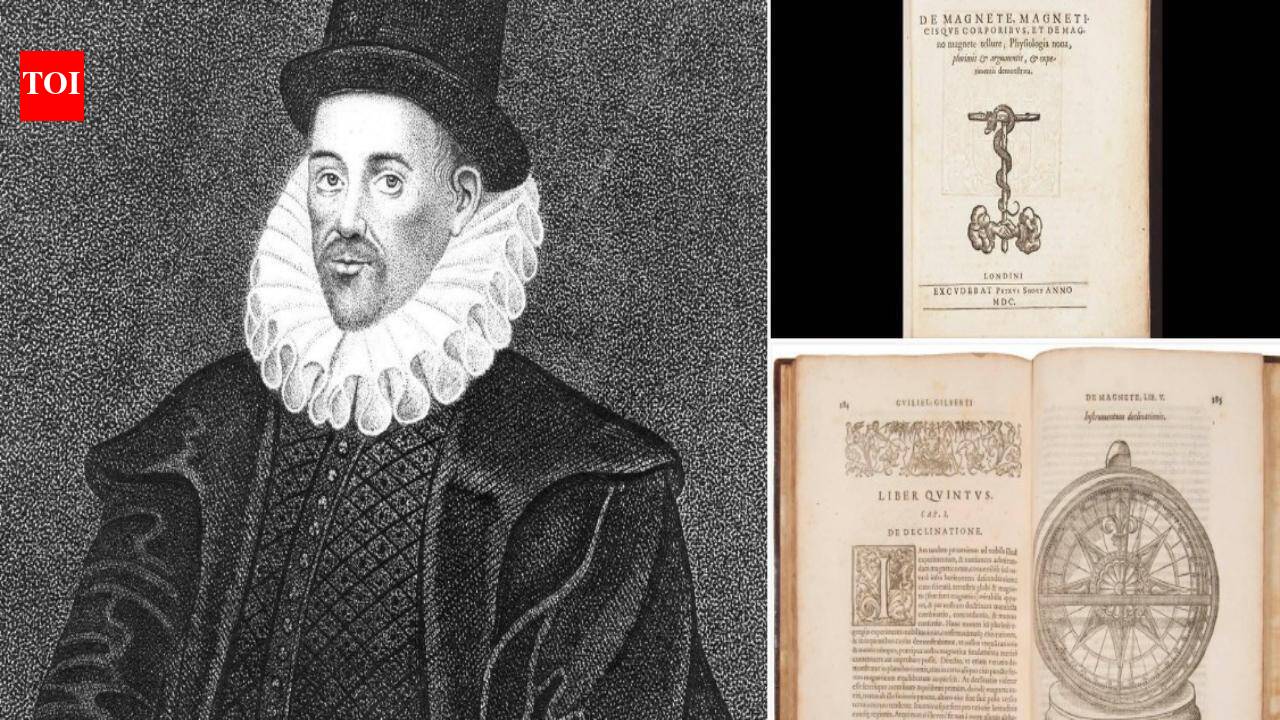
William Gilbert and his bookPublished in 1600, William Gilbert’s De Magnete argued that Earth itself behaved like a giant magnet. Four centuries after it challenged conventional ideas about the natural world, the book helped lay the foundations of modern electrical science. Written by English physician and natural philosopher William Gilbert, the book also introduced important terminology for understanding electrical phenomena.The first edition of the book is attracting attention once again at an auction conducted by Christie's. The book was sold for $61,440, approximately Rs 58.5 lakh. The copy, offered as Lot 61 in the auction house's Fine Printed Books, Manuscripts, and Science sale in New York on October 13, 2026, had been estimated at 25,000–35,000.The physician who saw Earth as a giant magnetWilliam Gilbert’s De Magnete's first edition (PC: Milestone Books)William Gilbert was born in 1544 and studied at Cambridge. He was an English physician who became one of the most influential early investigators of magnetism. He also practised medicine in London and eventually served as physician to Queen Elizabeth I.During Gilbert's lifetime, magnets were familiar objects, particularly because of their use in compasses. However, many explanations of magnetic behaviour remained rooted in inherited ideas rather than systematic experimentation.Gilbert sought to investigate these phenomena through observation and practical experiments. His findings culminated in De Magnete, Magneticisque Corporibus, et de Magno Magnete Tellure, a Latin title that can be understood as a treatise on magnets, magnetic bodies and Earth, the great magnet.The book was published in London by Peter Short in 1600. It was then known as the first major English scientific treatise to rely on experimental methods of research. It brought together observations, demonstrations and explanations in an attempt to establish a coherent account of magnetism.Gilbert's central argument was incredible: Earth was not merely a place on which magnetic phenomena occurred; it was itself a vast magnet.How he supported the theoryTo support his theory, Gilbert used a spherical magnet, often referred to as a terrella, meaning a little Earth. By studying how a compass needle behaved around this model, he could investigate magnetic direction on a small scale and compare it with the behaviour observed on the planet.How De Magnete helped lay the foundations of electrical scienceWilliam Gilbert’s De Magnete pages (PC: Milestone Books)The ancient Greeks had observed that amber could attract lightweight objects after being rubbed. Gilbert explored this effect and distinguished it from magnetic attraction, helping establish that the two phenomena required separate explanations.He used the Latin word electricus, associated with amber, to describe materials that displayed this kind of attraction. His work helped introduce the vocabulary of electricity, including the terms “electric force” and “electric attraction”, as noted in the historical references cited by Christie's.Gilbert also developed the versorium, an early instrument used to detect electrical effects. These experiments were significant because they reflected a change in how natural phenomena were studied. Instead of relying solely on the authority of earlier writers, Gilbert argued through observation and repeatable demonstrations. His book provided enough detail about many experiments for other investigators to attempt them.From a historic library to the auction roomAccording to Christie's catalogue, the volume was once part of the Signet Library, a historic legal library in Edinburgh, Scotland. Its eighteenth-century calf binding bears the library's arms. The copy was subsequently sold by Sotheby's on April 11, 1960, as Lot 1189.The book later appeared at Christie's New York on December 14, 2014, as Lot 221. It was acquired at that auction by its present owner, identified in the 2026 catalogue as a California collector. The volume was then offered again in the October 2026 sale.The 2026 copy was described as a folio volume measuring approximately 28.2 by 18.4 centimetres. Its features include a woodcut printer's device on the title page, numerous illustrations within the text, a large folding woodcut diagram and decorative initials.Why a 426-year-old book still mattersWhen De Magnete appeared in 1600, the systematic study of electricity was still in its infancy. There were no electric power grids, household electrical appliances or modern electronic devices. His assertion that Earth was a giant magnet was an important step towards understanding terrestrial magnetism. His investigations of amber and electrical attraction helped establish a vocabulary and experimental approach that later researchers could build upon.The book's sale for $61,440 in October 2026, equivalent to roughly Rs 58.5 lakh, therefore represents more than the market value of an old volume.And that’s why even after four centuries, the book continues to attract people.
William Gilbert's 1600 book saying Earth is a magnet sells for Rs 58.5 lakh
Full Article
Original Source
Read the full article at Timesofindia →KhanList aggregates and links to publicly available news content. We do not host full articles from third-party sources. Always verify important information with original sources.