
Get your news from a source that’s not owned and controlled by oligarchs. Sign up for the free Mother Jones Daily. In July 2025, Tulsi Gabbard, then–director of national intelligence, strode into the White House briefing room to press the case that Barack Obama had mounted a “treasonous conspiracy.” Days earlier, she had brazenly misrepresented declassified documents to challenge a damning 2017 intelligence assessment: Russia covertly assaulted the 2016 election—by hacking Democratic emails and pushing online disinformation—to sow discord, hinder Hillary Clinton, and assist Donald Trump. Now, Gabbard falsely claimed that Obama had cooked up the Moscow-aided-Trump finding as a “coup” to “undermine” Trump. She asked the Justice Department to open a criminal investigation into ex–Obama aides; it quickly did. Trump and his allies embraced her lies, even though they were easy to debunk. Russia’s interference had been exhaustively documented by special counsel Robert Mueller—and by the Senate’s intelligence committee, then chaired by Republican Marco Rubio, which concluded that Vladimir Putin “ordered” attacks to “harm the Clinton campaign…help the Trump campaign…and undermine” US democracy. Gabbard was providing Trump yet another chance to falsely claim the Deep State had conspired to delegitimize him. But Russian interference was very real—and it didn’t just happen in 2016. It’s occurred in every major election since, and Trump has abetted Putin’s decadelong assault, not only by denying this “gray warfare” is taking place, but also by neutering the federal government’s ability to thwart it. During the 2020 contest, the Kremlin colluded—yes, colluded—with Rudy Giuliani to smear Joe Biden. Trump’s personal attorney assembled a team of operatives who zeroed in on Hunter Biden’s board seat at Ukrainian energy company Burisma. To portray Biden as corrupt, they falsely claimed that as vice president, he had forced the firing of a prosecutor because he had investigated Burisma. This charge was readily disproved, but as the MAGA ecosystem kept hawking it, Giuliani hooked up with Andriy Derkach, a pro-Russia Ukrainian legislator who claimed to have documents showing Biden got $900,000 from Burisma. (No such evidence ever emerged.) Derkach had not yet been officially fingered as a covert agent, but it was known he had attended the KGB’s spy academy and had pushed the Moscow-generated conspiracy theory that Ukraine, not Russia, interfered in 2016. (Giuliani claimed he had “no reason to believe [Derkach] is a Russian agent.”) Nonetheless, in December 2019, Giuliani, joined by a One America News crew, interviewed him for hours at a luxury hotel outside Kyiv. OAN claimed the legislator “confirmed Burisma’s money laundering, Hunter and Joe Biden’s direct involvement, and [Ukraine’s 2016] interference.” In May 2020, Derkach again boosted Giuliani’s get-Biden operation by releasing audio of calls between Biden and a former Ukrainian president, claiming they showed “international corruption and state treason.” While the fragments revealed no wrongdoing, for MAGA they were ammo. Fox News reported there were “new questions” about the Bidens. OAN aired “Biden’s Bribe Tapes,” a three-part series, and Trump retweeted a post pushing the clips. Three weeks after that tweet, Trump’s Treasury Department sanctioned Derkach, declaring he had been “an active Russian agent for over a decade” who was running a “covert influence campaign…cultivating false and unsubstantiated narratives” to “discredit U.S. officials” ahead of the 2020 election. To sum up: According to the Trump administration itself, the president’s personal lawyer had collaborated with a Russian agent mounting a covert action to help Trump win. The Derkach plot failed to keep Biden from booting Trump out of the presidency. But for Trump’s 2024 comeback, the Kremlin again launched a massive disinformation campaign, this time through covert networks researchers assigned names such as Storm-1516 and Doppelganger. With Russia now waging a barbaric war against Ukraine, these groups initially concentrated on discrediting its president, Volodymyr Zelenskyy, as corrupt and criticizing Biden’s support of him. On sites designed to look like the Washington Post, Fox News, and other media outlets, Doppelganger also disseminated false stories about the election to US voters: Fraud was widely expected, bribed judges would impede Trump, Biden was close to “losing his mind.” In one instance, Russian operators created a video that supposedly disclosed a secret anti-Trump CIA–Ukrainian operation. Citing this video, DNI Avril Haines testified that Russia remained “the most active foreign threat to our elections.” In July 2024, the Justice Department announced it had seized US domains and taken down 968 X accounts that were part of a Russian AI bot farm. Intelligence officials told reporters that Moscow was engaged in a “whole-of-government approach to influence the election.” A DNI fact sheet noted Russia was working to “target specific voter demographics, promote divisive narratives, and denigrate specific politicians” and aimed to “covertly use social media to amplify narratives to sway…swing states.” Biden officials did not explicitly state Putin was interfering to assist Trump—they didn’t want to be accused of influencing the election themselves—but that was clearly Moscow’s intent. And hard evidence soon emerged. Two months later, the Justice Department revealed it had seized 32 domains used by Doppelganger to “covertly spread Russian government propaganda” smearing Ukraine and “influencing voters.” An internal memo from the operation disclosed by prosecutors said it “makes sense for Russia to put a maximum effort” into backing Republicans and Trump voters. In another case, employees of Kremlin propaganda outlet RT were charged with funneling millions via a US media company to prominent right-wingers such as Benny Johnson, who produced videos and podcasts bolstering pro-Trump themes. These MAGA influencers insisted that they knew nothing about Russian funding. But Margarita Simonyan, RT’s editor-in-chief, later boasted that the project had “created a large network” with “electorally significant influence.” After Biden withdrew and Kamala Harris stepped in, the Kremlin’s information war fixed on the new nominee and her running mate, Minnesota Gov. Tim Walz. A network dubbed Storm-1679 created posts and videos to look like mainstream media reports: Harris had an abortion as a teen, was concealing family wealth, and was exhibiting early Alzheimer’s. It stoked fears of civil war, postelection violence, and a US–Russia conflict that could end in nuclear catastrophe. One Storm-1516 video viewed by millions purportedly showed Harris supporters assaulting a Trump rallygoer. Another presented an actor sharing a fake story that Harris once paralyzed a girl in a hit-and-run. A deepfake depicted Harris joking about the assassination attempts on Trump. A month before Election Day, Storm-1516’s fake sites smeared Walz, a former high school teacher, saying he inappropriately touched a student—a false story seen by tens of millions. Storm-1516 also circulated a deepfake video of Pennsylvania mail ballots being destroyed. Another claimed Harris was linked to a small packet of cocaine found in the White House. Trump’s refusal to acknowledge Russian interference is a clear and present danger. Neither the Biden White House nor Harris’ campaign raised a major fuss, and there’s no telling the disinformation’s impact. But clearly, Putin remained on Trump’s side. After Trump’s victory, the Treasury Department sanctioned a Russian think tank for collaborating with the Russian military on “various influence operations,” including manipulating video to “produce baseless accusations concerning a 2024 vice presidential candidate.” So Russian meddling in the 2016 election was no anomaly, and Gabbard’s attempt to undermine and criminalize the intelligence community’s 2017 conclusion was nothing but a con job. But the Trump gang’s refusal to acknowledge what happened in the past is more than a lie; it is a clear and present danger. Since Trump reentered the White House, he and his aides, striving to wipe the Russia stain from his 2016 victory, have sought retribution against officials who investigated Putin’s information warfare. Even worse, they have eviscerated the government’s ability to counter it—or similar actions by other adversaries. FBI agents and intelligence officials involved in past inquiries into Russian interference were canned or forced out. The FBI’s foreign influence task force was dismantled, as was the DNI’s Foreign Malign Influence Center. Staffing at the Cybersecurity and Infrastructure Security Agency, which helps protect election systems, was slashed. Rubio, now secretary of state, shut down the department office tracking foreign disinformation. The Department of Justice and the intelligence services are now run by lackeys who’ve shown they are more dedicated to helping Trump rewrite history and preserve his power—perhaps even by undermining elections—than to national security. “It’s astounding,” former FBI counterintelligence chief Frank Figliuzzi told NBC. “It’s now a free-for-all for foreign intel services seeking influence.” November’s elections present Putin another opportunity. “One hundred percent: The Russians will want to screw around,” says a former top CIA official. Trump’s administration is not only unprepared to counter any such assault—it appears unwilling. “Trump wants them to mess around in his favor,” this official adds. A past beneficiary of Putin skulduggery, Trump has unilaterally disarmed and, in a way, surrendered to Putin, placing his own interests over those of the nation. Adapted from How Russia Won: Donald Trump, Vladimir Putin, and the Fight for America (HarperCollins), which is being published September 15, 2026.
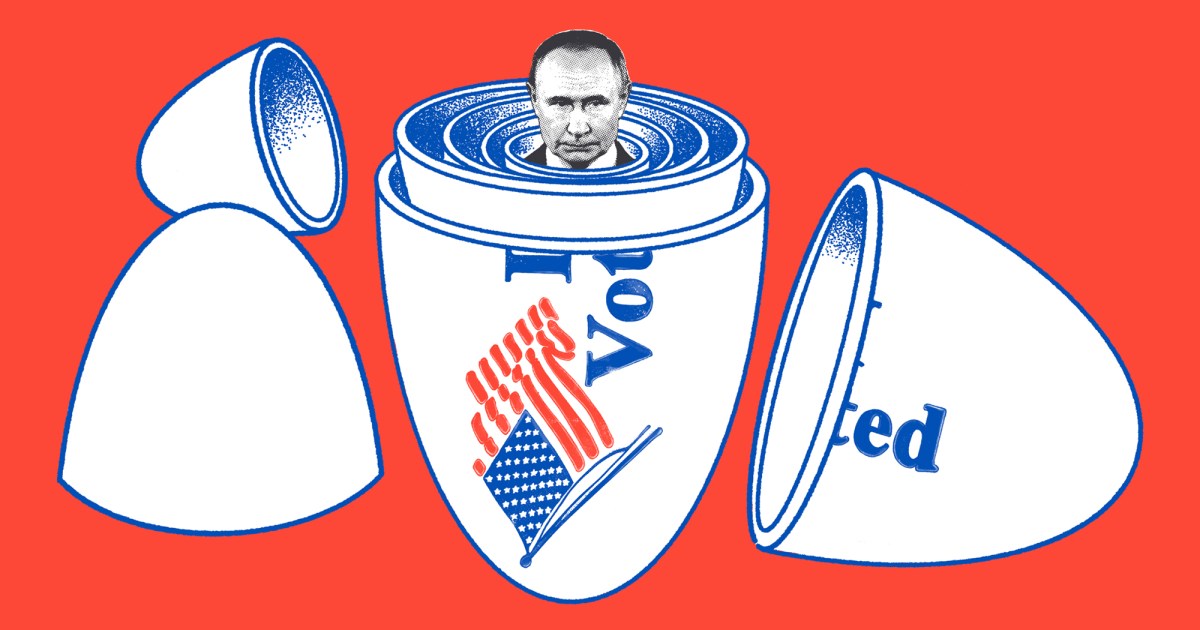
Will Putin’s Decade-Long War on US Elections Hit the Midterms?
Full Article
Original Source
Read the full article at Motherjones →KhanList aggregates and links to publicly available news content. We do not host full articles from third-party sources. Always verify important information with original sources.