
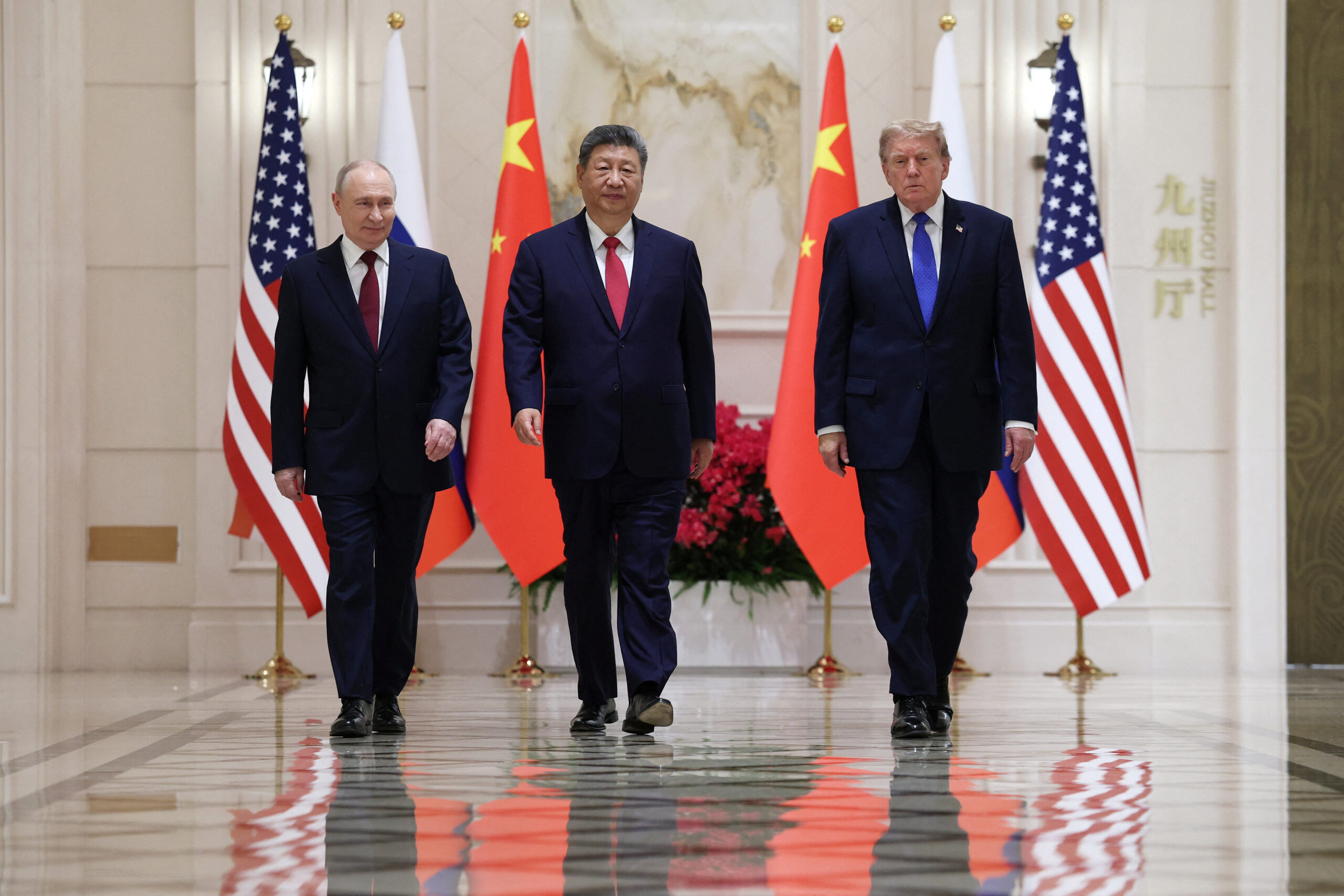
When this week’s trilateral meeting between the leaders of China, the United States, and Russia was first announced, commentators with an eye for history were soon asking whether the Shenzhen summit was going to be a second Yalta. The original Yalta was a conference held towards the end of World War II that brought together Joseph Stalin, Winston Churchill, and Franklin Roosvelt to decide the fate of Europe once Nazi Germany was defeated. Yalta was followed by the Potsdam Conference shortly after Germany’s surrender, leading to further agreement on the postwar territorial disposition of the European continent. As a result of these summits, Russia’s imperial grasp became far greater than at any time in its history and included substantial control over the countries of Eastern and Central Europe. This arrangement was to a large extent driven by the presence of more than a million Soviet troops in these territories. Putin famously stated early in his long tenure as Russian president that the greatest geopolitical tragedy of the twentieth century was the fall of the Soviet Union. Like many other Russian imperialists, Putin has long yearned for the return of Kremlin control over the lands it once ruled. The war against Ukraine is designed to reestablish control over a nation and territory that were formerly critical to the sustenance of the Russian and Soviet empires. But as Putin made clear on the eve of the full-scale invasion in a late 2021 memo to NATO, he also wants the return of the boundaries between NATO and Russian-controlled areas that existed at the end of the Cold War. Stay updated As the world watches the Russian invasion of Ukraine unfold, UkraineAlert delivers the best Atlantic Council expert insight and analysis on Ukraine twice a week directly to your inbox. Putin has had a hard time taking control of Ukraine. The Russian military made substantial gains in the first few months of the full-scale invasion but could not take Kyiv or control any other major Ukrainian cities for long. By the early fall of 2022, a Ukrainian counteroffensive had liberated over half of the territory seized by Russian forces during Putin’s initial blitzkrieg. Since then, Russia has been unable to capture all of eastern Ukraine’s Donbas region, even though Putin “annexed” it in September 2022. And this year, with the extraordinary development of Ukraine’s defense industries and domestic drone production, Russia has made virtually no advances on the battlefield despite suffering horrendous casualties. Meanwhile, Russian occupation forces have been subject to a punishing Ukrainian drone campaign that has isolated Crimea for resupply purposes. In parallel, an escalating strategic bombing campaign led by long-range Ukrainian drones has reportedly destroyed almost 50 percent of Russia’s oil refining capacity in the past few weeks alone, putting new pressure on the Russian economy. With Russian generals feeding him false information, Putin still thinks he is making gains on the battlefield. However, his main strategy for winning the war is to persuade Ukraine’s Western supporters to end their assistance to Kyiv. While Putin has high hopes for the French elections next year and for a further weakening of Merz’s position in Germany, his main focus has been to undermine American support for Ukraine. In many ways, Putin has proved to be a dreadful strategist. But like any former KGB official, he knows how to read people. This helps to explain his strategy today, which could be described as a Trump psyop: Putin’s aim is to influence the American president through the strategic use of communication and information. Eurasia Center events Trump came into office with two instincts on the war. The first was good for the US, which was to achieve a stable end to the war based on the current front lines, leaving Ukraine sovereign and secure. This approach would have left Russia in de facto control of substantial Ukrainian territory. Trump offered numerous proposals to achieve this outcome, with Ukrainian President Volodymyr Zelenskyy finding ways to say yes to each one. In contrast, Putin either deflected or rejected every new proposal. At times since President Trump returned to the White House, he has put at least some pressure on the Kremlin for rejecting peace. However, his other instinct is a certain deference toward Putin, for whatever reason. This has consistently moderated his impulse to pressure the side rejecting peace, and has led to unjustified pressure on the victim of aggression. Putin has been working assiduously to ensure that Trump’s deference to him became the driver of American policy. For example, unlike Zelenskyy, Putin has personally never criticized Trump, which is smart tactically. Putin’s constant attention to Trump, both through his own direct contacts and via Kirill Dmitriev as a personal emissary to US Special Envoys Jared Kushner and Steve Witkoff, has begun to bear serious fruit over the past six weeks. It began on October 9 when Trump moved against US sanctions policy to purchase Russian diesel fuel, which he justified as necessary for American farmers ahead of the US midterm elections. When Zelenskyy criticized this step, Trump responded harshly, stating that Ukraine should cease strikes on Russian refineries, even though this is one of the most effective instruments Zelenskyy has to weaken Russian aggression and protect his people. Zelenskyy’s reluctance to comply led to further problems in the provision of capabilities like Starlink and Starshield. Trump then gave Putin yet another concession when he waived all the sanctions in the Lindsey O. Graham Sanctioning Russia and Iran Act that he had signed weeks earlier. Finally, Trump agreed to Putin’s suggestion that the two leaders meet with Xi Jinping in a trilateral in China to discuss global issues. Trump initially said the meeting would focus on de-nuclearization, where the US has a major interest in bringing China into an arms control arrangement. He then also agreed to include Ukraine on the agenda. The three parties met on November 19. A statement was then issued by the Russian side reflecting the leaders’ views that they should work together to ensure greater production of oil for all global consumers. We cannot say for certain at present, but this seems designed for Trump to go back to Ukraine and insist that they stop striking refineries. This would be an enormous new gift to the Kremlin. To put the cherry on top, on the ride back from China, Trump reportedly called into a meeting in Berlin of Ukraine’s Coalition of the Willing allies and criticized the provision of arms and funding by these countries to Ukraine. The White House has denied these reports, which several European officials have made on background. We know that the current Russian position in negotiations with Ukraine includes the handover of additional Ukrainian territory. But with the acquiescence of the Trump administration, Russia has also recently raised the broader issue of Europe’s security architecture and demanded that NATO return to its 1997 borders. This would leave all NATO members in Central and Eastern Europe subject to Russian intimidation. Putin is clearly hoping that President Trump will continue to take further steps to accommodate his demands. If he succeeds, Putin may yet prove to be a magician who has achieved, principally by a psyop, what required millions of Soviet soldiers more than eighty years ago. John Herbst is the senior director of the Atlantic Council’s Eurasia Center and a former US ambassador to Ukraine. Further reading The views expressed in UkraineAlert are solely those of the authors and do not necessarily reflect the views of the Atlantic Council, its staff, or its supporters. The Eurasia Center’s mission is to enhance transatlantic cooperation in promoting stability, democratic values, and prosperity in Eurasia, from Eastern Europe and Turkey in the West to the Caucasus, Russia, and Central Asia in the East. Follow us on social media and support our work Image: US President Donald Trump, Chinese President Xi Jinping, and Russian President Vladimir Putin arrive for a trilateral meeting at Kylin Villa on November 19, 2026 in Shenzhen, China. The three leaders are meeting on the sidelines of the 33rd Asia-Pacific Economic Cooperation (APEC) Economic Leaders' Meeting hosted by China on November 18-19. (Win McNamee/Pool via REUTERS)
Will Putin achieve by guile what Stalin achieved with millions of troops?
Full Article
Original Source
Read the full article at Atlanticcouncil →KhanList aggregates and links to publicly available news content. We do not host full articles from third-party sources. Always verify important information with original sources.