
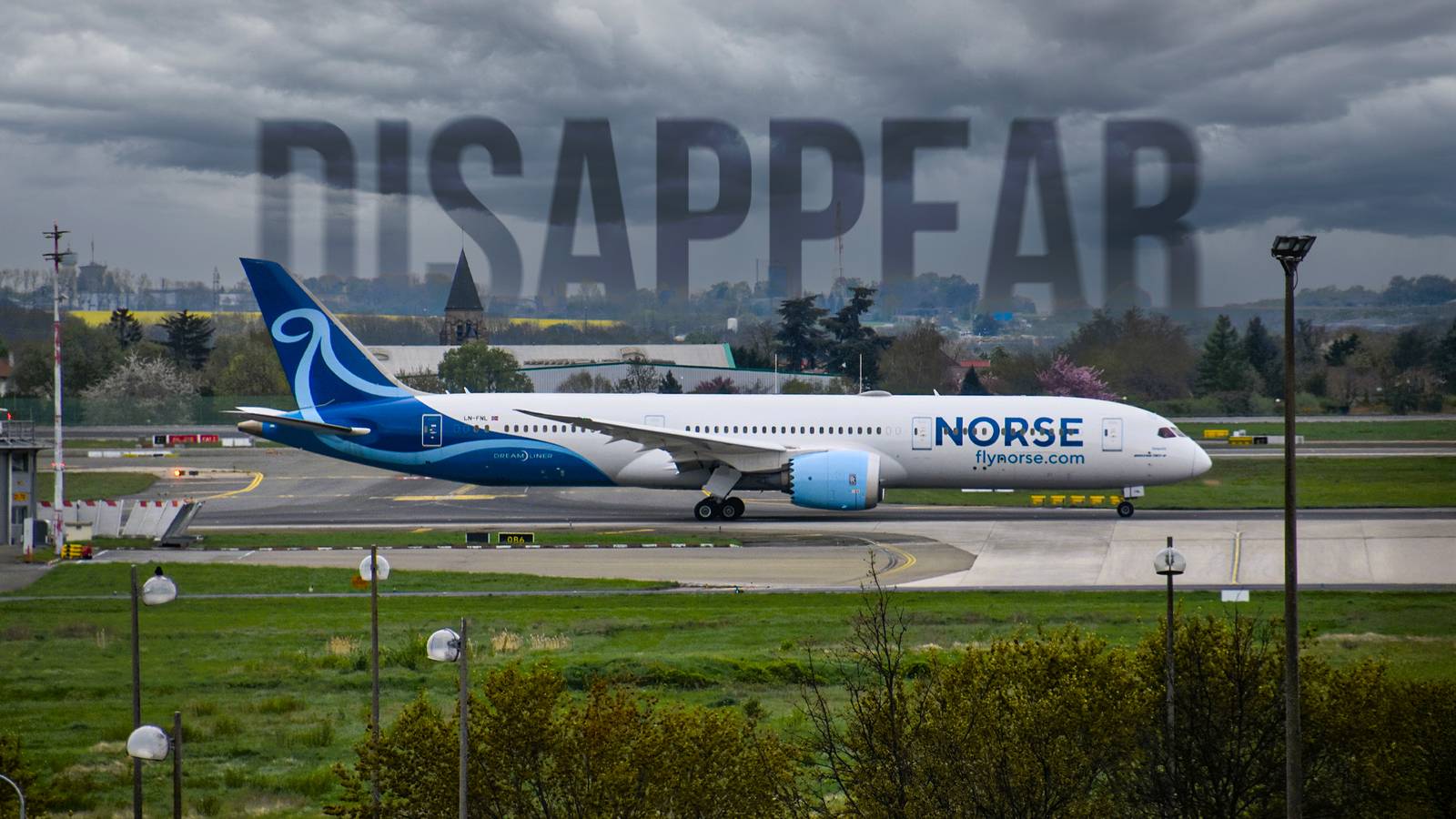
Published Sep 25, 2026, 3:04 PM EDT Based in Maastricht, the Netherlands, Nick joined Simple Flying in October 2025 and has a strong passion for travel and tourism, and in particular, the aviation industry, for as long as he can remember. Nick's focus is on aviation economics, airline strategy, and digital innovation. Before joining Simple Flying, he gained industry experience in ground handling and in a leading European airline group. Academically, Nick holds a Bachelor's degree in Aviation Management and is currently pursuing a Master's degree in Strategy & Innovation. Norse Atlantic Airways' share price has fallen by almost 98% since April 28, 2023. This sharp decline is perhaps unsurprising considering some of the operational results reported by the Norwegian carrier. For the second quarter of 2026, Norse reported a terrible operating margin of -21% despite achieving an excellent 94% load factor across its own network. This actually exceeded the roughly 84% average worldwide load factor reported by the International Air Transport Association ( IATA) for the same period. These results appear to make Norse another case study alongside carriers such as Norwegian Air Shuttle and WOW Air, highlighting the structural challenges of the low-cost long-haul business model and its apparent inability to succeed. Consequently, Norse Atlantic Airways' scheduled low-cost long-haul operations may soon be heading to the graveyard as well, with the airline already having drastically slashed its network, shifted a large share of its capacity toward ACMI operations, and started a formal process that could result in a sale or merger. Why Is Norse Atlantic Airways Struggling? Credit: Norse Atlantic Airways Regardless of the exact business model an airline uses, one of the most important commercial challenges is finding a satisfactory balance between yield and load factor. In simple terms, an airline can fill more seats by offering lower prices, but it still needs to charge enough to cover the cost of operating the flight. For anyone who has taken an economics class, this closely resembles the basic relationship between supply, demand, and price. This basic relationship is also where the low-cost long-haul model starts to break down. Traditional long-haul airlines can generate a disproportionate share of revenue from premium cabins, allowing them to sell many economy class seats at relatively competitive fares without destroying the economics of the flight. Norse does not have that same cushion. With most of its capacity concentrated in economy class and only a relatively small premium cabin at the front of the aircraft, the airline must extract far more revenue from price-sensitive passengers while still competing against carriers that can subsidize lower economy fares with significantly higher premium revenues. Norse's second-quarter results showed a 20% increase in revenue per passenger year-over-year to $447. However, Norse's Cost per Available Seat Kilometer (CASK) also grew substantially from 4.85 cents in the second quarter of 2025 to 8.23 cents one year later. This meant that every available seat kilometer cost considerably more to produce than the revenue it generated, despite Norse achieving both high load factors and record unit revenues. This gap between revenue and costs, rather than an inability to attract passengers, helps explain why the airline continues to lose money. Can Long-Haul Flights Even Be "Low-Cost"? Credit: Norse Atlantic Airways When moving to the cost side of the profit equation, things do not get much better. Traditional low-cost carriers have built much of their advantage by stripping out inefficiencies and unnecessary costs surrounding the actual flight. For low-cost long-haul airlines, however, there is considerably less room to do this. Crew scheduling becomes more complicated because of longer sectors, time zones, and mandatory rest requirements, while the efficient smaller secondary airports favored by short-haul low-cost carriers are often simply not viable for long-haul operations. Perhaps even more importantly, long-haul airlines have far less freedom to maximize aircraft utilization. Short-haul low-cost carriers can schedule multiple rotations per aircraft each day and build schedules around maximizing daily aircraft utilization, while long-haul operations are constrained by time zones, longer turnaround times, airport curfews, and dependence on slots at large and often congested hubs. Norse Atlantic Airways Q2 '25 vs Q2 '26 Norse Own Network Q2 2026 Q2 2025 Change Load factor 94% 96% -2 pts Revenue per passenger $447 $372 +20% TRASK 6.15 cents 5.01 cents +23% CASK 8.23 cents 4.85 cents +70% CASK excluding fuel 5.37 cents 3.41 cents +57% Source: Norse Atlantic Airways Q2 2026 report A widebody aircraft can therefore spend considerably more time sitting on the ground between revenue-generating flights, weakening one of the most important advantages that has traditionally allowed low-cost airlines to keep unit costs below those of their full-service competitors. At the same time, fuel is one of the highest operating costs and is largely unavoidable regardless of whether an airline markets itself as low-cost or full-service. On long-haul flights, these unavoidable flying costs make up a greater share of the overall cost base, meaning savings from removing complimentary catering, reducing airport staffing, or automating check-in only go so far. When also considering the added complexity and cost of operating widebody aircraft, combined with the relatively limited number of markets large enough to support them without substantial connecting traffic, it becomes increasingly difficult to understand why anyone is still brave enough to attempt operating an independent low-cost long-haul airline. Why Is Norse Shifting Toward ACMI? Credit: Norse Atlantic Airways Similar to how Icelandic low-cost carrier PLAY Airlines and others such as airBaltic increasingly turned toward ACMI in an effort to overcome their financial challenges, Norse Atlantic Airways is now following the same playbook. For airlines, this model can provide a solution because it removes much of the commercial risk of selling hundreds of seats on every flight itself while generating relatively stable revenue. However, this does not suddenly make operating a Boeing 787 cheap or less complex, but it does remove much of the uncertainty surrounding whether an airline can do so profitably. The customer airline takes responsibility for selling the seats, while the operator can focus on operating the aircraft and generating more predictable revenue from an asset it is already committed to leasing. For Norse, the shift toward ACMI and charter operations appears worthwhile. In the second quarter of 2026, Norse's own-network production was 64% lower than one year earlier, while ACMI and charter production increased more than eightfold. Revenue from the latter business consequently jumped from just $6.1 million to $45 million, with six of its 12 aircraft deployed in ACMI operations during the quarter. There is, however, one significant complication as Norse's major ACMI agreement with IndiGo is ending in November 2026, meaning the aircraft currently committed to the Indian carrier will once again need somewhere to fly. Norse says these aircraft can be redeployed across its own network, charters, and future ACMI contracts. Nevertheless, that flexibility also creates an interesting question for the airline's cheap transatlantic flights. If Norse can generate more attractive and predictable returns by flying its Dreamliners for other airlines, its own scheduled network increasingly has to justify why those aircraft should remain there. What Is Left Of Norse's Scheduled Network? Credit: Norse Atlantic Airways The consequences of Norse's strategic shift into ACMI are already clearly visible across its route network. In its third-quarter 2025 report, then-CEO and founder Bjørn Tore Larsen made clear that the airline would become much more selective about where it deployed its aircraft: “Next summer, we have a focused program between Europe and the U.S., based on routes with proven strong demand and higher ticket prices.” During peak summer 2025, Norse operated 12 transatlantic routes between Europe and the US. One year later, only four remained: Athens (ATH) - New York JFK Airport (JFK), Rome Fiumicino Airport (FCO) - JFK, London Gatwick Airport (LGW) - JFK, and LGW - Orlando International Airport (MCO). Oslo Gardermoen Airport (OSL) - JFK, the route on which Norse launched operations in June 2022, disappeared in September 2025, leaving the Norwegian airline without any scheduled transatlantic flights from its home country. Berlin Brandenburg Airport (BER) - JFK, Paris Charles De Gaulle Airport (CDG) - JFK, and LGW - Miami International Airport (MIA) also disappeared. The planned summer 2026 services from Los Angeles International Airport (LAX) to LGW, CDG, and FCO were ultimately scrapped as well, marking Norse's withdrawal from the US West Coast. Instead, the airline has increasingly turned toward long-haul leisure markets in Thailand and South Africa, particularly during the European winter. For winter 2026/27, Norse is increasing OSL and Stockholm Arlanda Airport (ARN) flights to Bangkok Suvarnabhumi Airport (BKK) to as many as five weekly services. Moreover, the carrier serves up to two weekly flights from both cities to Phuket International Airport (HKT), launching LGW - HKT three times weekly, and increasing Manchester Airport (MAN) - BKK to four weekly flights. LGW - BKK and Cape Town International Airport (CPT) will also continue throughout winter. Norse previously stated its Europe-Thailand operation received a strong response during the 2025/26 winter, while its first-quarter 2026 results specifically highlighted increased demand for point-to-point travel between Europe, Asia, and South Africa. The airline has also acknowledged that future capacity could shift away from the transatlantic market toward destinations with stronger growth and less competition. What's Next For Norse Atlantic Airways? Credit: Norse Atlantic Airways Norse Atlantic Airways increasingly appears willing to move its Boeing 787s to whichever markets or contracts offer the strongest returns, whether that means flying sun-seeking passengers to Thailand and South Africa during the winter or operating aircraft on behalf of another airline such as IndiGo. Earlier this year, the airline's CEO Eivind Roald stated the following: “We are working to make Norse profitable, which means securing higher unit revenue while also being agile and disciplined on capacity. This includes proactively reducing activity in our own network in softer periods and shifting capacity to ACMI and charter.” It is certain that the scheduled network that defined the airline at launch is already considerably smaller than it once was, and the airline's own network increasingly appears to be evolving from a primarily transatlantic airline into something closer to a seasonal long-haul leisure carrier. Moreover, scheduled flying seems to have become only one possible use for its 787 fleet rather than the company's core business model. There is also the considerably larger question of whether Norse will remain independent at all. The airline launched a formal strategic review in July that could result in a sale, merger, strategic partnership, or other transaction, meaning the future shape of the carrier may ultimately be decided by a new owner or partner rather than Norse alone. At the same time, Norse is still under considerable financial pressure, and earlier this year, the airline raised fresh capital and launched a major cost-cutting program aimed at reducing annual expenses by up to $50 million. Despite this, the company may still hold considerable value for a potential buyer, as its 12 Boeing 787-9s are leased at rates Norse says are significantly below current market levels. Cheap transatlantic flights might therefore not disappear overnight, but the airline built around providing them is clearly becoming something very different. The real question may no longer be whether Norse can make low-cost long-haul flying work, but how much of that original model will remain once the airline finally finds a sustainable way to make money.
Will Norse Atlantic's Cheap Transatlantic Flights Soon Disappear?
Full Article
Original Source
Read the full article at Simpleflying →KhanList aggregates and links to publicly available news content. We do not host full articles from third-party sources. Always verify important information with original sources.