
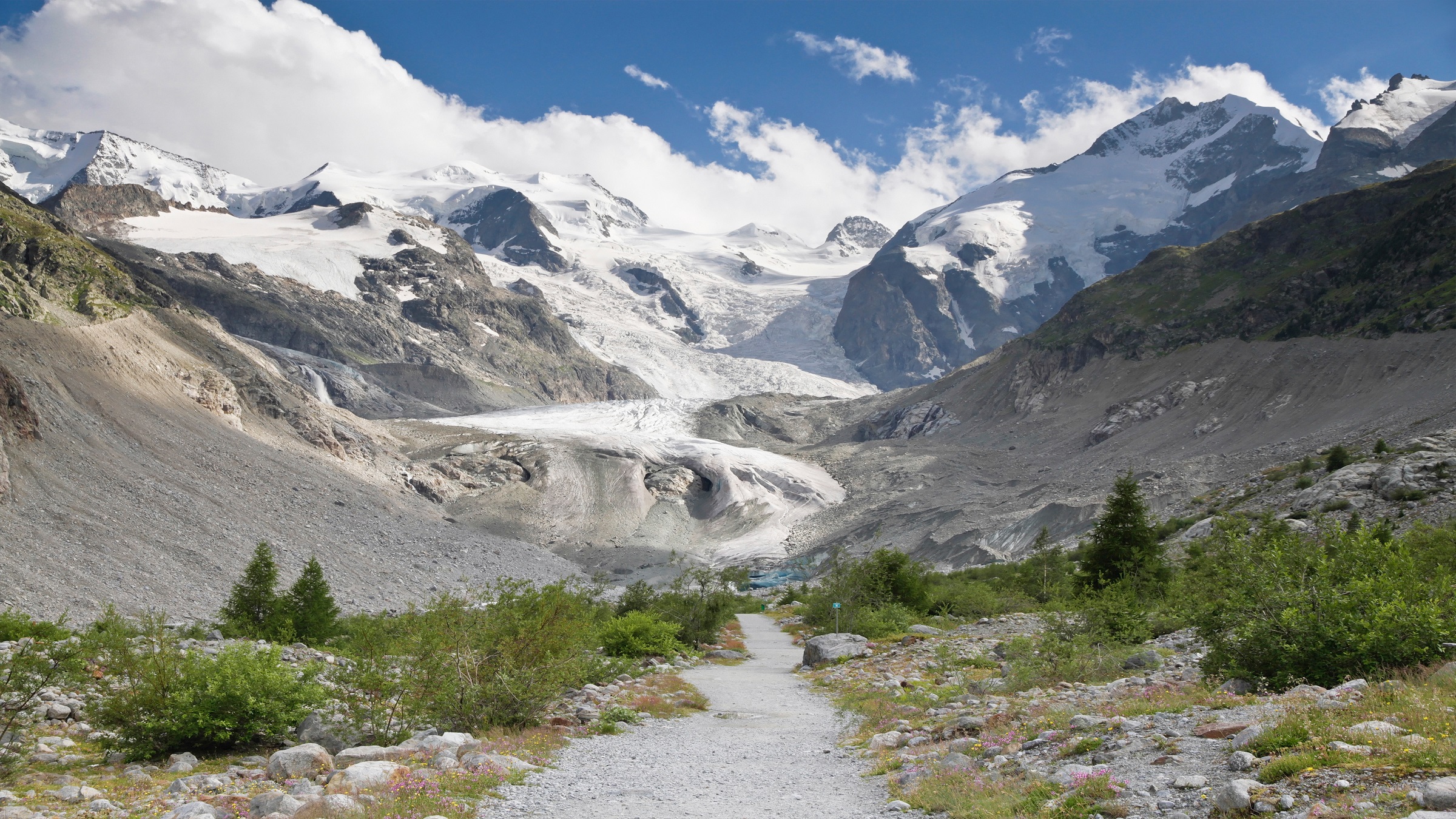
The Global Glacier Extinction Explorer is a platform that maps the world’s glaciers and projects when they’ll disappear under various global warming scenarios.The findings are bleak: even under the best-case scenario, “we will lose half of the glaciers on Earth,” says map developer Lander Van Tricht.Van Tricht and his colleagues developed the tool to help make science accessible to the general public and to provide information to communities that live in close proximity to glaciers. In mid-October, Lander Van Tricht received a message from a woman. She had visited a glacier when she was 10 years old and, according to a tool that Van Tricht had developed, that same glacier was now expected to go extinct in less than 40 years. Instances of public engagement like these were exactly what Van Tricht says he wished for while developing the tool. “What I really hoped was that scientific results are shared beyond the academic world,” Van Tricht, a postdoctoral researcher at ETH Zürich and Vrije Universiteit in Brussels, told Mongabay in a video interview. The Global Glacier Extinction Explorer is an interactive platform that allows people to zoom in on glaciers on a map and find out how they’re faring in the face of global warming. The tool is based on the findings from a 2026 study, published in the journal Nature, that looked at the disappearance of individual glaciers. The findings from the study, on which Van Tricht was the lead author, are dire. They show that even in a world where warming is limited to 1.5° Celsius (2.7° Fahrenheit) above the pre-industrial baseline, half of Earth’s glaciers will be lost. “I was surprised by how fast everything is happening,” Van Tricht says. He adds he hopes the tool will help translate the science to the general public, and also help communities around the world prepare for scenarios where glaciers go extinct. “Communities, cities and people have to prepare themselves for a future without glaciers, he says. “For them, it’s super important to know how long a glacier they rely on will still be there.” Lander Van Tricht spoke with Mongabay’s Abhishyant Kidangoor about the motivation behind building the Global Glacier Extinction Explorer, the findings that left him surprised, and what he hopes will come out of the tool. The following interview has been lightly edited for length and clarity. Lander Van Tricht, pictured above, developed the Global Glacier Extinction Explorer to make research about glaciers more accessible and relatable to the general public. Image courtesy of Lander Van Tricht. Mongabay: How would you describe the Global Glacier Extinction Explorer to someone who hasn’t heard about it before? Lander Van Tricht: We know glaciers are losing mass. They’re getting smaller, and many of them are just disappearing. They’re becoming too small and we don’t consider those as glaciers anymore, but as extinct glaciers. The Global Glacier Extinction Explorer allows people to zoom in into every individual glacier on Earth, click on it, and see when it will disappear or if it will survive beyond the end of the century. Mongabay: What’s the backstory behind this tool? What was your motivation behind doing this? Lander Van Tricht: In scientific research, we typically publish in journals. By doing this, we try to reach an audience and get our main results into climate reports. That’s always what we hope for. But it’s very difficult to really reach [a] general audience. My colleagues and I had a feeling that we have to try to put more effort into reaching everyone. For this, we needed to think about visualization and ways to communicate. The goal of this tool was really to translate the scientific findings into an easy, accessible format where everyone can really go and find out the results. Mongabay: Why is doing this more important now than ever before? Lander Van Tricht: People are witnessing the impacts of climate change on glaciers. If you’re in the mountains and you see a glacier today and you know how it was before, you’re really confronted by these changes. For a general audience, it’s important to know about these changes. How fast are they happening? When will a glacier disappear? On the other hand, communities, cities and people have to prepare themselves for a future without glaciers. For them, it’s super important to know how long a glacier they rely on will still be there. Imagine a valley with one glacier, which is very important as a tourism attractor. Do they need to have investments in tourism infrastructure, or is it not worth it because the glacier will disappear in five years? This community can look up the results and see how long the glacier will be there. Same for ski resorts. Do they need to invest in ski infrastructure, or is it not worth it? On the other hand, for people that rely on glacier runoff and water provided by glaciers, they need to know long this will be possible or when the glacier will disappear and not provide water anymore. So it’s really for communities, cities and countries to use the results to prepare for the future. Mongabay: The tool is based on a recent study of yours. If you were to highlight the findings from the study, how would you do it? Lander Van Tricht: One big highlight is that even in a 1.5° warming scenario, which is very positive, we will lose half of the glaciers on Earth. This is a huge number and, in fact, the decision on losing these glaciers is already made. We cannot do anything about them anymore. In many mountain ranges with small glaciers, like the Alps and Caucasus, even in a 2.7°[C, or 4.9°F] scenario, which is the scenario where we seem to head to, almost all glaciers disappear in these mountain ranges. So there is almost no future anymore for glaciers in these mountain ranges because they are very sensitive. The loss trajectory has already started. These mountain ranges will just completely “de-glacierize” in any case. As a third point, in the high-latitude regions — like the Russian Arctic, Svalbard, on the periphery of Greenland — we still have a lot of big glaciers. Even there, in the second half of the century, they will start to lose individual glaciers. These regions that seem healthy today will start to see extinction of glaciers in the future. Mongabay: Were you surprised at all by what you found? What stood out to you? Lander Van Tricht: I was mainly surprised by how fast everything is happening. I’ve done a lot of glacier simulations in the past. With these, we looked at glacier volume and glacier area, which matter for sea level rise. But so far, we never looked into individual glaciers. I think with this metric with the individual number of glaciers, it’s even more striking how fast everything is going. I’m most familiar with glaciers in the Alps and in Europe. For example, in the Pyrenees, there are [about] 15 glaciers left today, and in around 10-15 years, all these glaciers disappear. So that’s something that is very clear from our Extinction Explorer — that these mountain ranges [will become] completely glacier-free. Aletsch Glacier is the biggest glacier in the Alps. I would say it is the holy grail of glaciers in Europe. Even that glacier, which contains like 15 cubic kilometers [3.6 cubic miles] of ice today, could disappear before the end of the century in a 4°[C, or 7.2°F] warming world. So even the most famous and biggest glaciers that seem invincible can go extinct within the next 75 years. That’s something that is now super clear by zooming over the map, clicking on glaciers, and seeing these numbers in practice. Pictured above, a screengrab from the Global Glacier Extinction Explorer zoomed in on the Aletschorn mountain range in the Swiss Alps which houses the Aletsch Glacier. The glacier is projected to go extinct in 2063 in a 2° warming scenario. Image via the Global Glacier Extinction Explorer. Mongabay: For someone who is looking at the Extinction Explorer, how can they use it and what will they see? Lander Van Tricht: You have a world map, and every glacier, as it was mapped in the early 2000s, is colored. The color gives an indication of when that glacier could disappear. More orange and red means it will disappear earlier. More bluish means it will disappear later or it will still be alive at the end of the century, even though it will be in a smaller state and it might get extinct in the 22nd century. You can scroll over the entire world, zoom into individual glaciers and if you click on a glacier, then you get the extinction years for four different warming levels: 1.5, 2, 2.7, and 4° warming levels, which are the scenarios typically also used by the IPCC [Intergovernmental Panel on Climate Change]. One-point-five degrees is the Paris Agreement. Two degrees is also written in the Paris Agreement. Two-point-seven degrees is the scenario where we seem to be headed based on the current policy. Four degrees is the most pessimistic scenario. You could zoom into every glacier on Earth, click on it, and then see the extinction year for that specific glacier in these four different scenarios. Mongabay: How do you hope this information will translate into impact on the ground? Lander Van Tricht: I hope that as many people as possible will share it and use it for decisions in the future. A nice example is I got a message from someone who wrote a whole blog post about how she was on a glacier for the first time when she was 10 years, and now she saw that glacier will disappear in 2063. It’s nice that I don’t have to actively share the tool now. People just discovered it by themselves. That’s what I really hoped: that the scientific results are shared beyond the academic world. Eventually, I hope communities, cities and villages can really use it for their future development. Mongabay: What more do we need to do to slow down glacier loss? What gives you hope? And what scares you the most? Lander Van Tricht: The only way to save glaciers is to limit global warming. In a 1.5° warming scenario, we keep 400 glaciers in the Alps. In 4° warming, we keep only 20 glaciers. The lower the warming levels, the more glaciers we can save. The only way to really save individual glaciers is to stop greenhouse gas emissions as soon as possible to stabilize global warming. There are other ways that work very locally. For example, putting geotextiles on glaciers. But these methods are very expensive. They’re also polluting the environment. So typically, they’re only used in touristic environments like in ski resorts. When I just look around, I see positive evolutions in terms of sustainability in green energy. There are some positive tendencies, and I hope these will continue and will stabilize global warming. Banner image: A hiking trail leading towards Morteratsch Glacier in Graubünden, Switzerland in July 2012. Image by Ximonic (Simo Räsänen) via Wikimedia Commons (CC BY-SA 3.0). Abhishyant Kidangoor is a staff writer at Mongabay. Find him on 𝕏 @AbhishyantPK. Citation: Van Tricht, L., Zekollari, H., Huss, M., Rounce, D. R., Schuster, L., Aguayo, R., … Farinotti, D. (2026). Peak glacier extinction in the mid-twenty-first century. Nature Climate Change, 16, 143-147. doi:10.1038/s41558-025-02513-9 Credits Topics
Will my glacier go extinct? Interview with Lander Van Tricht
Full Article
Original Source
Read the full article at News →KhanList aggregates and links to publicly available news content. We do not host full articles from third-party sources. Always verify important information with original sources.