
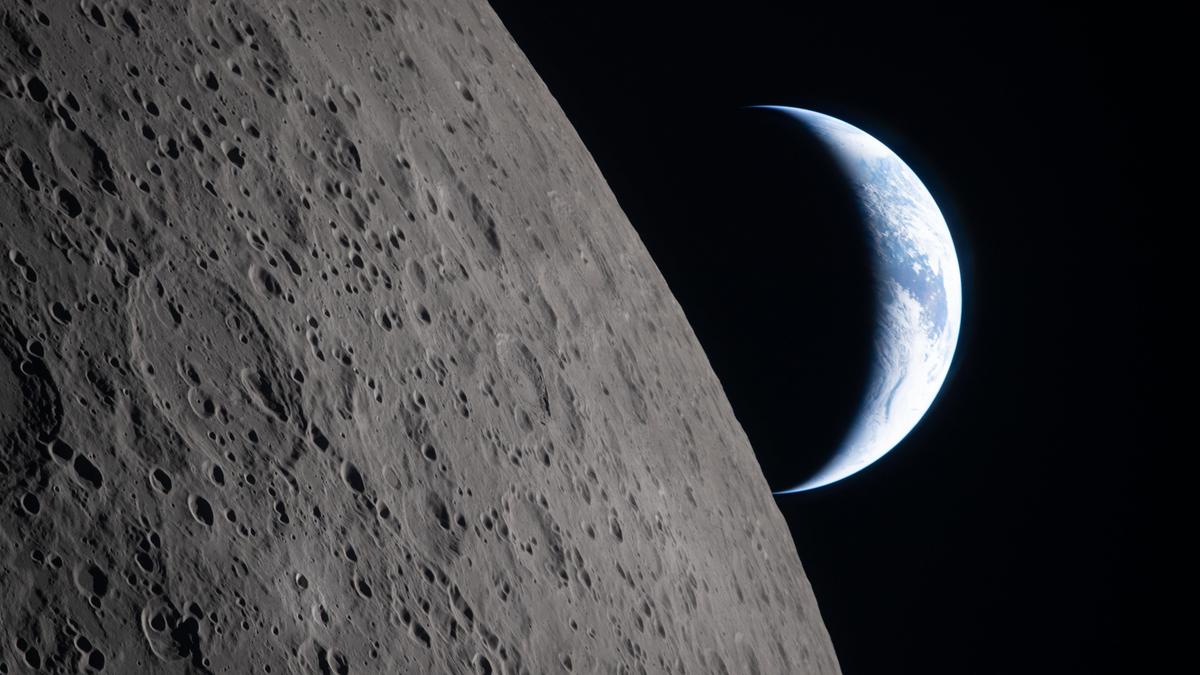
A year after the launch of the NASA-ISRO Synthetic Aperture Radar (NISAR) mission and the Axiom-4 mission that sent astronaut-candidate Group Captain Shubhanshu Shukla to the International Space Station, the U.S. space agency has formally extended an invitation to India to join its ambitious ‘Moon Base’ programme under the Artemis Accords.At the ninth meeting of the India-U.S. Civil Space Joint Working Group in Bengaluru, NASA invited the Indian Space Research Organisation (ISRO) to be part of this programme, through which it is looking to establish a lunar outpost — potentially the first of its kind where astronauts will make the moon’s south pole area their home, where they will live, work, and conduct scientific activities over the next decade, perhaps beyond.While ISRO has yet to take a call on being part of the Moon Base programme, the invitation extends the growing ties in the space sector between the two countries, especially under the Artemis Accords, to which India signed up in 2023. For ISRO, the invite offers a chance to be part of an international collaboration and gain exposure ahead of its Chandrayaan-4 and crewed moon missions.An important launchMoving on: After months of dilly-dallying, ISRO finally announced its second launch of the year, the GSLV-F17 mission carrying the EOS-05 earth observation satellite. The satellite will be India’s first imaging satellite stationed in the geosynchronous orbit.At the time of writing, its launch was scheduled to take place at around 3 am on September 4 from the Satish Dhawan Space Centre. Importantly, it will be ISRO’s first launch since the failure of the PSLV-C62 mission/EOS-N1 mission in January this year.ISRO also conducted the ground static test of an improved version of the solid booster stage (called SS1) of its Small Satellite Launch Vehicle at the Sriharikota spaceport. The stage is expected to enhance the rocket’s payload capability by around 100 kg to low-earth orbit.A distinguished engineIndia’s private space sector has been on a roll since Skyroot Aerospace’s Vikram-1 launch. It achieved another milestone as Bengaluru-based Astrobase Space Technologies unveiled India’s first privately built 800 kN full-flow staged combustion (FFSC) LOX-methane rocket engine, named ‘Everest’. If the engine successfully passes all its qualification tests, India will become only the fourth country in the world to have FFSC engine technology, which allows for cleaner launches.The other three countries with the technology are the usual suspects: Russia, the U.S., and China. It so happens that only three private sector entities have successfully developed the same technology, and they are in the U.S. and China: SpaceX and Stoke Space in the former and Land Space in the latter. And of them, SpaceX’s Raptor is the sole operational FFSC engine worldwide.A second portWith the Indian space economy set a target worth of $44 billion by 2033, the Indian National Space Promotion and Authorisation Centre (IN-SPACe) — the nodal regulator — has opened the door wider for private sector participation by issuing an ‘expression of interest’ (EoI) to operate and manage the Small-Satellite Launch Complex in Kulasekarapattinam, Tamil Nadu.The EoI proposes to hand over the aforementioned responsibilities to an Indian private firm and has invited responses from eligible Indian industries. SLC is the country’s second spaceport, after Sriharikota, and has primarily been developed to integrate and launch smaller launch vehicles, including the Small Satellite Launch Vehicle and the private Vikram-1 and Agnibaan, among others.This said, the Indian government’s privatisation drive has come in for criticism by the Congress party, especially by its general secretary (communication) Jairam Ramesh. In response, Union Minister of State Science and Technology Jitendra Singh said the country’s space programme was being scaled up, not scaled back.MOSAIC and SpaceOpsIn other private-sector news, Bengaluru-based space domain awareness and defence intelligence company Digantara unveiled ‘MOSAIC’, a distributed network of optical sensors, powered by artificial intelligence (AI), to provide continuous, real-time data of objects in low-earth orbit. Digantara has expressed hope that ‘MOSAIC’ will reduce India’s reliance on foreign commercial providers to track objects in orbit in a time-sensitive way during crucial missions, such as Operation Sindoor.Another space technology startup, GalaxEye, acquired spacecraft engineering company SpaceOps, including its proprietary technologies, qualified satellite platforms, and expertise in engineering deep-tech systems. SpaceOps also has an experienced engineering team, several of whose members previously worked at TeamIndus on the latter’s moon lander and rover.Unexpected findA new study published in Economics Letters has estimated that India spends more to put a kilogram of payload into orbit than any other major spacefaring nation. This claim has brought into question India’s reputation as an economical launch provider for satellites. Per the study, it cost Indian rockets $13,302 to send a kilogram to low-earth orbit in 2025 — higher than Europe ($9,897), Russia ($6,682), China ($5,809), Japan ($5,287), and the U.S. ($3,225). The global average was $3,868. The reason, the authors figured, was that India did not launch often enough to bring its costs down.Disputes about the study’s methods aside, the point about launch frequency is not misplaced: ISRO has undertaken 105 launches since the first experimental flight of its SLV-3 rocket in 1979. Since it launched the DLR-TUBSAT and KITSAT-3 satellites for Germany and South Korea respectively in 1999, ISRO has also launched 434 foreign satellites, with the last one being the American BlueBird Block-2 in December 2025. That said, as mentioned earlier, the September 4 launch will just be the second one of 2026.hemanth.cs@thehindu.co.in
Will ISRO be part of NASA’s moonshot?
Full Article
Original Source
Read the full article at Thehindu →KhanList aggregates and links to publicly available news content. We do not host full articles from third-party sources. Always verify important information with original sources.