
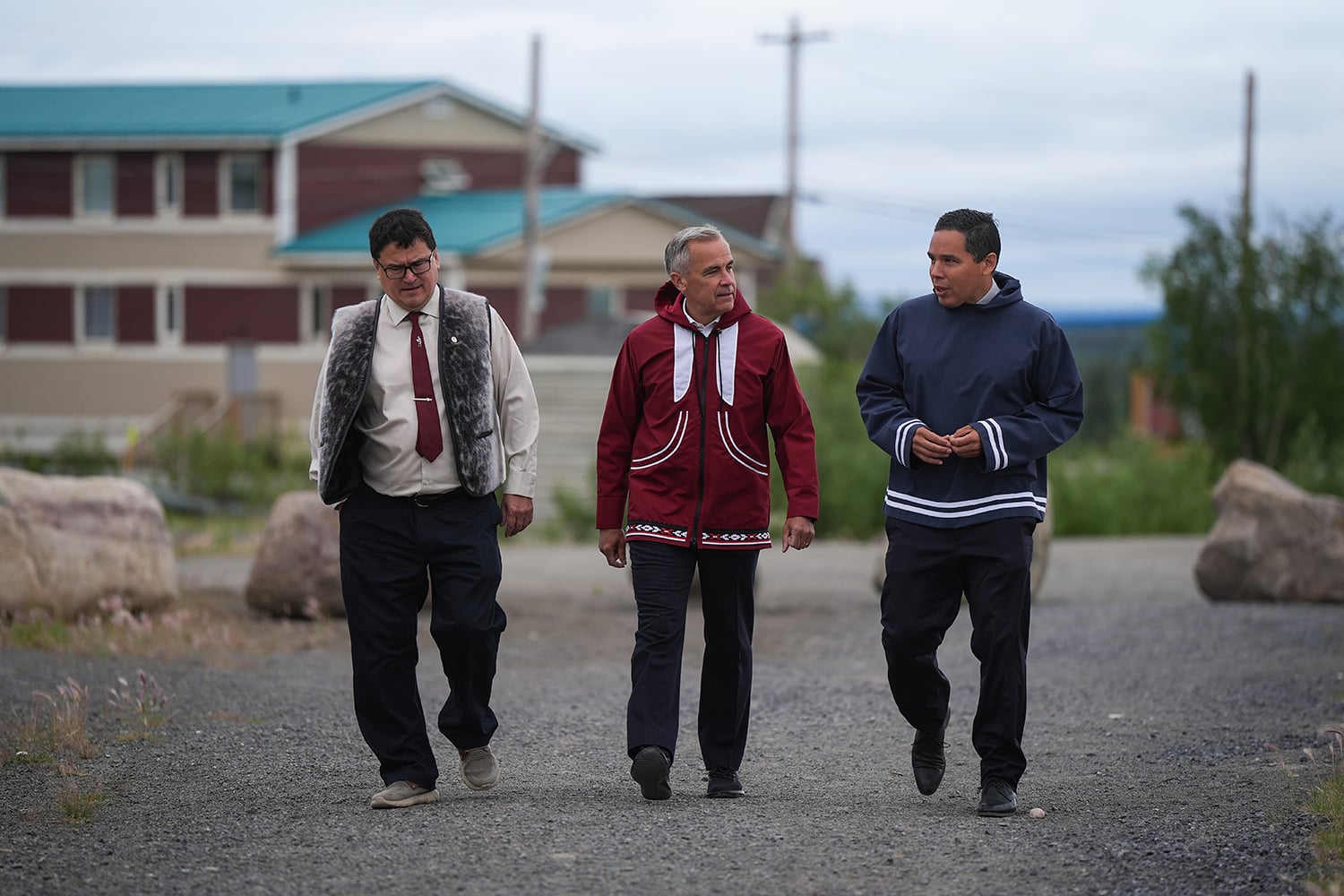
These days in Canada, all eyes are on the country’s west. Alberta is hurtling toward a controversial Oct. 19 independence referendum, with reported meddling by both U.S. influencers and Russian bot farms. In response, Ottawa is promising billions in new investments in the province’s fossil fuel industry despite Supreme Court judgements that the entire separatist campaign is likely unconstitutional—and polling suggesting that it will lose. But while this noisy sideshow distracts policymakers and pundits, a much more serious challenge to Canadian unity has arisen in the country’s far north, where the nation’s Inuit leadership has decried what one leader called “a very large shift” in the federal government’s dealings in the region. In the past few decades, modern treaties signed across Inuit Nunangat—the Inuit homeland that spans parts of Yukon, the Northwest Territories, Nunavut, Quebec, and Labrador—have affirmed the right for Inuit organizations to play a role in dictating resource and infrastructure developments across the region, which is home to vast strategic reserves of minerals used in green and military technologies. In some cases, that extends to outright ownership of the lands and resources in question; in others, treaties grant broad powers to reject developments that infringe upon traditional hunting and gathering activities. Under the leadership of former Prime Minister Justin Trudeau, treaty organizations such as Inuit Tapiriit Kanatami (ITK), the representative body for all Inuit in Canada, were often called upon for consultations—and respected for their views. When it came to funding for new initiatives, like food and childcare subsidies, regional Inuit organizations were often the federal government’s preferred partners over territorial governments. Inuit representatives could veto the expansion plans of billion-dollar corporations with little fear of federal intervention. But under Trudeau’s successor, Mark Carney, the federal government has changed tack. Inuit leaders have grumbled that Carney has been quicker to deal with territorial governments, which represent Inuit and non-Inuit alike—and often find corporate developments more palatable. When Ottawa in March announced a plan to invest $40 billion “to defend, build, and transform Canada’s Northern and Arctic region” via a series of massive, multiyear infrastructure projects, Inuit organizations were not invited to consult, according to Natan Obed, ITK’s president. “We are not an essential part of those conversations, even though they are in our homeland,” Obed said at a June summit on Arctic sovereignty held in Ottawa. The feeling has only been deepened by an ongoing devolution process, in which the federal government has begun passing responsibility for land, water, and mineral rights to territorial governments. Though presented by the federal government as deepening Inuit self-determination, critics have decried the devolution as colonial for transferring powers from one largely non-Indigenous government to another. “Since its creation [in 1999], the promise of a representative territorial government [in Nunavut] has not been fulfilled,” Kunuk Inutiq, an Inuit researcher, wrote in a 2022 brief for the Yellowhead Institute, an Indigenous research institute in Toronto. As a result, Inutiq argued, as much as 76 percent of public procurement money spent in Nunavut goes south. “Nunavut is still very much a colony; it is a place for others to generate wealth from our lands and resources and leave the scraps and waste for the Inuit,” she wrote. Similar dynamics play out in other regions of Inuit Nunangat: the Northwest Territories government is still staffed primarily by southern imports; Quebec has still never had an Inuit member of its provincial legislature. With these tensions rising, it’s no surprise that many Inuit are worried about their relationship with Canada. But at the June summit, Obed floated an idea not raised by Inuit leadership before: outside partnership. “If we are not going to be respected partners, then should we not be looking for other partners … to uphold our interests?” he said. Speaking as a representative for all of Canada’s Inuit treaty groups, Obed’s question carries some weight. “You might think he was toying with something akin to separatism,” read one editorial covering the remarks. “There are other Arctic actors, or people who wish to be greater Arctic actors, whether it be nation-states or corporations,” Obed later clarified to Foreign Policy. “It isn’t as if I was saying, ‘Let those actors in.’ But we should be able to consider the benefit to our homeland.” Inuit have no shortage of potential partners around the world. China has already demonstrated a keen interest in Arctic development. Beijing has partnered with Russia to establish a sizable and permanent presence along the Northern Sea Route and has been bidding aggressively for mineral rights across the north. In Greenland, China has invested more than $2 billion in mining projects and bid for control of major airports. It is estimated to have invested more than $90 billion in the Arctic overall, across Russia, Iceland, Greenland, Norway, and Finland. Looming behind Obed’s comments was the recent case of the Nunavut-based Hope Bay Gold Mine, whose purchase by a Chinese state-owned minerals company was blocked by the federal government on national security grounds in 2020. Inuit lobbied prominently for the purchase, which promised royalties and jobs. “Inuit have been discouraged from working with Chinese interests for natural resource extraction,” Obed told the Canadian Press—forced to watch investment opportunities go by, only to see Carney offer a détente with the country just years later. Federal tools such as the Investment Canada Act, which allows national security reviews of foreign corporate purchases such as Hope Bay, have so far stymied efforts by Chinese state-owned companies to gain a foothold in the Canadian Arctic, with the exception of a single mine in Nunavik. But experts say that won’t hold forever. “A lot of the risk has actually shifted to controlling [majority] ownerships” by Chinese shareholders, said P. Whitney Lackenbauer, a research chair in the study of the Canadian North at Trent University. Complex arrangements via shell corporations still enable money, benefits, decision-making, and critical information to flow up the chain to state-owned enterprises. The Izok Lake and High Lake deposits in Nunavut’s Kitikmeot region are an illustrative example. Technically owned by MMG Limited, a publicly traded company headquartered in Australia, its majority shareholder is the Chinese state-owned China Minmetals Corporation. The deposits have sat idle for many years, waiting for adequate infrastructure to bring their ores to tidewater. But after years of lobbying by the Kitikmeot Inuit Association, which stands to benefit from improved infrastructure and royalties, the federal government is now planning to fast-track a port and road to the region—at an estimated cost of $1 billion to Canadian taxpayers. The Hope Bay decision rankled some Inuit leaders, who noted that there are often few others willing to pick up the tab for expensive mineral developments in their homeland. “Chinese companies don’t function under the same type of challenges that Western companies do,” said Rob Huebert, a professor of political science at the University of Calgary and a frequent commentator on the north. While “most of the investors within Canada simply saw no opportunity in the north” to turn a profit, many Chinese companies can justify their existence in other ways, he said—including by granting a strategic edge to Beijing. Inuit are seeking investments beyond mineral developments, too. Across Inuit Nunangat, basic infrastructure lags behind that in other Arctic nations. Broadband internet, reliable power, and all-season roads are scarce in many communities. China can win friends by stepping in to fill gaps where Ottawa will not. A recent white paper on Arctic sovereignty from ITK underlined the issue: Inuit are “in the vulnerable and awkward position of being warned against accepting or soliciting needed investments from others without a clear alternative provided by Canada.” Inuit officials and intelligence analysts alike have warned that these shortcomings pose a security risk for the country at large. “Any number of foreign actors may seek to exploit the vast inequities … to assert their own interests,” the ITK white paper reads. On a recent podcast, Northwest Territories Premier R.J. Simpson acknowledged that Chinese officials have already approached local and Indigenous governments directly about building infrastructure. That has Canada’s security establishment on edge. Canada’s spy agency is already briefing Inuit leaders against allowing foreign investments in infrastructure. The Canadian military reportedly even gamed out a scenario where a Chinese warship entered the Northwest Passage and beamed free internet to remote communities in an effort to win their support and control their communications. Nor is China the only potential threat. The United States would likely have a far easier time than China securing footholds in Inuit Nunangat. Like Beijing, Washington disputes Canada’s control of the Northwest Passage, insisting that it is in international waters. A recent congressional review has already recommended direct investment in northern communities to secure U.S. dominance in the region. President Donald Trump already offered to send a hospital ship to Greenland, suggesting that Denmark was neglecting to provide healthcare for its residents. “Those tactics could be used in Inuit Nunangat as well,” Obed said. Obed’s comments have raised the specter that Inuit leadership could actively solicit foreign interference in the Canadian Arctic. How would Obed’s statements “be interpreted in Trump’s White House? Or how would this be interpreted in Xi’s inner circles?” Lackenbauer asked, referring to Chinese President Xi Jinping. “The world is looking, and the world is interested,” he said. Obed has tried to downplay his earlier remarks in subsequent appearances, telling press at a summit with Carney in the Arctic village of Kuujjuaq, Quebec, that he never wanted to raise the suggestion of separatism. The Carney government, too, has appeared eager to respond. At the summit in Kuujjuaq—the first by a prime minister in nearly 20 years—he announced renewed commitments to Inuit child welfare and efforts to eradicate tuberculosis, as well as accelerating accreditation of a new university in Inuit Nunangat. But so long as they appear to be working, analysts don’t expect threats such as Obed’s to go anywhere anytime soon. “There is a strong bond today between Canada and Inuit,” Obed told Foreign Policy. “But that doesn’t mean that those things hold. And it also doesn’t mean that foreign actors or political interference can’t drive a deep wedge in the feelings that Inuit have about Canada as a nation-state.”
Will Inuit in Canada Turn to China?
Full Article
Original Source
Read the full article at Foreignpolicy →KhanList aggregates and links to publicly available news content. We do not host full articles from third-party sources. Always verify important information with original sources.