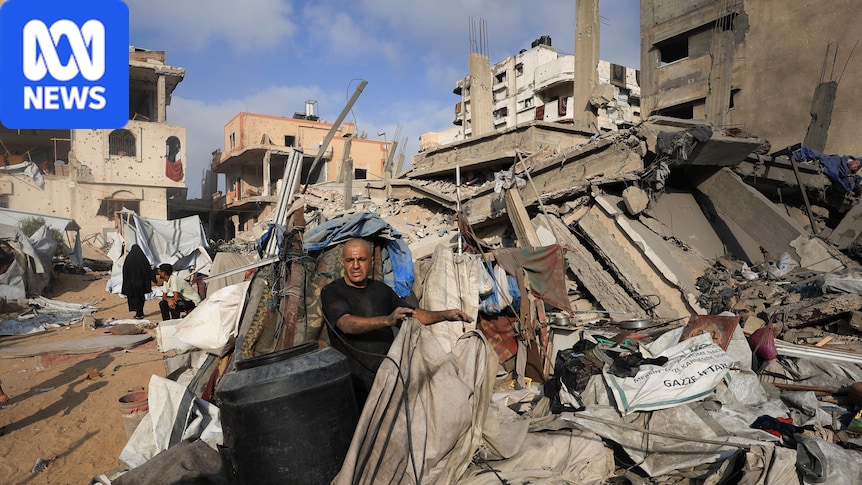
US President Donald Trump has announced what could be a "huge moment in Palestinian history" by declaring the complete disarmament of Hamas.He said the group relinquishing its weapons would be followed by Israel withdrawing from Gaza, more than half of which is under Israel Defense Forces (IDF) control."This is a monumental step toward lasting PEACE and SECURITY," Mr Trump wrote on social media.But several Middle East analysts told the ABC they were sceptical the paramilitary group would willingly lay down its arms, or that Israel would agree to totally withdraw from Gaza.Hamas, the governing authority in Gaza, which has been designated a terrorist group by several countries, including Australia, told news agency AFP "an agreement has been reached regarding the issue of weapons".Israel has yet to respond.Here's what we know about the agreement and why experts are sceptical it's a done deal.How did this come about?Let's briefly rewind to October 2025, when a ceasefire between Israel and Hamas was declared after two years of heavy bombardment.At the time the death toll in Gaza had surpassed 70,000. The vast majority of the dead were civilians, including children, according to Palestinian health authorities.Israel's military campaign was launched in response to Hamas's attacks on October 7, 2023, when almost 1,200 Israelis were killed and about 250 were taken as hostages into Gaza.Central to that ceasefire deal was a "20-point peace plan" proposed by the United States. The first steps included the repatriation of the surviving Israeli hostages and the remains of deceased hostages in exchange for about 2,000 Palestinian prisoners detained in Israel.Another part of the ceasefire deal was that a "Board of Peace" would be put in charge of the transition in Gaza and manage the implementation of the 20 points.Fast forward to now and Mr Trump has announced two key breakthroughs: that Hamas and "all other armed groups" in Gaza will disarm, and that Israeli forces will withdraw from the territory.The Board of Peace said the agreement held "the promise of delivering significant benefits to the people of Gaza … and security to the people of Israel".The Board of Peace said in a statement that "for the first time, Hamas officially has committed to an actionable plan for relinquishing all its weapons".Several Middle East experts said it was uncertain whether the agreement would hold.University of Sydney Middle East politics analyst Martin Kear said the announcement was a "huge surprise" and that a complete disarmament of Hamas would be a "huge moment in Palestinian history".Hamas has previously resisted disarmament, claiming it would be equivalent to surrender. (Reuters: Dawoud Abu Alkas)"I would find it difficult to believe that Hamas has agreed to completely disarm, because in the past that has always been contingent on Israel ceasing the occupation of the West Bank, Gaza Strip and East Jerusalem, which is never going to happen," he told ABC NewsRadio."We would need to see exactly what Hamas has agreed to [in disarmament], if indeed they actually have agreed to do that at all."Hamas told AFP it was making "concessions for the sake of our people in the Gaza Strip".But according to Al Jazeera, a Hamas spokesperson said the group "would not implement any part of the agreement if Israeli forces failed to fulfil their obligations"."The official said disarmament depended on Israel's withdrawal from Gaza and progress on reconstruction in the Palestinian territory," Al Jazeera reported.Will Israel completely withdraw from Gaza?Israel has not responded to the latest news, but several experts doubt it will completely withdraw.Part of last year's 20-point plan deal was that Israel would pull back to an agreed "Yellow Line" before totally withdrawing from Gaza down the track.In the months since that line was drawn Israel has taken control of more territory.Israel recently said it controlled 60 per cent of Gaza's territory, up from the 53 per cent agreed to in the ceasefire deal, and planned to expand that control to 70 per cent.Satellite imagery and witnesses inside Gaza have documented the large concrete blocks used to mark the Yellow Line being moved further into the territory.Additionally, earlier this year the IDF issued humanitarian organisations with a map showing a new "Orange Line", along with a warning that any movement in that zone would require coordination with Israeli authorities."Prime Minister [Benjamin] Netanyahu and senior ministers have stated categorically that they would be not willing to give up any ground in Gaza," Dr Kear said."Indeed, they're actually seeking to cement their control of those areas that they now occupy in Gaza by proposing the establishment of military settlements and agricultural areas."What is next for Gaza?If the plan proceeds as announced by Mr Trump and the Board of Peace, the process will begin "soon", but an exact timeline has not been given."The agreement will be carried out in carefully structured phases. As disarmament is completed, Israeli forces will withdraw," Mr Trump said.According to Al Jazeera, which cited a copy of the agreement, the disarmament road map will be prepared within 14 days.It would then need to be agreed to by all parties and any extensions would need to be signed off by an "international verification body", the report said.Hamas said its disarmament depended on Israel's withdrawal from Gaza. According to the Board of Peace statement, Israel's withdrawal will come after Hamas disarms.Middle East analysts say it is not yet clear how exactly this will play out.Several experts also warned against taking the US president's statements too seriously."President Trump has spoken in grandiose terms in the past about developments in the Middle East and they haven't actually come to fruition," Australian National University Midddle East analyst Ian Parmeter said."The other bit that I'm quite uncertain about is what the Israeli reaction is … If Israel's unhappy, it's not going to work, because there's zero trust between [Hamas and Israel]."Dr Kear said Mr Trump's announcement of a deal could have been a tactic to put pressure on Hamas and Israel."He's already announced it — it would be difficult [and] embarrassing — particularly for Israel — to say, 'Well, no, we're not going to withdraw,'" he said."But there are lots of ifs and buts."
Will Hamas disarm? Experts say 'it's difficult to believe'
Full Article
Original Source
Read the full article at Abc →KhanList aggregates and links to publicly available news content. We do not host full articles from third-party sources. Always verify important information with original sources.