
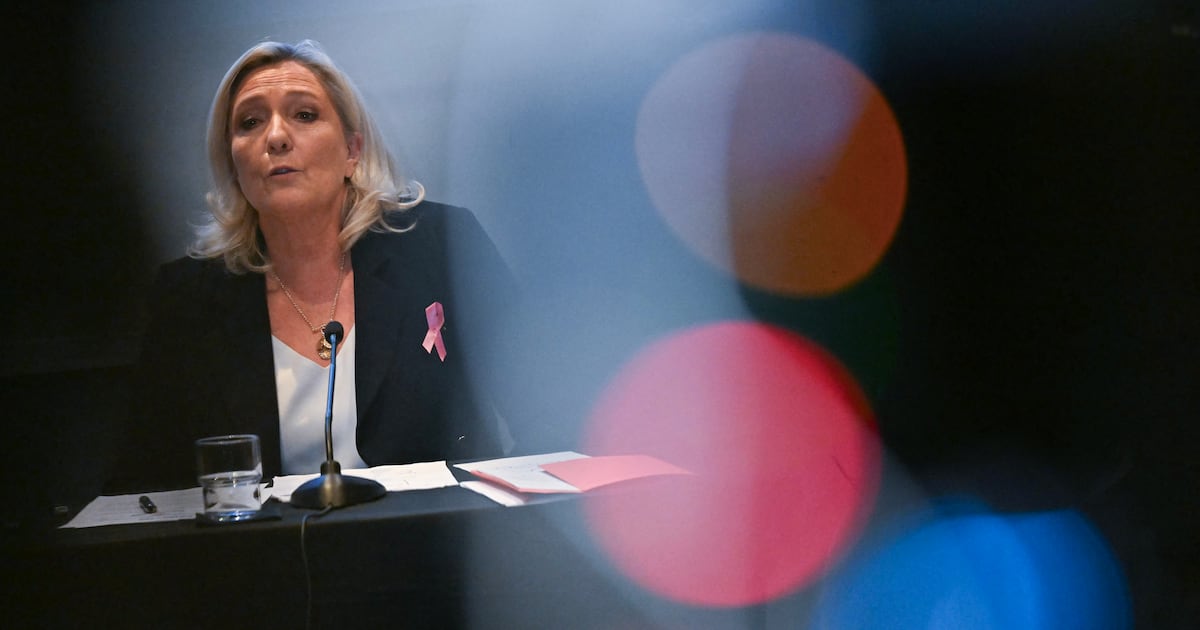
Sitting presidentially behind a huge desk, the French flag behind her, Marine Le Pen took the occasion of the unrest in France this weekend to make a grave address to the nation.“In six months, the French people will be able to choose another path. That of authority and security restored,” the veteran far-right campaigner said. “The path of hope, the path of rebirth. Long live the Republic.”On the face of it, the chaos and widespread destruction may have benefited Le Pen’s chances in the presidential election next spring, especially as she has been able to link it to her favourite campaign topic, immigration.However, the picture may be more complex.READ MOREThe French government and moderate politicians of all stripes have focused on pinning blame for the weekend’s unrest on the hard-left political movement of Jean-Luc Mélenchon, who is the runner-up to Le Pen in polls as a presidential candidate.Judicial authorities have been more circumspect, avoiding casting blame on any political group. The Paris prosecutor told French media she “absolutely cannot confirm” that those responsible for violence in Paris were “politically aligned with the far left” and that those arrested were low-profile people who did not make political demands.Speaking anonymously to French investigative outlet Mediapart cast, police leadership and local officials cast doubt on whether Mélenchon’s France Unbowed (LFI) was to blame and suggested there could be a political agenda at work.“There were far-left activists at Saturday’s demonstrations, but they weren’t a majority,” a local police chief in an area hit by unrest told the outlet. “The rioters are just kids.”A local politician in Marseilles told the outlet that Mélenchon’s party “isn’t organised enough in the city to orchestrate anything ... In this instance, I think LFI was the first to be overwhelmed.”[ ‘I have never felt anything so painful in my life’: Irish caught in French riotsOpens in new window ]It is true, of course, that Mélenchon and members of his party have backed the student protesters, and took part in their vast marches over the last few weeks, including on Saturday.Mélenchon was also very slow to condemn the rioting and looting, insisting until a late point that whatever violence took place was the fault of the police.Until Saturday, the student demonstrations were accompanied by the kind of running battles with riot police and minor vandalism that is traditional at such protests. They did not come with the destruction, arson and looting of the sort seen this weekend.What changed on Saturday was that the students were joined by a revived Yellow Vests or Gilets Jaunes movement, which had called out on social media for nationwide protests on October 17th, long before the student movement even started.The Yellow Vests are politically diffuse. Past polling has found their supporters vote both for the far left and far right.A Yellow Vest is pictured on the statue of Marianne on the Monument à la République during demonstrations last weekend. Photograph: Carl Court/Getty Images Initially angered about the high cost of fuel but with wide-ranging grievances, they called on groups as diverse as farmers, civil servants and climate activists to take part and have declined to disown the violence.Yet there is a political reason why the current French government and moderate politicians might want to pin the unrest on Mélenchon.French presidential elections usually have two rounds. If no candidate wins an outright majority, the two leading candidates face each other one-on-one for a second-round run-off, which would take place in May.Until now, polls have suggested this second-round scenario would be Le Pen versus Mélenchon. They are old rivals who have run for the presidency multiple times and are probably each other’s preferred opponents, each representing everything the other abhors.Violent clashes took place across France as as tens of thousands of people angered by rising costs and declining services took to the streets. Video: Reuters Polls suggest that this scenario would lead to a landslide Le Pen victory. This is because while Mélenchon has a strong base of support, he is also sufficiently divisive to drive some voters to choose whoever he is running against.The political calculation behind attempts to blame the unrest on Mélenchon may therefore be to prevent him from getting to a second round.If the unrest causes Mélenchon’s support to falter, that may allow space for a more moderate candidate to emerge as Le Pen’s main contender – someone with broader appeal and a better chance of beating her in a head-to-head contest.[ What led to the eruption of violence across France last weekend?Opens in new window ]The centre-left Raphaël Glucksmann, the centre-right Édouard Philippe, the “Macronist” Gabriel Attal and the conservative Bruno Retailleau are all less prolific presidential candidates who hope to emerge as the moderate figure who can unite the votes of all those who don’t want president Le Pen.So far, polls only reflect French opinion from before the unrest. All eyes are now on the next surveys to see how it all plays out.
Will French unrest benefit Marine Le Pen’s presidential run?
Full Article
Original Source
Read the full article at Irishtimes →KhanList aggregates and links to publicly available news content. We do not host full articles from third-party sources. Always verify important information with original sources.