
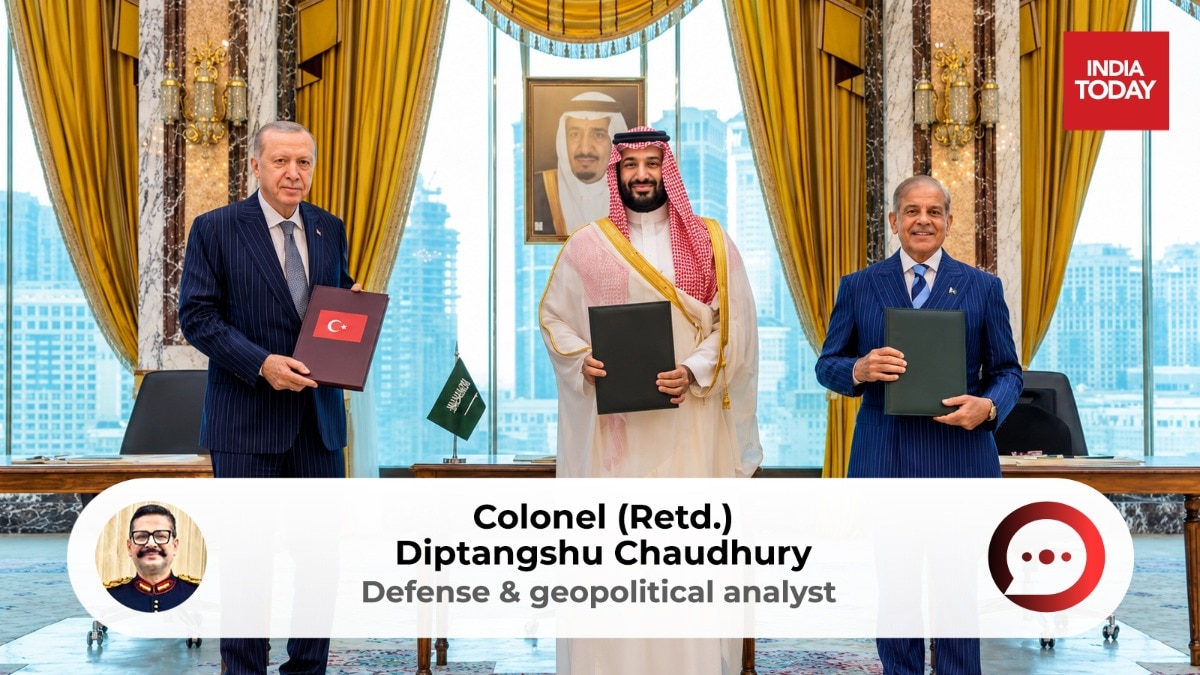
The Mecca Joint Defence Agreement was signed by Saudi Arabia, Pakistan and Turkey on 7 August 2026. It provides that an armed attack against one member will be regarded as an attack against all three.The Mecca Pact combines Saudi financial power, Turkish defence capabilities and Pakistan’s military and nuclear expertise, creating a framework with the potential to become far more consequential. (Photo: Reuters)Bangladesh’s indication that it is open to joining the Saudi Arabia-Pakistan-Turkey “Mecca Pact” deserves much greater attention in New Delhi than it has so far received. Dhaka has not joined the pact, and any suggestion that Bangladesh has already become part of this security arrangement would be premature.But the fact that Bangladesh has publicly kept the option open is strategically significant.The Mecca Joint Defence Agreement was signed by Saudi Arabia, Pakistan and Turkey on 7 August 2026. It provides that an armed attack against one member will be regarded as an attack against all three.Turkish President Recep Tayyip ErdoGan has indicated that the framework could potentially be expanded, while Turkey defence ministry has stressed that the agreement is intended to institutionalise defence cooperation and does not identify a particular country as an adversary. It would therefore be simplistic to immediately label the pact an “Islamic NATO”. It currently lacks NATO’s integrated command structure, permanent military architecture and institutional depth.Nevertheless, its strategic significance should not be underestimated. The agreement brings together Saudi financial and strategic weight, Turkish military-industrial capability and Pakistan’s military experience and nuclear capability in a framework that could gradually develop into something considerably more consequential.BANGLADESH: THE MISSING PIECE IN INDIA'S EASTERN STRATEGIC EQUATION For India, the more important question is not whether the Mecca Pact becomes an effective NATO-like alliance in West Asia. The real question is: what happens if Bangladesh becomes associated with it?Bangladesh occupies a unique geographical position. It sits astride India’s eastern frontier, borders the entire northeastern region except for a narrow international interface, overlooks the northern Bay of Bengal and provides the most practical geographical connectivity between mainland India and the Northeast.If Dhaka were to enter a defence framework involving Pakistan, Turkey and Saudi Arabia, the consequences would therefore extend far beyond religion or symbolism.The most immediate concern would be the strategic proximity of Pakistan to India’s eastern flank through a multilateral security mechanism. Pakistan has historically sought strategic depth against India, while Bangladesh has traditionally maintained a careful balance between its relationships with India, China, the Gulf and other external partners.A formal or semi-formal defence relationship involving Dhaka and Islamabad could create new avenues for military exchanges, intelligence cooperation, defence training and political coordination. That does not automatically mean Pakistani military personnel or intelligence assets would acquire access to Bangladesh. Such conclusions would be premature. But even the institutionalisation of defence cooperation can create new possibilities over time.For India, this would be particularly sensitive because the Siliguri Corridor - the Chicken’s Neck - is already one of the country’s most strategically vulnerable geographical points. Bangladesh surrounds much of India’s eastern strategic space, and the ability to maintain secure communication between mainland India and the Northeast is fundamental to national security. A Bangladesh increasingly embedded in an external security architecture involving Pakistan would therefore require India to reassess not merely border security, but the entire strategic architecture of eastern India.THE BAY OF BENGAL DIMENSION The second major consequence concerns the Bay of Bengal.India has steadily expanded its strategic presence in the Indian Ocean and regards the Bay of Bengal as a critical maritime theatre. Bangladesh, with its ports at Chattogram and Mongla and its access to the Bay, has considerable geopolitical value.If Dhaka develops deeper defence relations with Turkey and Pakistan, and if Saudi Arabia provides financial or strategic backing, a new network of military diplomacy could gradually emerge around the northern Bay of Bengal.This does not mean foreign naval bases will suddenly appear in Bangladesh. Such an assumption would be speculative. The more realistic concern is subtler: increased naval visits, defence agreements, training programmes, intelligence exchanges, military technology cooperation and access arrangements could gradually change the strategic environment.For India, the Bay of Bengal is also essential to the security of the Andaman and Nicobar Islands and the approaches to the Malacca Strait. Any external power acquiring greater strategic influence along the northern Bay therefore deserves careful scrutiny.PAKISTAN'S OPPORTUNITY Islamabad would almost certainly see Bangladesh’s participation as strategically valuable.Pakistan’s relationship with Bangladesh has historically been complicated by the legacy of 1971. Yet geopolitics has a habit of overriding historical hostility. If Dhaka joins a Saudi-Turkey-Pakistan framework, Islamabad would acquire an opportunity to rebuild a degree of strategic relevance in India’s eastern neighbourhood.This could potentially provide Pakistan with a diplomatic and political platform from which to discuss South Asian security issues beyond its traditional western orientation.For Pakistan, therefore, Bangladesh would not merely be another member. It could represent an important strategic bridge between West Asia and the Bay of Bengal.India must recognise this possibility without exaggerating it.CHINA: THE SILENT BENEFICIARY?China is another crucial variable. Beijing has substantial economic and strategic relationships with both Pakistan and Bangladesh. It’s Belt and Road interests, investments in infrastructure and growing engagement with the Indian Ocean make the Bay of Bengal strategically important.China may not want to openly associate itself with a Saudi- Turkey -Pakistan military grouping. Nor would Beijing necessarily welcome an autonomous Islamic security architecture that could eventually acquire a life of its own. But from India’s perspective, one possibility is unmistakable: anything that complicates India’s strategic predominance in its immediate neighbourhood potentially creates additional room for Chinese manoeuvre.Beijing could therefore pursue a classic strategy of strategic hedging-maintaining excellent relations with Bangladesh, Pakistan, Saudi Arabia and Turkey while avoiding direct ownership of the pact.India should be particularly alert to the possibility of overlapping Chinese economic influence and Pakistan-linked security cooperation in Bangladesh.INDIA'S GULF ADVANTAGE Yet India is not without leverage. India’s relations with Saudi Arabia and the Gulf have undergone a remarkable transformation. New Delhi today has much deeper economic, energy, investment and strategic relations with Riyadh than in previous decades.This is a critical diplomatic asset.India should make it clear through quiet diplomacy that its relationship with Saudi Arabia is not based on ideological competition. India seeks stable energy supplies, economic partnerships, counter-terrorism cooperation and regional stability.The same principle applies to Turkey. India’s relationship with Ankara has had differences, particularly over Pakistan and Kashmir, but Turkey remains an important regional power. New Delhi should continue engagement rather than allow the relationship to become permanently defined by Ankara-Islamabad strategic convergence.WHAT INDIA MUST DO IN BANGLADESHIndia’s response should be engagement, not alarmism. First, New Delhi must strengthen economic interdependence with Bangladesh. Trade, investment, electricity, fuel, logistics, digital connectivity and infrastructure should become instruments of strategic stability.Second, India should accelerate connectivity projects linking Bangladesh with the Northeast. Rail, road, inland waterways and port connectivity can transform geography from a security vulnerability into a strategic advantage.Third, defence diplomacy needs greater attention. India should expand professional military exchanges, training opportunities, humanitarian assistance, disaster-response cooperation and maritime engagement with Bangladesh.Fourth, intelligence cooperation against terrorism, radicalisation, trafficking, illegal arms movement and transnational crime must remain institutionalised.Fifth, India must pay greater attention to Bangladesh’s armed forces. Professional military relationships built around training, technology, disaster management and peacekeeping can create long-term institutional familiarity and trust.Most importantly, New Delhi must avoid treating Bangladesh purely as a security problem. Bangladesh is a sovereign country with its own national interests, economic ambitions and strategic choices. Excessive pressure could become counterproductive and push Dhaka further towards alternative partners.THE LARGER GEOPOLITICAL SHIFTThe Mecca Pact should ultimately be understood as part of a much larger phenomenon: regional powers are increasingly trying to construct security arrangements that reduce their dependence on traditional external guarantors. The pact emerged amid profound instability in West Asia and questions over the reliability of existing security arrangements. Reuters describes it as a collective-defence framework, while analysts have noted that it currently lacks many of the concrete military commitments associated with NATO. That distinction matters. India should not react to the Mecca Pact as though a new military bloc has already been fully established. Instead, it should monitor whether the pact develops joint exercises, defence-industrial cooperation, intelligence mechanisms, institutional command arrangements or expanded membership. Turkey has already discussed possible expansion, including Egypt, demonstrating that the framework may not remain trilateral indefinitely.If Bangladesh eventually joins, the implications for India would be substantially greater.The strategic map would then potentially stretch from Saudi Arabia and Turkey, through Pakistan and Bangladesh, towards the Bay of Bengal. Such a chain would not necessarily constitute an anti-India alliance, but it could create a new strategic ecosystem in India’s immediate neighbourhood. That is why New Delhi should neither panic nor become complacent.There is also, at present, no credible evidence that the Mecca Pact is a CIA-designed project. The available reporting points more convincingly towards regional states responding to their own security calculations amid the changing West Asian environment. The real challenge for India is therefore diplomatic and strategic: prevent its neighbourhood from becoming strategically hostile without treating every independent foreign-policy decision by its neighbours as an act of hostility.India’s best answer is a stronger India-Bangladesh relationship-economically indispensable, militarily cooperative, politically respectful and strategically resilient.If Dhaka joins the Mecca Pact, India should be prepared. But preparation should begin before accession, not after it. The cardinal lesson for New Delhi is simple: Do not allow strategic space in Bangladesh to be vacated and subsequently occupied by others. India must remain Bangladesh’s most consequential economic partner, its most reliable connectivity partner and one of its most trusted security partners. Geography has given India and Bangladesh an unavoidable strategic relationship. Diplomacy must ensure that geography becomes an advantage rather than a vulnerability. The Mecca Pact may or may not evolve into a powerful regional security architecture. But Bangladesh’s willingness to consider joining it is already a warning signal. For India, the answer is not confrontation. It is strategic engagement, economic integration, neighbourhood diplomacy and constant vigilance. Watch carefully. Engage intelligently. And above all, never surrender the strategic initiative in your own neighbourhood.- EndsPublished By: Shipra ParasharPublished On: Aug 25, 2026 17:03 IST
Will Dhaka join the Mecca Pact? The strategic stakes for India
Full Article
Original Source
Read the full article at Indiatoday →KhanList aggregates and links to publicly available news content. We do not host full articles from third-party sources. Always verify important information with original sources.