
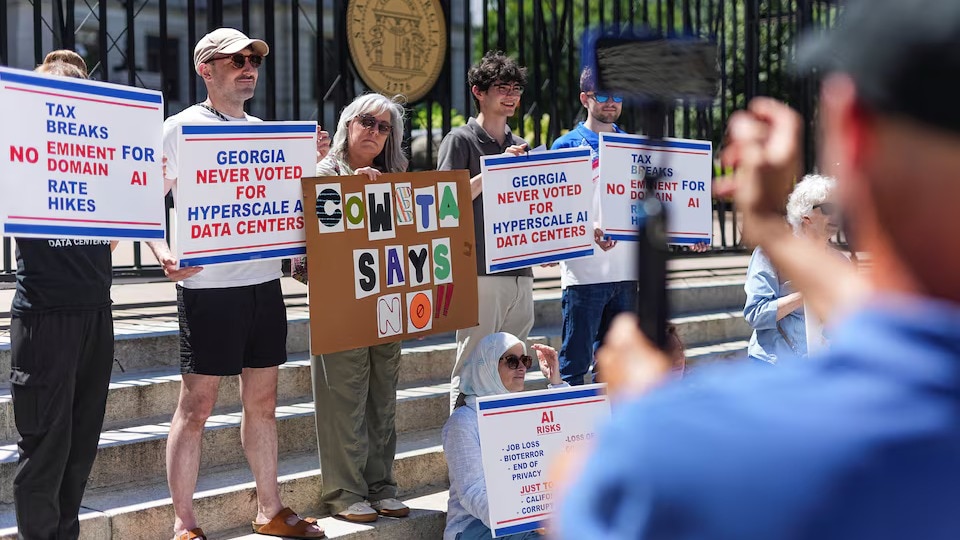
AI, like any new idea, is as much about politics as it is about technology. In the US the victory of Democrats, which now allows them to control the Senate and the House, means aspects of AI may see some changes in the coming months.Image credit: ReutersAfter the last few weeks when the world of AI buzzed with some frantic and hyperactive developments, this week was somewhat slow. We didn’t get any new major model, although there were some releases such as GPT-6 Cyber, an AI model specifically tuned for cyber security. But not many big AI announcements. I suspect it was partly due to the Midterm elections in the US. Technology is as much about politics as it is about the next big breakthrough. AI more so because it is joined at hip with politics and economy. By the beginning of the week it had become clear that political winds in the US were blowing in a different direction, in favour of Democrats. And AI companies likely want the air to get clearer before they again show their hand. Looking back this Sunday we can guess how Democrats winning the control of the Senate and the House is likely to impact AI. The fear is that unlike Republicans, who are money-minded people and are happy to help tech companies shove AI in people’s lives, Democrats might take a more measured and nuanced approach. There are also fears that the cozying up that tech giants — from Google to OpenAI to Meta — have done with Donald Trump all these years may bite them back. People like Elon Musk, Peter Thiel, and Oracle CEO Larry Ellison are supposedly close to the Trump administration and they may see their business prospect take a hit. Because they also have fingers in AI pie, it may impact the overall state of AI. It is these fears that led to tech giants shedding around $2 trillion in the stock market a day after the Midterm results. The same fears also made Elon Musk say on the night of the elections, “Data centers in space looking pretty appealing right now.” Musk, and a few others, in recent years have moved to Texas from California because they believed the Republicans would be kinder and sympathetic to their giant data centres. Now, Texas has elected a Democrat to the Senate. Technology doesn’t exist in isolation, although not many people in Silicon Valley see it that way. They deem technology a neutral force and close their eyes to how it is used. Their idea always is: We build because we are builders, how someone uses it or how it impacts the world is not our problem. The real world, of course, is different. AI as a technology is a catalyst. The science behind it is sound, the maths checks out. It is going to transform the world. But how? On this question, Republicans and Democrats in the US differ. Republicans, as shown by Trump a few weeks ago when he rubbished all the AI doomsday talk, want to accelerate AI. They are all for more data centres, more AI at work even if it means job losses, all for AI rewriting the rules of copyright, all for AI in weapons and wars. They want more and more AI. In the process, they also want to make as much money as they can, either through the financial markets or by having direct stakes in everything AI. Democrats seemingly are for AI but with caution. They are more tuned to the concerns and grievances of normies — aka anyone without a stake in the AI game. They want fewer data centres, they want slower pace of AI development, more accountability from AI companies, probably more regulation in how AI is rolled out in the world and society. Democrats are also, as the Midterm elections indicated, more in line with the negative public sentiments around AI and data centres. So, will the world of AI change going forward? In some ways it will. In many ways it will not. I believe we will continue to see AI move forward. But at the same time, its business and operational side will come under more intense scrutiny. Chances are that Anthropic may delay its IPO. Chances are that many proposed data centres in the US may not move forward. Chances are that AI companies and executives like Dario Amodei and Sam Altman face tougher questions from the Senate and the House. Chances are that AI rollout may slow down in the face of a tougher regulatory regime. None of this is likely to impact AI as a technology. But it may calm down the overheated financial and business environment. The gravy train will not stop but may slow down. The spending on data centres may come down, the valuations of AI startups may cool down a bit. A few people may end up losing some — or a lot — of money with which they are currently punting in the financial market revolving around everything AI. There might be bloodbath on Wall Street. It won’t be too bad but some people may end up hurting. And many may get some temporary respite from AI overdose.China, America, Huang & HuangNot just politics. AI is also about geopolitics. This week we got a very clear sign of it. The US government has reportedly concluded that Alice Huang, a woman close to Nvidia CEO Jensen Huang is a Chinese spy. And that she was romantically involved with him. There is buzz that Jensen may have to go to Washington DC and subject himself to questioning on the nature of his relationship. (@LinkedIn/AI-modified) Of course, we don’t know the full details yet. But the story seems to be straight out of a novel written by John Le Carre. Nvidia is one of the most important companies in the world right now due to its ability to develop and design the most powerful AI chips. Jensen is, in the same vein, one of the most powerful persons in the world. Getting close to him to either extract information or to influence his decisions is a move that is classic Cold War playbook. Given the nature of AI, it is not just another technology. People as varied as Dario Amodei and Donald Trump have called it a tool that will give godly powers to any country that takes an insurmountable early lead in it. China is currently the world’s most industrialised nation if we go by what all it can make. But the future is all about AI and robotics. The Chinese know it and they don’t want to be left behind. The US knows it too. And it wants to ensure China does not win the race. So, it has used its control on Nvidia to cripple the Chinese AI space. Nvidia cannot sell the most advanced AI chips in China. The US government no longer allows it. There are a lot of pushes and pulls between these two countries. China badly needs and wants the most-powerful AI chips. There are smuggling routes that have been used. There are subterfuges, hacking, theft, and grand overt and covert programmes that attempt to bring to China chips its AI companies badly need. The US, meanwhile, has made every attempt — overt, covert, by the book, beyond the book — to ensure that the same chips never reach Chinese ports.The Huang and Huang episode seems to be another chapter in the same story. Nasscom wants Indian techies to learn new tricksThe AI and jobs debate continues. This week Rajesh Nambiar, president of Nasscom, warned that AI is upending the Indian IT job market. In an interview with Nikkei Asia, he said: From a fresher's point of view, AI is a concern. I will not sugarcoat it… If our education system is unable to make (a) transition very quickly, students will come out with skill sets which may be very obsolete already.” In other words, Nambiar is warning that AI is making many IT skills obsolete. The only way for IT professionals (or engineering students) to survive the future is by changing their skillset so they continue to be relevant. Although what can be the next relevant skillset is not yet clear, thanks to the pace at which AI is moving. I mean six months ago top theoretical mathematicians would have felt safe with their unique and genius-level skills. Now, half of them have existentialist crises after seeing what AI models like Astra and Mythos are doing. Nambiar’s comments come at a time when tech companies are offering voluntary exit offers to many employees. Last week, it was Microsoft. Now, there is chatter that even Google is offering similar exits to employees in as many as five of its offices. Meta too is contemplating doing the same. Meanwhile, Canva laid off over 1000 employees this week. Although, they did give a fairly decent severance package, including the MacBooks that the employees were using.CERT doing pen-testing using MythosBetter late than never. Given the poor security of our websites and digital infra, India needs to prepare itself for the AI era on a war footing. AI is going to spark a fresh arms race between those who attack digital infrastructure and those who defend it, and this time the attackers might have advantage. So, this week it was good to hear that CERT IN, the Indian cyber agency, was testing Indian websites and critical parts of our internet, such as banking, using Anthropic Claude Mythos. Several other countries, most notably the US, got access to Mythos a few months ago for the same purpose. In security terms, the exercise is called pen-testing, which is short for penetration testing. The idea is that good people should proactively break websites and digital systems because then it can be fixed before bad people arrive. A CERT IN official this week said the organisation “just got the access” to Anthropic Claude Mythos and that “it is detecting issues” that “we are able to patch, and we are able to go forward.”Of course, pen testing with Mythos will not be enough to keep the Indian internet safe in the coming months and years. In our country we are not particularly concerned about the safety of our websites and digital systems. This is the reason why even teen hackers, as we saw in the case of CBSE, routinely break into systems. The coming months, with AI in hands of hackers across the world, will bring far more serious challenges. But it is good to see that CERT IN has started moving on the matter, and that it is beginning to use some of the best AI tools that are currently available to cyber defenders. The future of phones — something Nothing?In the last few months, there are a number of phones that I have tried and written about. In almost all cases, I have heard from phone makers how they are now giving AI tools to users. In almost all cases I have found that these AI tools are not particularly useful.AI will be useful when it becomes a part of the device in a fundamental way. Currently it is still an afterthought on a device that was first conceived two decades ago — that is iPhone aka smartphone.Nothing CEO Carl Pei this week outlined his vision for an AI device. It is a long post that he wrote on X, but there are two takeaways. One, to truly make an AI device that is useful, the entire form factor, design, utility and functionality needs to be imagined and created afresh with AI at the centre of it. And two, Nothing is making its “first AI-native product. It has no new screen, and it couldn't have been an app.” It will be coming in December.SIX STORIES YOU CAN'T MISS01Elon Musk says Grok Bot is too expensive to run, calls costs unsustainable as users hit limits02Goldman Sachs bans some employees from using AI, Replit CEO says this is widespread in finance03India launches three new AI models, including two that work without the internet04Frustrated with Google Search, users are turning to ChatGPT, report reveals05Sam Altman says he hates AI companies claiming it will cure cancer, talks about human freedom06You have no right: Microsoft AI chief says AI can't be conscious, humans did not sign up for this
Will Dems break AI? Tech is safe and sound but gravy train is at risk
Full Article
Original Source
Read the full article at Indiatoday →KhanList aggregates and links to publicly available news content. We do not host full articles from third-party sources. Always verify important information with original sources.