3 min readHere’s what you’ll learn when you read this story:Through a process called “puffing,” fires create pressure waves that produce noise in the infrasound range, or sub-20 hertz. While our ears can’t hear infrasound, sensitive microphones can, and a new study used infrasound produced by a preplanned burn in Idaho to track its movement.The true test of this potential technology will be tracking a wildfire live, which will require distinguishing between infrasound from wildfires and high winds. While human hearing is pretty remarkable—capable of detecting sounds from 20 hertz to 20 kilohertz—like the rest of our senses, it’s easily bested by other members of the kingdom Animalia. Homing pigeons, for example, can hear sounds as low as 0.5 Hz while moths can hear up to 300 kHz. Much as our eyes can only perceive a small part of the much larger electromagnetic spectrum, our ears are unable to detect infrasound (noises below 20 Hz) and ultrasound (above human hearing).However, just because we can’t hear these imperceptible sounds doesn’t mean they can’t be useful. Back in 2024, a team of researchers led by scientists at Boise State University (BSU) published results in the Journal of Applied Acoustics showing how listening for a fire’s “puffing”—a process in which fires release plumes of hot gas, draw in cool air, and emit pressure waves that can be as low as one hertz—could provide vital early-detection signals for wildfires. The major benefit of infrasound detection is that it doesn’t rely on line of sight, in contrast to typical wildfire-tracking technologies like satellites and airborne sensors.“Our pile fire recordings extend from an approximate 1.0 to 1.3 Hz mode puffing frequency up into the low frequency audible band,” the authors wrote at the time. “This remote surveillance result is encouraging because we anticipate that larger, more vigorous fires will be detectable at much farther distances permitting infrasound to be developed as an effective ground-based remote sensing tool.”Now, a new study published in the journal Geophysical Research Letters scaled up the experiment by testing infrasound detection on a larger, more realistic fire than the one used in the earlier BSU research. The researchers, who are from Boise State University and the U.S. Forest Service, essentially mic’d up a preplanned fire to see what infrasound could be detected by 90 sensors. Scientists placed these sensors, each roughly the size of a book, in configurations of eight total arrays containing anywhere from three to 44 sensors. The largest array accurately tracked the infrasound produced by the fire from more than two kilometers away.“Despite being farther from the fire than four smaller arrays, the 44-sensor array performed best at identifying coherent infrasound and yielding consistent directions of arrival,” the authors wrote. “Our results show infrasound's potential for tracking low-intensity wildland fires in research or hazard monitoring.”While the team reports that they could accurately distinguish between the infrasound produced by the fire and the helicopter that started it, one concern is that wind, which often fuels wildfires across a landscape, could limit how well these infrasound arrays work. The only way to know is to test the technology on a real wildfire. But to quote Doc Brown, “you never know when or where it’s ever going to strike.”“If there’s a lot of wind around, it could create all sorts of problems,” BSU geophysicist Jake Anderson, lead author of the study, told Science News. “In the long run, an ideal solution would be to have a technology that’s installable by firefighters themselves.”Past land management practices coupled with the ever-warming effect of climate change are exacerbating wildfires around the world, with one 2025 study estimating that smoke from wildfires could kill 70,000 Americans per year by 2050. Detecting these wildfires before they grow into windblown infernos will be vital to save money, property, and human lives.Darren lives in Portland, has a cat, and writes/edits about sci-fi and how our world works. You can find his previous stuff at Gizmodo and Paste if you look hard enough.
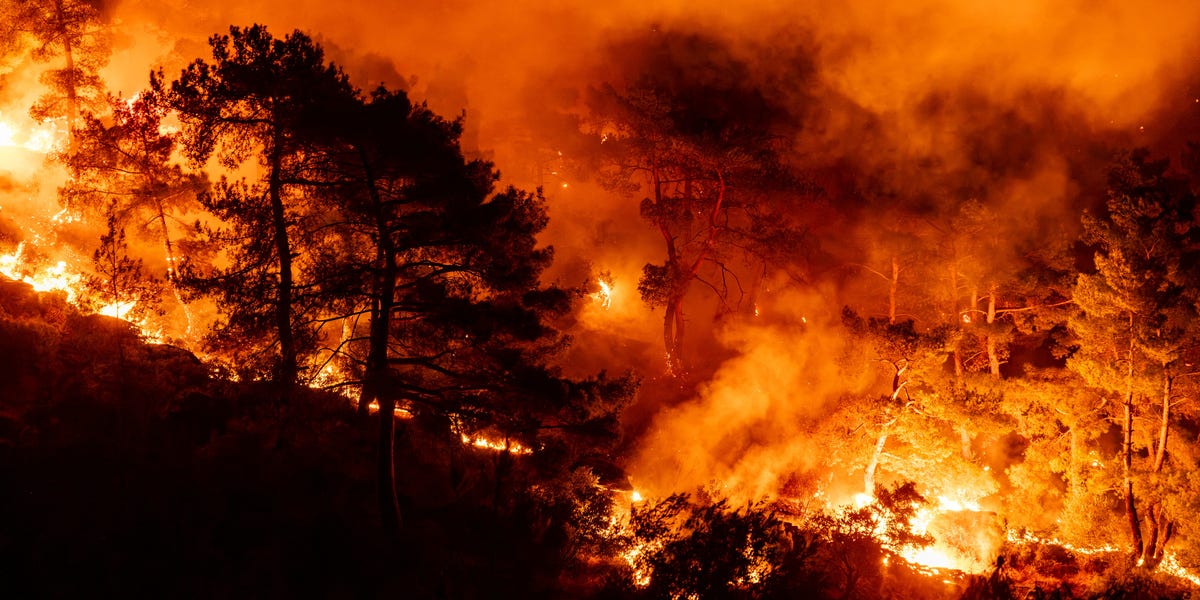
Wildfires Make Sounds We Can’t Hear—and That Could Help Us Extinguish Them Faster
Full Article
Original Source
Read the full article at Popularmechanics →KhanList aggregates and links to publicly available news content. We do not host full articles from third-party sources. Always verify important information with original sources.