
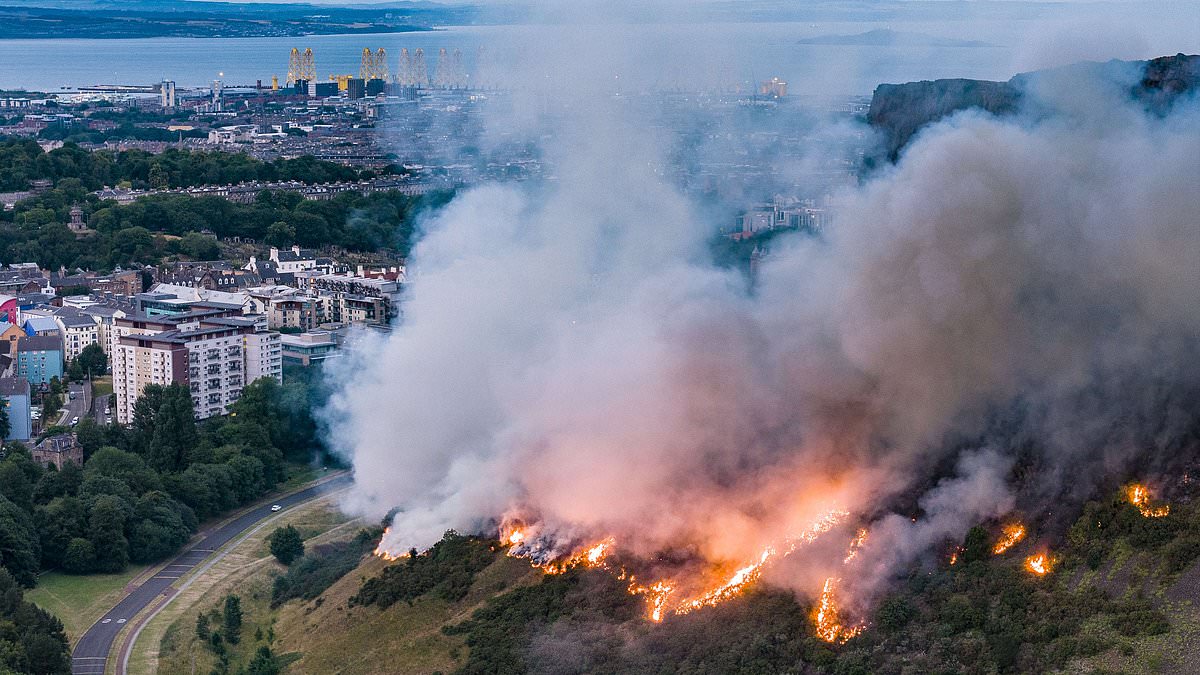
Firefighters are battling multiple wildfires across the UK as warm, dry weather continues to fuel dangerous conditions, with a fresh blaze breaking out at Edinburgh's Arthur's Seat.More than 250 wildfires and grassfires have broken out in two weeks due to dry conditions.The latest wildfire erupted at the Scottish landmark on Sunday evening, prompting a large emergency response from the Scottish Fire and Rescue Service (SFRS) - in addition to major incidents in the Scottish Highlands and Derbyshire.It comes as temperatures will dip slightly following almost two weeks of days above 30C, but will remain in the high twenties throughout next week, continuing a run of ideal conditions for blazes.The Scottish Fire and Rescue Service said it was alerted to reports of a fire in the open at Arthur's Seat at 6.38pm on Sunday. Six fire appliances were sent to the scene, with crews continuing to tackle the blaze into the night.A Scottish Fire and Rescue Service spokesperson said: 'We were alerted at 6.38pm on Sunday, 19 July to reports of a fire in the open at Arthur's Seat in Edinburgh.'Operations Control mobilised six fire appliances and specialist resources to the scene where firefighters are working to extinguish a fire affecting an area of grass.'There are no reported casualties and crews remain at the scene.'The incident comes as firefighters continue to battle one of Scotland's largest wildfires in recent years in the Cairngorms National Park, where crews have now been working continuously since Wednesday.Cairngorms blaze enters the fifth day as the wildfire near Ryvoan Bothy, close to Nethy Bridge, has already devastated more than a square mile of heathland and woodland, forcing the evacuation of nearby homes and businesses as a precaution. Firefighters tackle a huge blaze on Arthur's Seat in Edinburgh on Sunday evening, with six fire engines at the scene Hot, dry weather is set to continue this week, although temperatures will dip slightly compared to the recent heatwave (Pictured: Monday's UK weather forecast) Temperatures will remain well into the 20s throughout the week, reaching peaks of 27 or 28C (Pictured: Tuesday's UK weather forecast)Residents have warned the crisis is 'only going to get worse', fearing the exceptionally dry conditions could allow the fire to continue burning for days.Local community council chairman Sandy McCook said changing wind direction had prevented the flames from sweeping into Abernethy Forest and the village of Nethy Bridge.He said: 'We were basically saved by the direction of the wind.'Had the wind been blowing as normal, the fire would have consumed the Abernethy Forest... and Nethy is known as "The Forest Village".'Mr McCook also questioned the early assessment that the fire had been contained, arguing helicopters should have been deployed sooner.He added: 'We are worried about the days and weeks ahead because this summer is not over yet. The forecast is for warm and dry weather for next week.'Firefighters have described the blaze as a 'complex and protracted incident', with mountainous terrain making operations particularly difficult.On Sunday, the Scottish Fire and Rescue Service said significant progress had been made but warned the wildfire remained unpredictable.Six fire appliances, two all-terrain vehicles, a wildfire support unit and a water carrier remain at the scene.An SFRS spokesperson said: 'There continues to be significant progress... There are encouraging signs across the affected area, with visible improvements becoming increasingly evident. Helicopters use waterbombs to help tackle a devastating wildfire in the Cairngorms National Park The fire in Cairngorms sweeps across a parched landscape as more than 50 firefighters on the ground battle to contain the flames'While this is positive, wildfires can change rapidly and unexpectedly, and it is important that we do not become complacent.'The public has again been urged to stay away from the area, with Glenmore Forest Park and Loch Morlich remaining closed while emergency crews continue their work.Fire crews were also called to the Rustic Stomp festival near Wareham, Dorset, at about 7:40 p.m BST on Friday. Firefighters said an area of heathland measuring 100m (330ft) by 40m (130ft) was destroyed.Festival-goers quickly moved tents and vehicles to safety as the flames took over, Dorset and Wiltshire Fire and Rescue Service (DWFRS) said.Elsewhere, a huge firefighting operation remains underway on Tintwistle Moor near Glossop, where Derbyshire Fire and Rescue Service has been tackling a major moorland fire since 24 June.The blaze has affected around 260 hectares (642 acres) of land, with a major incident declared last week.More than 100 firefighters and volunteers are working across Derbyshire and neighbouring Greater Manchester, supported by specialist resources from fire services across the UK.Four helicopters have been dropping water on hotspots across Didsbury Intake, Featherbed Moss, Arnfield Moor and Crowden, with Crowden remaining the main focus of operations.Fire chiefs have warned that tactical controlled burns may lead to increased smoke in the area, while strict airspace restrictions remain in force because of the helicopter operations.The public has also been reminded that flying drones is prohibited, as they pose a serious risk to aircraft supporting the emergency response.Fire crews expect to remain at the scene into next week.The wildfire incidents come as much of the UK enjoys another spell of warm weather, with temperatures expected to reach 27C in parts of England on Monday. The fire in the Cairngorms has been ongoing for five days now, with fire crews facing copious amounts of smoke as they bring the inferno under control The wildfire in northern Scotland became so intense it could be seen from spaceForecasters say the dry conditions will continue across many areas this week, increasing the risk of further grass and heath fires.Looking further ahead, weather models suggest another significant heat surge could arrive before the end of July.The Global Forecast System (GFS) model indicates temperatures could climb back into the low 30s from July 27, with highs of around 33C in western England and 32C across much of southern England.Temperatures could rise further on July 28, with highs of 35C possible across southern and western England and 34C elsewhere across central and eastern parts of the country.The model then suggests July 29 could become the hottest day of the year, with temperatures potentially reaching 38C across parts of western, central and eastern England. If that were to happen, it would exceed the current highest temperature recorded in the UK this year of 37.7C.Temperature anomaly maps also indicate much of England and Wales could experience conditions well above the seasonal average during the final week of July.However, the Met Office has urged caution over the longer-range outlook, saying it is too early to determine whether heatwave conditions will persist into the final days of the month. Its forecast covering 22 to 31 July nonetheless indicates temperatures are likely to remain above average, with the potential for further hot spells.
Wildfire breaks out at Arthur's Seat and firefighters tackle blazes across the country as temperatures to hit 27C
Full Article
Original Source
Read the full article at Dailymail →KhanList aggregates and links to publicly available news content. We do not host full articles from third-party sources. Always verify important information with original sources.