
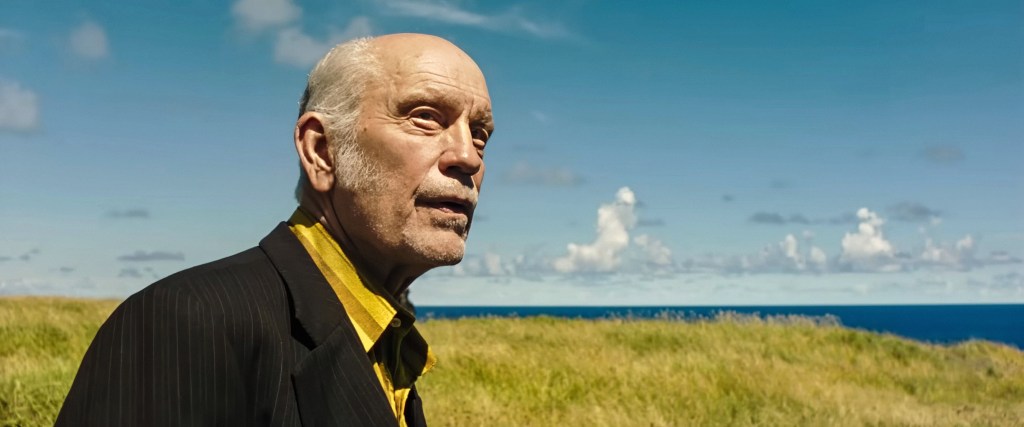
British cinematographer Ben Davis has just wrapped shooting Bradley Cooper’s Ocean’s Eleven prequel when he touches down at the ToruńCamerimage Film Festival in Poland to discuss Wild Horse Nine, his latest film with writer-director Martin McDonagh. The film, which is the fourth collaboration between Davis and McDonagh, stars Sam Rockwell and John Malkovich and is shot on the remote shores of Easter Island, some 2,330 miles west of mainland Chile. “I’d been to Easter Island before in 1999 to shoot a one or two-minute piece about the millennium that we shot there for some reason,” Davis tells Deadline. “So, I kind of knew the place. It’s an extraordinary place. It’s very odd, but very beautiful. There aren’t words really to describe it. It’s quite spiritual and it’s sort of this deforested island with these [Moai] heads just looking out to the ocean. You’re surrounded by an endless horizon in every direction, but it has this idea that you have immense space and isolation, which is obviously what attracted Martin to it as he likes to isolate his characters.” Wild Horse Nine, which played at ToruńCamerimage earlier this week, follows CIA agents Chris (Rockwell) and Lee (Malkovich) as they are sent from Santiago to Easter Island shortly before the 1973 Chilean coup. As the longtime partners wrestle with their dark pasts and present conspiracies, Chris’ newfound bond with a pair of students threatens to send everyone’s trip sideways. Steve Buscemi and Parker Posey also star. Watch on Deadline The beauty of Easter Island was, says Davis, an “essential element” in the film, noting the role it played for Chris, who audiences learn is nearing the end of his life. “He becomes very aware of the beauty of the world around him and what he is leaving behind,” he says. “So, I think it was an essential element of putting them there, in that the beauty of this place was almost tangible and that’s what we tried to deliver.” He continues: “The story is very character and dialogue-driven and there’s a lot of scenes of two men talking and Martin is a fantastic scriptwriter and the dialogue is incredible. So, when you have those scenes, you need when you’re moving away from that into something else, to give an idea of space. There has to be a visual rhythm to that language.” Davis took a lot of inspiration for the look of the film from American photographers William Eggleston and Stephen Shore, and recalls looking at various photographs of theirs from that period of time while in prep for the film. “There were two particular photos of Eggleston’s that really resonated with me, and I brought those along to show Martin, and he liked those a lot,” he says. There were other images that came from our art department too. But for me, Eggleston’s work when he shot on Ektachrome in the 1970s was extraordinary. I loved the vibrancy and the color. So, I was really interested in shooting Ektachrome.” Kodak Ektachrome is complex reversal film known for its fine grain and clean and vibrant colors as well as distinct cool-toned images. “Now the thing is, Martin wanted to shoot film and Ektochrome only comes in 16mm, and I didn’t want to shoot in 16mm,” says Davis. “Shooting film on the island was virtually impossible because the turnaround to get something to the lab and back again would have been seven or eight days. So, on an early scout, I took some photographs on Ektachrome stills and I shot some Super8 Ektachrome and then we shot some video and we came back and looked at that and that was the way we wanted to go.” The film was ultimately shot on ARRI Alexa 35, and they used those Ektachrome stills for reference throughout the shoot. It’s also peppered with Super 8 footage, as Rockwell’s character Lee carries a Super 8 camera around with him throughout the film and frequently films small segments. “There’s something really nostalgic about Super 8 footage, about just the way it moves and the way things move within the frame,” says Davis. “It has this joy about it, and it feels like you’re watching a memory and so we kind of fell in love with that we shot more and more of it as we went along.” Now that he and McDonagh have shot four films together, Davis says they’ve mastered a shorthand for their collaborations. “We’ve always been friends as much as colleagues,” he says. “I think the language and the shorthand has always been the same. We just kind of got each other pretty much right away and that hasn’t really changed.” The ToruńCamerimage Film Festival runs November 7-14, 2026.
‘Wild Horse Nine’ Cinematographer Ben Davis On Reuniting With Martin McDonagh & Capturing The “Immense Space And Isolation” Of Easter Island — ToruńCamerimage
Full Article
Original Source
Read the full article at Deadline →KhanList aggregates and links to publicly available news content. We do not host full articles from third-party sources. Always verify important information with original sources.