
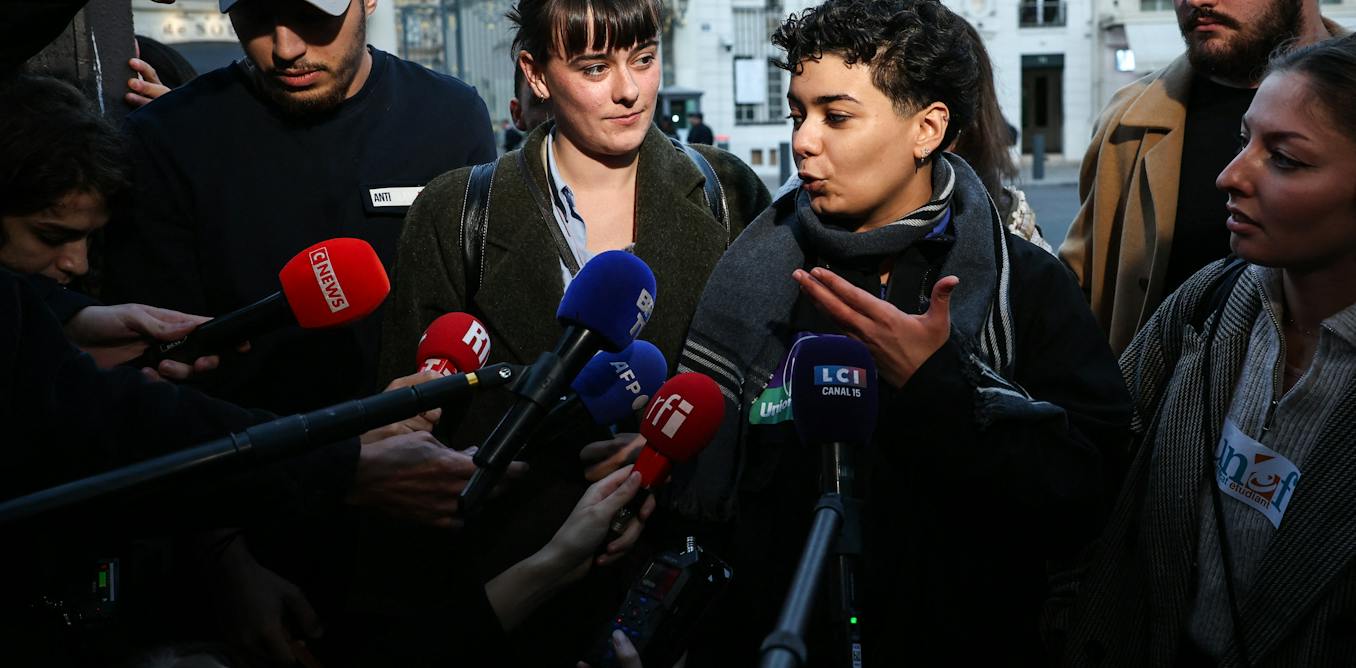
On November 5, as secondary school students gathered in Paris for another day of demonstrations, a journalist associated with French media outlet CNews met an unusually hostile reception. Protesters shouted for him to leave, and police officers reportedly asked the journalist to stop heckling the crowd. What happens when a protest movement turns against the media covering it? In France, students are challenging the government’s education policies and increasingly the news outlets through which their demands reach the public. A petition calling for CNews to be taken off air has gathered more than a million signatures. Petitions and headlines show how much attention the movement commands, but for the protesters themselves, however, the terms of their visibility are part of the problem. The paradox of visibility The activist movement began in late September, first emerging in working-class schools in the Paris suburbs, spreading from Créteil across the Val-de-Marne and Seine-Saint-Denis departments to the East of Paris before reaching the rest of France. Students protested, inter alia, teacher shortages, overcrowded classrooms, crumbling premises and inequalities between schools. Since then, the movement has received extensive coverage, in France and abroad. But how much of that attention has been devoted to the actual student demands? In my recent research on climate activism and media power in France, I examine what I call asymmetric visibility: how protesters can become highly visible as objects of media scrutiny and policing while struggling to gain recognition as political actors with legitimate demands. The climate activists I followed in Paris were labelled “eco-terrorists” and placed under police surveillance; increasingly, they responded by contesting the media institutions themselves, including those owned by ultraconservative French media mogul Vincent Bolloré. Coverage of the student movement follows a similar pattern. On October 6, CNews featured commentator Éric Naulleau describing the protesters as a “lost generation”. On October 30, the same channel highlighted claims by a representative of the right-wing student union UNI that most young people wanted to return to class. These editorial choices fit a longer shift: after Vincent Bolloré took control of the Canal+ group in 2015, the share of CNews airtime given to radical-right guests rose by nearly 15 percentage points from its 2013–14 level of 7.4%, according to a study of French broadcasts between 2002 and 2020. They also raise important questions about who gets to speak for the movement: indeed, by giving prominence to commentators who question the protests’ legitimacy, rather than to the students organising them, broadcasters can shape public perceptions of what young protesters want and whether their demands deserve to be heard. Competing for visibility This asymmetry also operates within the movement itself. Sociologist Jacqueline Kennelly describes an uneasy relationship between the legitimate “youth citizen” and the “youth activist”, often portrayed as troublemakers. As the protests spread, politicians similarly distinguished between legitimate students and disruptive casseurs. The prime minister’s office condemned violences urbaines, a term that has long been equated with France’s working-class suburbs. In France, class and racialised inequalities are frequently expressed through geographical categories such as banlieue and quartiers populaires. The distinction between legitimate students and disruptive casseurs therefore carries particular political weight when a collective social movement begins in working-class suburbs. Visibility also takes the form of police surveillance and scrutiny. By October 9, 6,877 people had been held in police custody, 86% of them were under 18. In my research, climate activists described how arrests fed police records such as the TAJ (Traitement d’antécédents judiciaires) database, which is a judicial record database managed by the police and gendarmerie containing information on suspects, victims and missing persons; whose photographs can be searched using facial recognition. This kind of visibility to the police can outlast the protest itself and have a long-lasting impact on lives and opportunities. These inequalities of representation are also being contested within the movement itself. On October 4, students in Saint-Denis, in the North of Paris, founded the Fédération lycéenne des quartiers (FLQ), arguing that young people from the working class suburbs where the protests began were being sidelined in media coverage in favour of more privileged spokespeople. “We, people from working-class neighbourhoods, suburban residents and children of immigrants, were not sufficiently represented,” explained co-founder Walid Mansouri in an interview on October 17. Soumaya Sarré, another founder, argued that students from these neighbourhoods were best placed to speak about the problems they face, criticising the prominence given on television to commentators who misrepresent the movement. The FLQ seeks to ensure that those who initiated the mobilisation also have a say in how their demands are represented publicly. This echoes findings from my research on youth activism, which examines how inequalities of race and class shape whose voices gain recognition and authority within youth movements. When the media become part of the conflict On October 5, the headmistress of a Parisian school refused to speak to CNews, arguing that its editorial line harmed young people. The channel then portrayed her refusal as intolerance, and one of its journalists asked France’s minister for education whether the headteacher in question might face disciplinary action. In short, a disagreement about editorial practices spun into controversy about whether anyone may refuse a broadcaster’s questions. This portrayal of powerful media institutions as victims of exclusion has a longer political history. In Making the Liberal Media (2026), A.J. Bauer shows how American conservatives built a political movement around the claim that mainstream journalism was biased against them, even as they developed powerful media institutions of their own. A similar dynamic emerges around CNews, often described as “France’s equivalent of Fox News”: despite its considerable institutional influence, it portrays refusals to engage with its journalists as attacks on press freedom. In June 2026, France’s media regulator Arcom formally warned CNews over a sustained lack of pluralism in its programming. Refusing interviews and enforcing broadcasting pluralism can challenge some of these inequalities. Yet neither individual refusals nor regulation alone addresses the concentration of media ownership, which gives a small number of powerful actors considerable influence over the terms of public debate. These tensions extend beyond CNews. On November 5, journalists at BFMTV went on strike over concerns about reporters’ safety and the channel’s editorial integrity, following internal criticism of racist remarks aired on the channel. The dispute reveals how struggles over who gets to shape public debate extend into newsrooms themselves, where journalists are also challenging the editorial decisions that determine whose voices are amplified and how they are portrayed. From visibility to influence Unequal representation matters because it shapes which demands become politically actionable. The government has acknowledged students’ grievances and proposed measures on teacher shortages, buildings and admissions. Student representatives have questioned whether these responses match the scale of their demands. Governments can recognise grievances, hold consultations and announce reforms while keeping control over the political agenda. Many protesters are also too young to vote, limiting their electoral leverage ahead of the 2027 presidential election. What matters, then, is who takes part in defining problems, negotiating solutions and judging whether political responses are enough. The movement is also travelling. In Italy, students have blockaded schools under the slogan “Facciamo come in Francia” (“Let’s do what France is doing”). The movement has extended to Switzerland, where calls for blockades also circulated in Geneva. The education department, citing online calls for violence, asked teachers to report pupils’ calls to mobilise. Serbia’s student movement began earlier and independently: students who blockaded the public broadcaster in 2025 over its coverage of their protests went on to win a parliamentary majority in October 2026, ending Aleksandar Vučić’s party’s fourteen years in power. These cases reveal how student uprisings are confronting media and political institutions across Europe, although with very different outcomes. Digital platforms have made it easier to organise such movements and be seen without relying on media outlets, but the ability to reach an audience remains unequally distributed. It is shaped by state surveillance, concentrated media ownership and the commercial interests of the platforms through which political messages circulate. The students confronting CNews, and those from neighbourhoods in France demanding recognition within their own movement, are challenging different dimensions of the same inequality: asymmetric visibility. Their struggle reveals the limits of visibility as a measure of democratic participation. The question then becomes not only who gets to be seen or heard, but who has the power to define both what the protests mean and what should be done in response. A weekly e-mail in English featuring expertise from scholars and researchers. It provides an introduction to the diversity of research coming out of the continent and considers some of the key issues facing European countries. Get the newsletter!
Why young protesters in France are turning against TV channel CNews
Full Article
Original Source
Read the full article at Theconversation →KhanList aggregates and links to publicly available news content. We do not host full articles from third-party sources. Always verify important information with original sources.