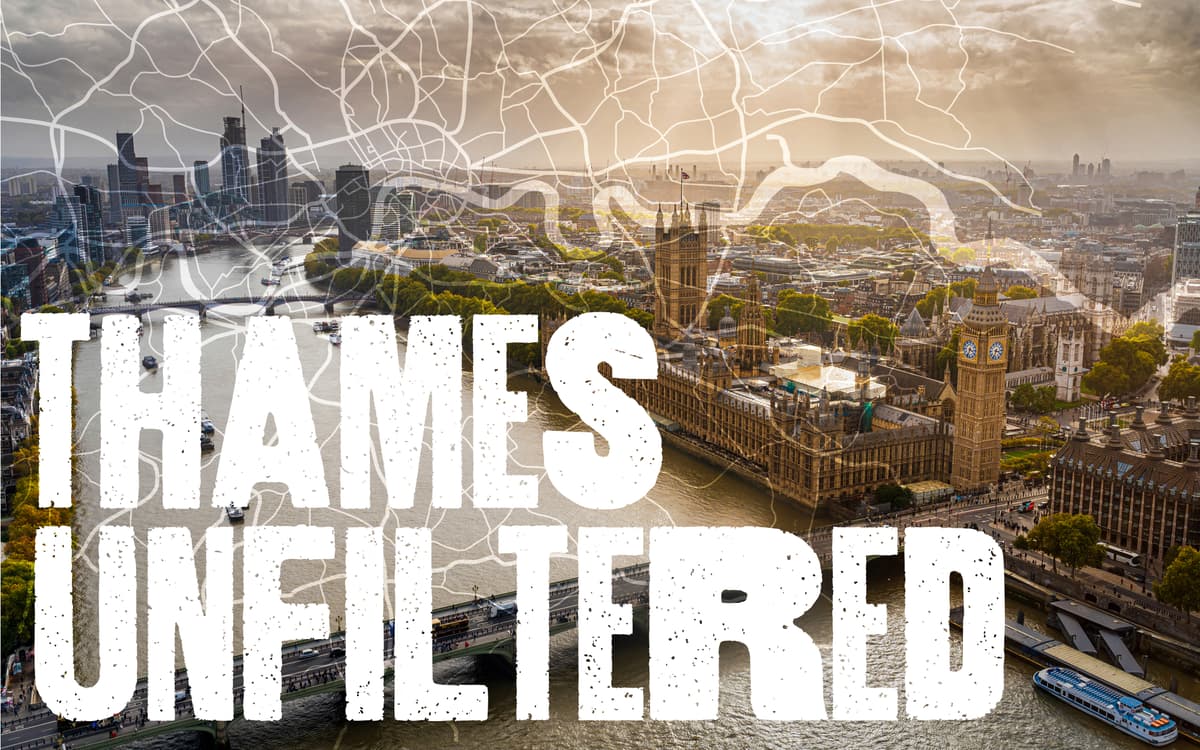
Standing beneath a vast dome, surrounded by ornate painted ironwork and soaring decorated Dalek-like columns, I feel like I’m in a Londonmaxxing wedding venue. Or an industrial-chic cathedral. But this is no centre of worship (unless you pray at the altar of the digestive system) — I’m at Abbey Mills Pumping Station, also known as “Poo Palace”.It’s a working — and beautiful — part of the capital’s sewage system, where millions of tonnes of waste are raised up 12 metres on a journey from Londoners’ loos to sewage treatment plants. Behind a barbed wire security fence, it’s off-limits for visitors. The Standard’s podcast, Thames UnfilteredHuge sewage treatment works such as Abbey Mills Pumping Station are vital for Londoners’ clean water supplyGetty ImagesStepping inside the Poo Palace was just one part of my investigation as the host of The Standard’s podcast, Thames Unfiltered. Over six episodes, we look at the condition of the River Thames, from the pristine Cotswold country streams where it begins, to the high stakes financial and environmental crisis unfolding in the heart of the capital.From the multi-billion-pound engineering marvels that fill up our water bottles, to the issues at the heart of Thames Water that have arguably drained funds — and attention — from the water itself. The podcast examines a system that is fiercely alive but under massive pressure, dealing with climate change, population growth, data centres and things we shouldn’t flush down the loo.You will never look at a glass of tap water, or London’s waterfront, in the same way. Challenges facing the Thames and Londoners’ clean water supply70 per cent of London’s drinking water is drawn directly from the river, with 30 per cent being supplied by aquifers across London and the Thames Valley Getty Images/iStockphotoThe story of London's modern plumbing stretches back to the 1860s and the aftermath of the Great Stink, the Victorian environmental crisis where sewage made the capital reek so severely it disrupted Parliament. In response, engineer Joseph Bazalgette was commissioned to build the brick-lined sewage network that still serves London today.But Thames Unfiltered reveals how, more than a century and a half later, the river faces an entirely different set of demands. The Victorians built a system designed for a capital they dreamed might one day hold four million people. Today, that infrastructure is struggling to cope in a city of 9.1 million. On the podcast, I speak to customers impacted by floods and quiz Thames Water on soaring bills and a £20 billion debt mountain. Thames Unfiltered also uncovers some remarkable signs of ecological resilience. Chris Livett, a seventh-generation waterman who helps film James Bond boat chases, lives on a river that hosts seahorses off Greenwich and harbour seals in central London, while porpoises are found in surprising numbers out in the Thames’ estuary. The Thames has been brought back to life after being declared biologically dead in 1957. But that doesn’t mean it’s now clean: a healthy river is a river that allows wildlife to thrive. The underlying mechanics of the Thames in the city are staggering. The capital’s sewage currently generates enough electricity via anaerobic digesters to run the entire City of London for five days. Under normal conditions, a flush from west London takes 24 hours traveling through underground drains to reach Abbey Mills. But during heavy rain, that journey goes express, taking just two hours — which is the main reason why an overwhelmed system diverted storm overflow into the river over 9,000 times last year. But it’s not that which turns the river brown. Even if no industry ever touched the river, the Thames would always be the colour of builder’s tea, because the tide constantly stirs up sediment from the riverbed. Thames Unfiltered reveals that the pressures on the river extend beyond headlines of perilous corporate finances. Bazalgette’s original work may have saved more lives than almost anyone else in British history by effectively ending London's cholera epidemics, but modern engineers are facing huge new problems. While the underground infrastructure of the new 16-mile Tideway Tunnel super-sewer can hold the volume of hundreds of Olympic swimming pools of diluted wastewater, scientists from the Zoological Society of London (ZSL) warn that invisible threats, like agricultural runoff and a massive influx of toxic rubber tire particles from road surfaces, are altering the river's chemistry. Simultaneously, 70 per cent of London’s drinking water is drawn directly from the river, with 30 per cent being supplied by aquifers across London and the Thames Valley, to satisfy us showering, glugging Londoners. Demand is growing: across the UK, we now use an average of 143 litres per person every day. But the capital actually receives about 25 per cent less rainfall than the national average, a geographical fact obscured by London’s rainy reputation. Experts on the podcast map out for us how a hotter, drier future climate will stretch this vital water source to its limit. What you shouldn’t put down your sink or flush down your toiletThousands of toilet-flushed wet wipes, now removed by Thames Water, had created a massive unpleasant cultural landmark near Hammersmith BridgeGetty Images/iStockphotoAfter verbally wading through the Thames’ sewage, environmental and finance problems, I didn’t exactly put down my mic and head for a dip in one of the Thames’ new designated swimming spots. When we Londoners put fats, oils, grease, and milk — I didn’t know that one — down the sink, the system seizes up. Thousands of wet wipes created a cultural landmark near Hammersmith Bridge, forming a ball so big (it was the weight of 15 double-decker buses) it showed up on Google Maps and was labelled Wet Wipe Island, before being removed by Thames Water in 2025. In fact, the company removes around 75,000 pipe blockages a year.Millions of us see, drink, and cross the Thames every day, but unlike the Victorians, we barely talk about how it keeps us safe and healthy — or otherwise. Thames Unfiltered proves there's a lot more going on beneath that brown water than most Londoners would ever guess.Thames Unfiltered is a podcast from The Standard which asks, how clean is our river, really. This podcast is supported by Thames Water. Listen now
Why you'll never look at the River Thames the same way again
Full Article
Original Source
Read the full article at Standard →KhanList aggregates and links to publicly available news content. We do not host full articles from third-party sources. Always verify important information with original sources.