
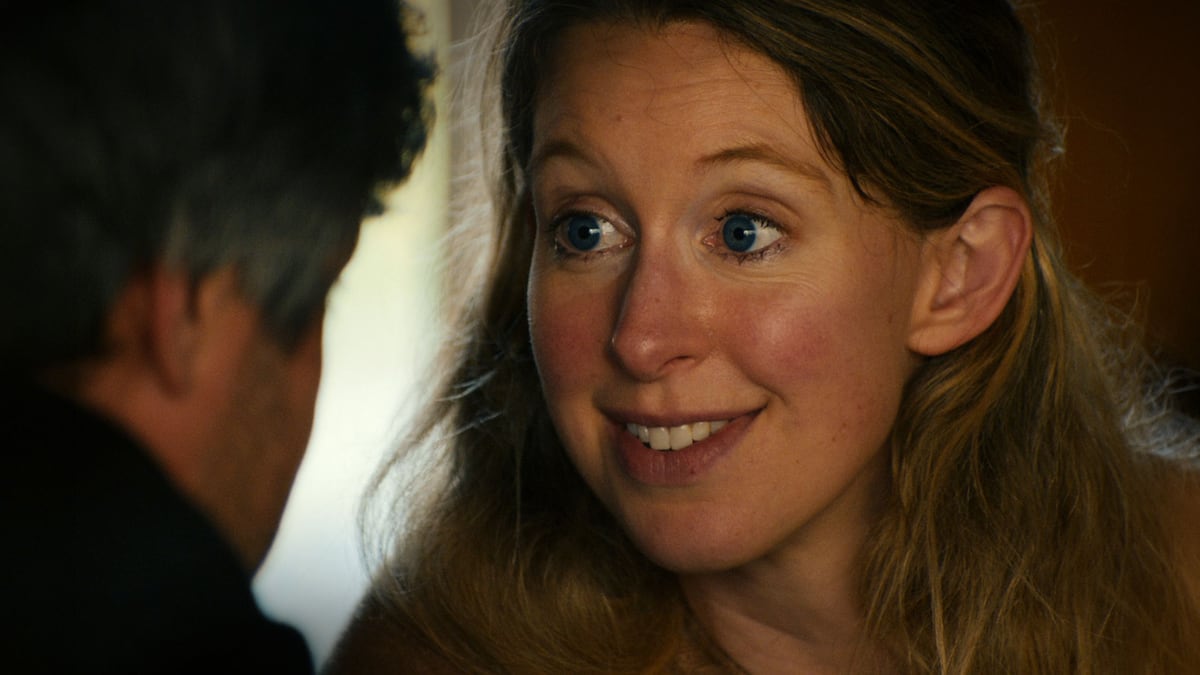
How long has it been since a documentary dominated public conversation, the box office, chats between friends and social media memes? You might have to go back to 2004 and Fahrenheit 9/11, by Michael Moore, or that hybrid (but a film, nonetheless) that blew many minds — The Blair Witch Project in 1999 — to see something similar to what’s happening in the United States surrounding You Can See Everything, this season’s cultural phenomenon.But what is this documentary about — one that nobody was aware of (in fact, it was even developed semi-secretly) — and how is it selling out screenings, earning millions, and even starting to look Oscar-worthy? These key points explain what its nearly three hours cover and the reasons for its wave of success, with some details that touch on its plot but without spoilers (just the one, highlighted at the end).What is ‘You Can See Everything’ about?You Can See Everything is a nearly three-hour documentary about Elizabeth Holmes, who was born in Washington, D.C., is now 42, and who in 2003, aged just 19, founded Theranos. Through that innovative company she became a billionaire by 30, then lost everything, and is now serving a prison sentence for fraud.The documentary follows Holmes’s daily life, that of her husband, Billy Evans, and their children in San Diego, California. Holmes met Evans in 2017, they married in 2018 and had their son Will in July 2021 and their daughter Ivy in February 2023, three months before she entered a Texas prison in spring 2023. Access to their life is complete; everything is public and on view, as the family insists.This is not the first audiovisual work about the case. Those who want to know more can watch the Hulu/Disney+ miniseries The Dropout from 2022, or HBO’s 2019 documentary The Inventor: Out for Blood in Silicon Valley.What was Theranos?Theranos (a portmanteau of therapy and diagnosis) was a Silicon Valley startup that, according to Holmes, would revolutionize medicine. The entrepreneur’s idea was that with a tiny blood sample and a small revolutionary machine, they could, in a short time, uncover all of a patient’s health problems and delay their death. After an initial $3,000 investment, she and her then partner and boyfriend, Ramesh Balwani (known as Sunny), quickly recruited major investors to raise capital and ended up running a company valued at $9 billion.But in reality Theranos’s technology did not work. After unmet promises, deceptions, and whistleblowers, the house of cards collapsed. Lawsuits followed, Balwani and Holmes split, and both were ruined. After a long trial that ended with an 11-year prison sentence, the entrepreneur began serving her term in May 2023.Who is Elizabeth Holmes?Holmes has fascinated the United States and the wider world for years. She marketed herself in documentaries, reports, and through talks as a brilliant young inventor to whom money supposedly never mattered. After Theranos’s fall and her conviction, she has always maintained her innocence.Whether a real person or a character — created by herself or by the media (a question the documentary explores in depth) — a being of pure light or an incredible method actress, Holmes is an incredible mystery. She was one of the few young women at a time when Silicon Valley was at its peak. Reserved in her manner, with a deep voice, tall, blonde, and with enormous blue eyes that barely blink — another of her key characteristics — and always wearing her signature black turtleneck sweater, in You Can See Everything she is seen in a somewhat different light than she has been portrayed in other fictional works and documentaries: older, more mature.Holmes’s narrative is compelling: the story of having it all and losing it all. Here she is more humanized, yet she retains a double edge: the scientific genius who, literally, does not know how to beat an egg (her husband does it for her in one of the film’s most viral scenes); the woman who got into Stanford but does not understand a simple joke; the woman who goes to prison for fraud yet insists, without blinking, that she has never lied, since childhood. Part of the documentary’s appeal is that it presents her this way — more human, but still the peculiar person she is.Who is behind all this?You Can See Everything is directed by Nathan Fielder — a Canadian actor and director (creator of series such as The Rehearsal and The Curse) who often plays on the boundary between fiction and reality and who frequently appears in the footage — and Lance Oppenheim, who makes a few brief appearances. Much of the documentary’s charm lies in the connection between Holmes and Fielder — two strange beings who at times understand each other and at others are diametrically opposed. Also notable is that the director has no filter and asks Holmes and her husband direct questions about money, sex, guilt, their relationship, and legal matters. For example, he gets laughs from the audience when, minutes before she goes to prison, Fielder asks the couple if they’d prefer he leave the house and lock himself in his car so they can have sex.It is produced by the powerful studio A24, which this year has released films such as The Debut, The Invitation with Penélope Cruz, and Primetime, also by Oppenheim. The studio established itself with the Oscar for best picture for Everything Everywhere All at Once in 2023. It has both the appetite — and the possibility — to do it again.What has happened in theaters and at the box office?If you don’t want the front row, it was hard to find a seat to see You Can See Everything at the weekend in much of the United States. All week long, theaters were packed at almost any time of day. On its opening weekend, it sold out more than 2,000 showings.The documentary premiered on Friday, October 16 in the United States (it will reach the United Kingdom and some European countries on November 20, with a release date in Spain of February 12) and, surprisingly, was the second-highest grossing film of the weekend, behind Street Fighter, while costing one-eighth as much: with a $7 million budget, it grossed $15 million at the box office despite opening in only 855 theaters. As the industry newsletter The Dailies joked on Monday, “Theranos finally yields results.” It is the second-best opening weekend ever for a documentary, surpassed only by Fahrenheit 9/11.And all this without promotion, without marketing, without billboards, and with hardly any interviews. And of course with no access to its star, who is in prison.What explains this collective craze?The documentary was almost a secret. A24 gave the directors a free hand to shoot for four years without revealing anything. They premiered it as a surprise at the Telluride festival in early September. When the trailer launched, it became A24’s second-most-viewed and has already amassed 20 million views on YouTube.Learning more about this story, which had a huge impact in the United States, is drawing a younger generation to theaters. Word of mouth has worked. So has its 98% rating (excellent, in other words) on the movie review site Rotten Tomatoes. Audience members even applaud at the end of the screenings.But above all, it’s the clarity of what it tells and how it tells it, with Nathan Fielder’s candor. Discovering the dynamic between Holmes and her husband also surprises viewers, who are left uncertain about who the entrepreneur really is, what she’s after, and where her guilt or innocence lies. In short: it’s hard to explain without spoiling it.What’s happening online?The Elizabeth Holmes look, or the Holmes-and-Fielder combo, is already shaping up as one of the top Halloween costumes in the United States (where costumes do not have to be strictly scary). Even The New York Times listed it among the season’s best.No U.S. media outlet or content creator hasn’t adapted the documentary to their angle: real estate sites comment on the couple’s San Diego house, plastic surgeons discuss Billy Evans’s physical changes at the start and end of the footage, outlets like Vanity Fair analyze Holmes’s wardrobe, People talks about Emma Stone’s connection to the film (warning: it contains spoilers), and there are street contests for impersonators.Can a documentary win the Oscar for best picture?You Can See Everything could win an Oscar, not just for best documentary (though Naza is nipping at its heels), but for best picture. In fact, it is aiming high. This week the awards-specialist outlet Gold Derby gave it a 40% higher chance than the previous week of winning the top statuette.The Oscars would allow it to be nominated and, therefore, to win. It meets all the requirements: release dates, theater run times, length, territories, production... No rule specifically states that a documentary cannot be nominated for best picture. But it has never happened to date.The best picture category can include up to 10 slots, more than any other Academy Awards category. For now, with less than three months until nominations and in the middle of awards season, there aren’t many contenders beyond staples like The Odyssey or Dune 3, surprise pseudo-indies like The Debut and Wild Horse Nine, or the surprise that Spanish film La Bola Negra could deliver.To finish, a small revelation about the documentary’s structure and a spoiler — a bigger one — left to the reader’s discretion.Small reveal: Elizabeth Holmes is not the only lead in the filmElizabeth Holmes — her truths, her lies, and the mix of both — is the documentary’s heart. But halfway through she enters the Bryan, Texas, prison. There it seems that You Can See Everything deflates.However, this small step backward is just to build momentum, because it’s in the second half that the documentary is full of surprises and new twists in its narrative — which is what makes it even more entertaining and compelling. Holmes becomes merely a secondary character in her own story, with her husband and their circumstances taking center stage.(From here, the main spoiler of the documentary...)The surprise actor whose performance could also prove Oscar-worthyYou Can See Everything also contains a surprise cameo that the film itself tries to keep secret (although not for long) and that is causing a sensation in theaters. In 2022 the miniseries about Holmes, The Dropout, premiered, in which Amanda Seyfried played the entrepreneur. That dramatized account helped at the time to better understand Theranos and its founder. Seyfried’s performance earned her an Emmy for lead actress in a limited series — the only Emmy of her career so far.But in the documentary, Seyfried reappears and is again central because she teams up with Fielder to revisit part of that footage. What was meant to be a small appearance turns into her starring in a large portion of the second half; she delves so deeply into the story that she becomes one of its protagonists. She becomes Fielder’s accomplice in the recordings but also portrays Holmes while she is in prison. And that is part of what makes the film so special, because viewers will identify with her, even though it’s not necessarily easy to identify with a Hollywood actor.Her gestures, expressions, conversations with the directors and, above all, her clashes with Billy Evans resonate with the audience. Her portrayal of the entrepreneur could place her in the awards race. A documentary with acting nominations would underline why You Can See Everything is truly unique.Sign up for our weekly newsletter to get more English-language news coverage from EL PAÍS USA Edition
Why ‘You Can See Everything’ dominates conversations, social media, Halloween costumes, and has even been Oscar-tipped
Full Article
Original Source
Read the full article at English →KhanList aggregates and links to publicly available news content. We do not host full articles from third-party sources. Always verify important information with original sources.