
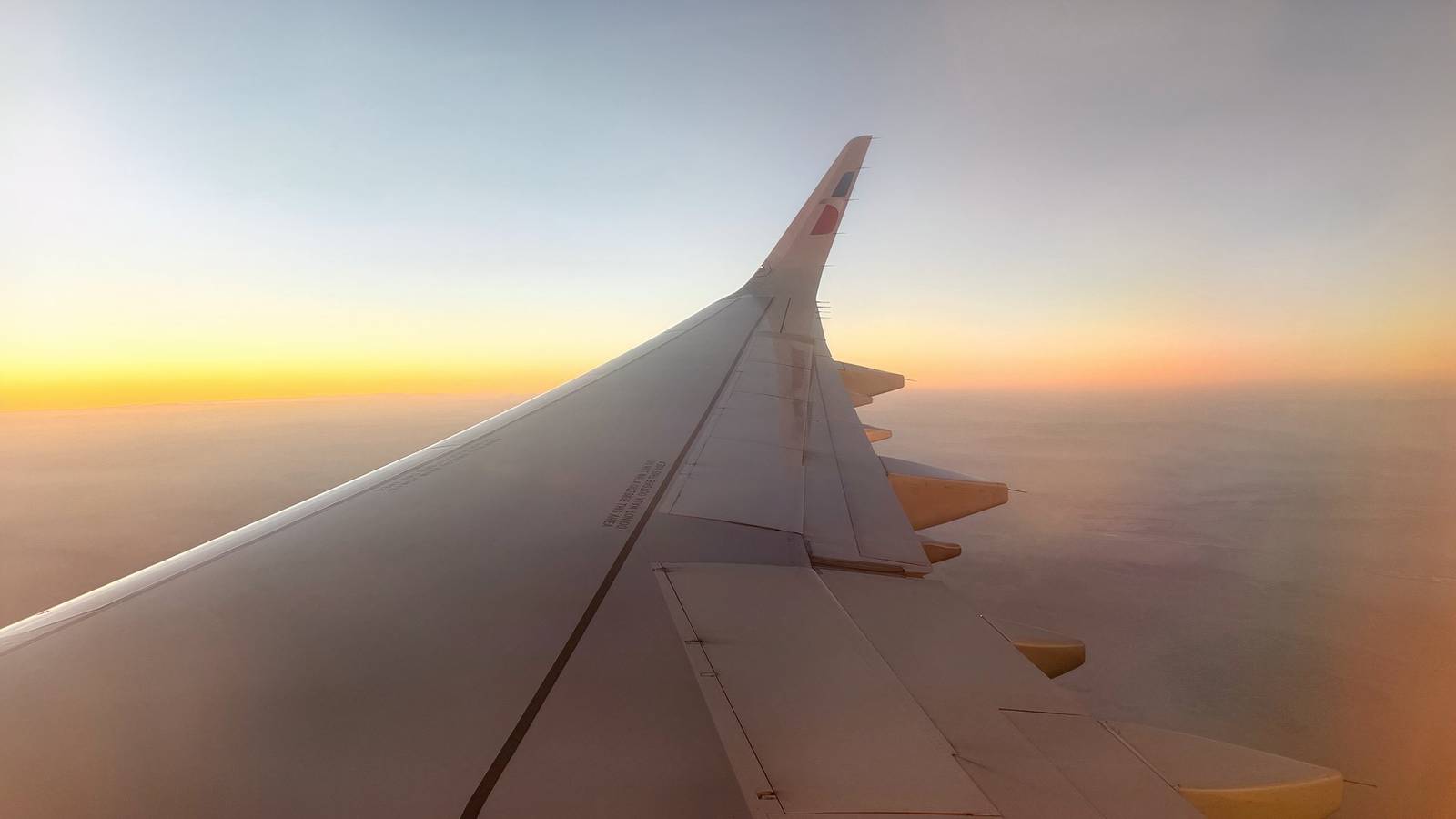
Published Nov 20, 2026, 7:00 AM EST Brandon's passion for aviation started at a young age. He became involved in the flight simulator and VATSIM communities, which sparked his interest in aviation and eventually led him to earn his private pilot license. Outside of work, he continues to build flight hours, explore new airports, and stay involved in the aviation community. The assumption behind the question is that aircraft at cruise are spread across enormous distances, and that is not what the regulations require. Between 29,000 (FL290) and 41,000 feet (FL410), the band where most long-haul flights cruise, the minimum vertical separation is 1,000 feet (305 meters). Laterally, radar separation runs to five nautical miles (9.3 km) enroute and three nautical miles (5.6 km) in terminal areas. An aircraft meeting those minimums is close enough to be plainly visible in good conditions. What keeps most passengers from noticing is the shape of the view, not the distance involved. A cabin window is small, sits at shoulder height, and faces sideways, which rules out the one position where traffic is most likely to be: directly above or below. Aircraft that pass laterally do so quickly, and on a quiet routing there may be nothing within the window’s field of view for hours at a time. In busy corridors, passengers regularly see other aircraft. The Vertical Gap Is Smaller Than You Think The Federal Aviation Administration (FAA) defines RVSM airspace as any airspace between FL290 and FL410 inclusive, where eligible aircraft are separated vertically by 1,000 feet. That band covers almost all long-haul cruise flying, which means the aircraft nearest to a passenger at 35,000 feet (10,668 meters) is frequently one flight level above or below, rather than somewhere over the horizon. The standard was not always this tight. RVSM reduced the vertical minimum from 2,000 feet (609 meters) to 1,000 feet (305 meters), and the global framework is in ICAO Doc 9574, the manual on implementing a 984-foot (300 meters) vertical separation minimum between FL290 and FL410 inclusive. In the US, the rules appear in 14 CFR 91.706 and Appendix G to Part 91. Above FL410, separation returns to 2,000 feet, which is why the band has a defined upper limit rather than continuing indefinitely. A thousand feet is close by any ordinary measure. It is roughly three times the length of a Boeing 777-300ER, and an aircraft at that vertical distance passing overhead is larger in the sky rather than a distant speck. Passengers who do catch sight of opposite-direction traffic at cruise often describe it as startlingly close, which is a reasonable reaction to the geometry involved rather than a sign that anything has gone wrong. The separation is deliberate, monitored, and the product of a decades-long safety case. Aircraft operating in RVSM airspace require specific equipment approval and height-keeping performance monitoring, the conditions on which the reduced minimum rests. Laterally, Five Miles Is The Standard Credit: fotogurmespb | Shutterstock Vertical separation is only half of the picture. When radar separates aircraft at the same altitude, the standard minimum is three nautical miles (5.6 km) within 40 nautical miles (74 km) of the antenna and five nautical miles (9.3 km) beyond 40 nautical miles, under FAA Order JO 7110.65. Enroute centers work to 5 nautical miles below FL600. Those minima can be increased or decreased in specific situations, including wake turbulence sequencing on final approach, where larger gaps apply behind heavier aircraft. Five nautical miles is a meaningful distance on the ground and a modest one at cruise. Two aircraft on reciprocal tracks at typical cruise speeds close that gap in well under a minute, which means lateral traffic is visible briefly rather than persistently. An aircraft crossing ahead of or behind the cabin window enters and leaves the frame quickly enough that a passenger looking down at a screen will miss it entirely. The standards are not uniform worldwide. ICAO Doc 4444 sets a horizontal separation minimum of 5 nautical miles under certain radar and surveillance conditions, and in non-radar or oceanic environments the figures grow substantially, reaching 10 to 20 nautical miles (19 to 37 km) where controllers rely on position reports rather than continuous surveillance. A flight crossing the North Atlantic on a track system therefore operates with different numbers than the same aircraft would over the continental US, which affects how much traffic is nearby and how predictably it appears. In surveillance airspace with five-nautical-mile spacing, there can be a great deal of traffic within a short distance of any given aircraft. It's The Position Of The Window Credit: Janice Chen | Shutterstock If the separation standards put traffic within a few thousand feet vertically and a handful of miles laterally, the reason passengers rarely see anything has to lie elsewhere. It lies where a cabin window is and which direction it faces. A passenger window sits at roughly shoulder height along the side of the fuselage, which produces a field of view that extends sideways and downward. It does not extend upward in any useful way, and it does not extend forward or aft beyond a narrow arc. Traffic 1,000 feet directly above the aircraft, which under RVSM is the single most likely position for another aircraft to occupy, is in the one place a seated passenger cannot look. Traffic 1,000 feet directly below is slightly better placed but still largely obscured by the wing on most seats. That leaves lateral traffic, which is visible but brief. An aircraft five miles away at a similar altitude occupies a small part of the sky, and at combined closing speeds approaching 1,000 knots on reciprocal headings, it moves through the available arc quickly. Looking out of a window at the right moment is a matter of timing rather than frequency. Conditions compound it. Cloud layers above or below the cruise altitude hide traffic entirely. Haze reduces contrast at distance. In daylight, an aircraft against a bright sky is harder to pick out than the same aircraft against darkness at night, when navigation and anti-collision lights make it considerably more obvious. Most of the reports from passengers who have clearly seen nearby traffic at cruise come from night flights, where there is something lit to see. What RVSM Changed, And Why Credit: Andy Dean Photography | Shutterstock The current standard is relatively recent. The North Atlantic became the first ICAO region to implement the reduced vertical separation minimum on March 27, 1997, applying it initially at flight levels 330 through 370. The entire Western Hemisphere implemented RVSM across FL290 to FL410 on January 20, 2005, and Africa followed on September 25, 2008. The rollout therefore took just over a decade from the first region to the last. Halving the vertical minimum roughly doubled the number of usable cruise levels in the band. At 2,000-foot spacing, FL290 through FL410 offers seven levels. At 1,000-foot spacing, it offers thirteen, which is the capacity argument that drove the change. The FAA describes RVSM as allowing aircraft to fly more optimal profiles, save fuel, and increase airspace capacity; a Federal Register notice on the rule stated that RVSM saves fuel and minimizes traffic delays by accommodating more aircraft on the most fuel-efficient routes available. The efficiency gain comes from altitude rather than distance. An aircraft burns less fuel at the altitude its weight and the conditions favor, and that altitude changes during a flight as fuel burns off. Before RVSM, a crew wanting to climb had to wait for a level 2,000 feet higher to be free. With 1,000-foot spacing, the next available level is closer to the one the aircraft is already at, making step climbs easier to obtain and keeping more aircraft nearer their optimum profile. The safety case required equipment and monitoring to match. Aircraft operating in RVSM airspace need specific approval, and height-keeping performance is monitored on an ongoing basis. Where You Actually Do See Traffic Credit: frantic00 | Shutterstock Framing this as something passengers almost never see overstates it. In busy airspace, other aircraft are visible regularly, and anyone who flies often enough will have seen traffic passing above or below on a clear day. The places to look are the places where aircraft concentrate. Oceanic track systems funnel traffic onto a small number of parallel routes at similar altitudes, which is why passengers crossing the North Atlantic frequently see other aircraft on adjacent tracks or one level away. The same applies to major continental corridors, where traffic converges on the same waypoints regardless of origin and destination. Terminal areas produce the most sightings of all, with separation reduced to 3 nautical miles and aircraft at a range of altitudes during climb and descent rather than spread across a single cruise band. Night flying improves the odds considerably. Anti-collision strobes and navigation lights are visible at distances where the airframe itself would be invisible in daylight, and the contrast against a dark sky does the rest. Passengers on overnight transatlantic and transpacific flights report seeing other aircraft more often than those on daytime sectors, which reflects visibility rather than traffic density. The flight deck sees more than the cabin does, which is the clearest indication that the aircraft are there. A forward-facing windscreen covers the arc where converging and opposite-direction traffic appears, and crews receive traffic information from controllers and from TCAS regardless of what is visible. For passengers, the view is sideways, the window is small, and the aircraft most likely to be nearby is in the one direction the window does not cover.
Why You Almost Never See Another Plane From The Window At 35,000 Feet
Full Article
Original Source
Read the full article at Simpleflying →KhanList aggregates and links to publicly available news content. We do not host full articles from third-party sources. Always verify important information with original sources.