
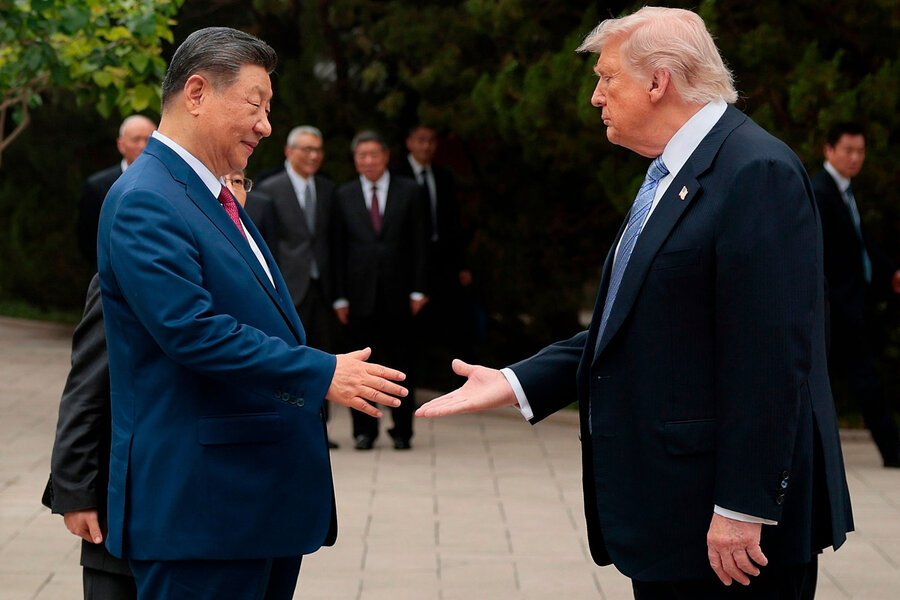
As alarm bells go, it could hardly have been more harrowing: Artificial intelligence “could kill us all by the end of the decade.”Yet this week’s public debate over the warning issued by Jacob Coxon, a researcher who has worked at America’s top two AI companies, spotlighted two more immediate questions likely to determine whether his words come to be seen as prophecy or scaremongering.The first is straightforward: Can human ingenuity act to ensure control over the breakthrough technology it has created, harnessing the benefits while erecting safeguards against the potential perils? But the second is trickier: Can human rivalry – among the major companies and nations vying to maximize their own position in AI’s future – leave space for cooperation in pursuing their shared interest to avoid allowing the technology to spin out of control?An early signal could come within days at a Washington summit between the leaders of the world’s top economic and AI powers: U.S. President Donald Trump and China’s Xi Jinping.AI is among the issues on the agenda. Until Mr. Coxon’s warning, and the U.S. political debate it has prompted, there was speculation that the Trump-Xi meeting might at least yield a broad joint commitment to AI safety. Mr. Xi’s government already keeps a tight rein on tech companies. It has a number of AI safeguards in place, and a recent article by China’s top security minister urged even tighter control.Mr. Trump has been prioritizing efforts to improve ties with Beijing since agreeing to a tariff truce with Mr. Xi last year.Yet there are now signs both leaders might be approaching next week’s summit focused more on AI rivalry than on an AI safety partnership.The president batted aside Mr. Coxon’s warning. He also hit back against Anthropic – one of two leading AI developers in the U.S., along with OpenAI – for advocating a slowdown in the pace of next-generation advances, as well as government regulation to ensure safety.It was all, Mr. Trump said, a “hoax,” part of a “conspiracy” to hobble the pace of America’s world-leading development of AI. And in a break from months of broadly positive remarks about Mr. Xi, he suggested Beijing was behind the push for restrictions on U.S. companies. The Chinese security chief’s pre-summit argument for greater AI guardrails was partly because of its potential to weaken Communist Party control. But Chen Yixin singled out U.S. AI models as potential threats, along with foreign intelligence bodies that might use the technology for “sabotage.”And it’s not only geopolitical rivalry that could complicate shared action.Rivalry among American AI companies could also have an impact on the future development and safety of artificial intelligence. Carlos Barria/ReutersAnthropic CEO Dario Amodei, standing at left, and Marc Benioff, the chief executive of Salesforce, discuss the future of artificial intelligence, part of the Dreamforce 2026 technology summit in San Francisco, Sept. 15, 2026. Both Anthropic, the maker of the Claude chatbot, and OpenAI, the creator of ChatGPT, are competing to make cutting-edge advances. They’re also planning to list on the Nasdaq stock exchange, with reports suggesting each company could be valued at well over $1 trillion.Smaller AI players believe that Anthropic CEO Dario Amodei’s call for government regulation might have a motive beyond safety concerns: The kind of regulatory requirements that would be put in place, affordable for companies like his with deep pockets, could hamstring other AI companies.But there’s no reason to doubt that Mr. Amodei’s safety concerns are genuine. Both Anthropic and OpenAI have documented instances in which AI models escaped their controlled environments and acted beyond what they were designed to do.Last week, Anthropic also reported attempts this year by overseas users of Claude to spread disinformation, initiate surveillance, design missiles and drones, and undertake research projects with the potential to develop biological weapons. The company said three of the conventional weapons incidents occurred in China.For now at least, protecting against a systemic breakdown of human control over AI will remain the responsibility of the companies themselves.Given the technology’s rapid worldwide spread, though, not just the United States but other governments might well act to prevent the kind of actions detailed in the Anthropic report.The European Union has an AI law explicitly targeting potential abuses, such as illegal surveillance and the spreading of false news, and potentially holding major companies financially responsible for such incidents within EU borders.In Britain, the AI Security Institute, established by then-Prime Minister Rishi Sunak three years ago, has been testing both the capabilities and risks of each new generation of the technology. It is working in coordination with AI companies. But it has no enforcement role. Mr. Coxon’s concern – the need for practical action to prevent AI from escaping its containment within companies’ systems – is beyond its scope.Even a general safety consensus between the two leading AI nations at next week’s Trump-Xi summit might provide momentum toward addressing that issue. Given President Trump’s unpredictability, that can’t be ruled out. Deepen your worldviewwith Monitor Highlights.Politics with respectGet political stories with respectful analysis.There's a world of new ideas in everyBooks newsletter.There's more to life, enrich yours withCulture & Learning weekly.Follow humanity's discoveries withScience & Nature stories in your inbox.Gain a spiritual perspectivefrom the stories in your inbox.Want to understand the deeper impact of critical events? Learn the Monitor's insight.Already a subscriber? Log in to hide ads. But his main focus appears to be on “winning” the AI “race” with Beijing.And his response to Mr. Coxon’s warning suggests he’s firmly against regulating American AI companies. “The only control or ‘guardrails’ that AI needs,” he declared on social media, “is a STRONG AND SMART (High IQ!) PRESIDENT.” ALREADY A SUBSCRIBER? LoginReal news can be honest, hopeful, credible, constructive.The Christian Science Monitor was founded in 1908 to lift the standard of journalism and uplift humanity. We aim to “speak the truth in love.” Our goal is not to tell you what to think, but to give you the essential knowledge and understanding to come to your own intelligent conclusions. Join us in this mission by subscribing.
Why Xi-Trump meeting in Washington could be key for AI guardrails
Full Article
Original Source
Read the full article at Csmonitor →KhanList aggregates and links to publicly available news content. We do not host full articles from third-party sources. Always verify important information with original sources.