
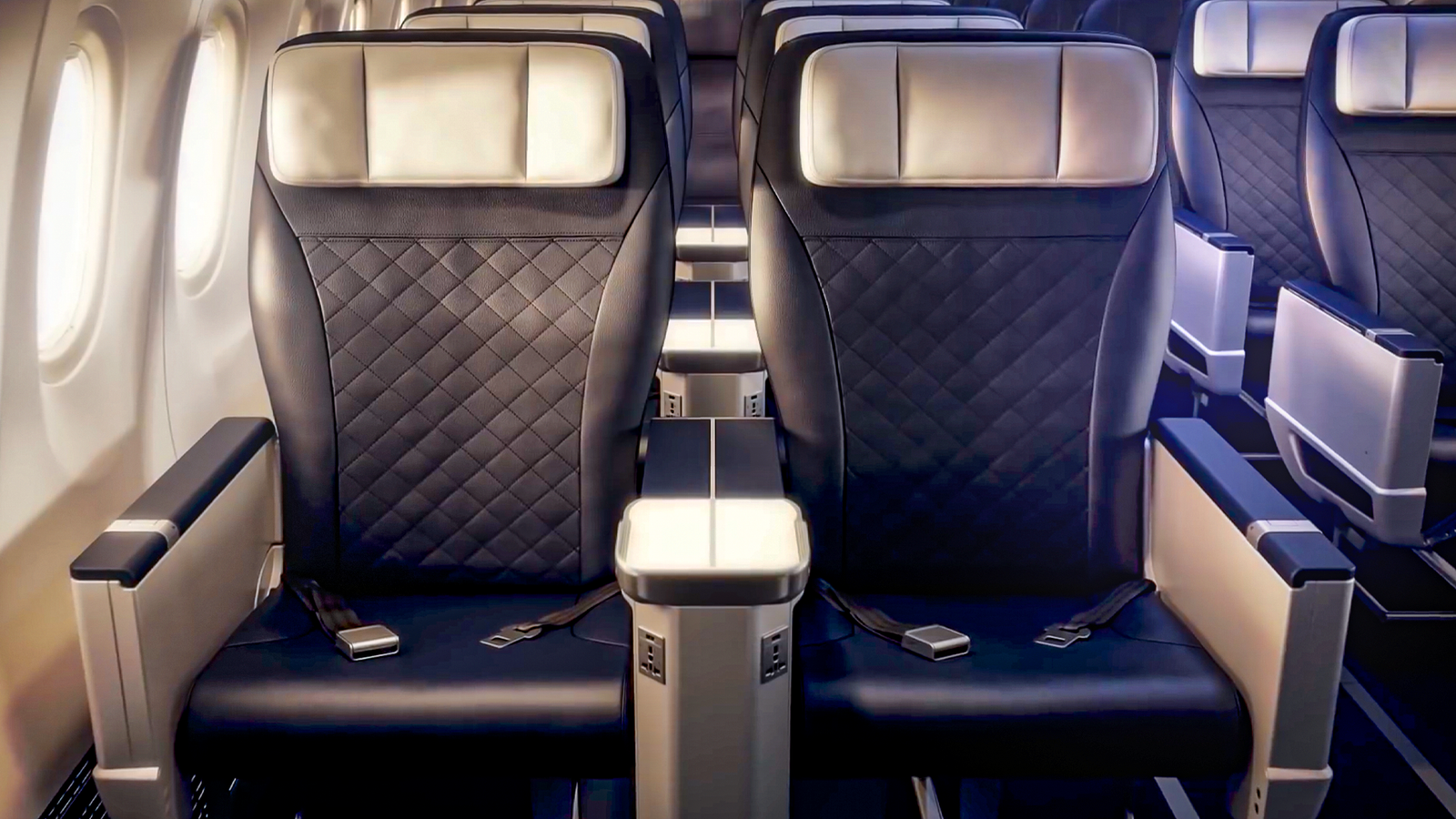
Published Oct 25, 2026, 4:00 PM EDT Based in the UK, Josh is a keen writer with a degree in Military History. Having worked previously as a financial journalist, he has covered the aviation industry extensively, reporting on airlines' results and monthly passenger statistics in the aftermath of the pandemic, alongside the likes of regulation around sustainable fuels, and the prospects for hydrogen-powered commercial flight. He joins Simple Flying with a lifelong love of all things aviation. WestJet offers a prime example of where the Boeing 737 MAX 8 is used to serve a similar purpose to the larger and longer-range Airbus A321LR or Airbus A321XLR. Over the past summer, the Canadian-based carrier has ramped up its transatlantic offerings using the 737 MAX 8. This has placed it as the second-largest narrowbody transatlantic operator behind only Icelandair. But WestJet has stuck with a full cabin of recline-only seats on its 737 MAX 8s for such flights. In contrast, the likes of American Airlines and JetBlue offer a number of lie-flat options on similar routes flown by Airbus narrowbodies between North America and Europe. While each example reflects different ways of approaching the same market, standing by all-recliner-style seating offers WestJet a range of other benefits. WestJet Does Offer Some Premium Seats On 737 MAX 8s WestJet does actually offer several fare options for passengers flying on its 737 MAX 8s, so it is far from a case of a one-size-fits-all solution aboard its narrowbody transatlantic services. This does look different to some peers’ offerings within the same market, however. With 69 narrowbodies in its mainline fleet, WestJet’s 737 MAX 8s come in one of two slightly different configurations. All offer 174 seats, 12 of which are labeled as Premium by the airline and are laid out 2-2 across the first three rows of the aircraft. In terms of economy seating, WestJet offers either 36 or 24 so-called Extended Comfort options depending on the specific aircraft. Passengers can also choose between Preferred and Standard Economy seats, with the former simply located farther forward in the cabin and retaining the same specifications as the most basic option. Seat type Pitch Width Recline Premium 38 inches (96.5 cm) 21.3 inches (54.3 cm) 5 inches (12.7 cm) Extended Comfort 34-36 inches (86.4-91.4 cm) 17.3 inches (43.9cm) 2-4 inches (5.1-10.6 cm) Preferred and Standard Economy 30 inches (76.2 cm) 16.3-17.3 inches (41.4-43.9 cm) 2 inches (5.1 cm) Exit Row 38 inches (96.5 cm) - - Premium seats aboard all of WestJet’s 737 MAX 8s measure 38 inches (96.5 cm) in pitch, 21.3 inches (54.3 cm) in width, and can recline up to five inches (12.7 cm). Preferred and Standard Economy options come in at 30 inches (76.2 cm) and 16.3 to 17.3 inches (41.4 to 43.9 cm) in pitch and width, respectively, while Extended Comfort narrows the gap between the cheapest and most luxurious offerings. All told, that means WestJet’s 737 MAX 8s carry three distinct seat types without sacrificing too much room in favor of one cabin over another. This is arguably necessary given how the carrier uses the aircraft. WestJet Moves Further Into European Market Using 737 MAX 8 In recent months, WestJet has moved further into the European market by launching eight new nonstop routes. Originating from four airports in Canada and serving seven airports across the Atlantic, these are all operated exclusively by 737 MAX 8s, which themselves make up a large proportion of WestJet’s fleet. Specifically, the new routes include: Three connections from Halifax / Stanfield International Airport (YHZ) to Lisbon Humberto Delgado Airport (LIS), Adolfo Suárez Madrid Barajas Airport (MAD), and Copenhagen Kastrup Airport (CPH); three between Toronto Pearson International Airport (YYZ) and Glasgow Airport (GLA), Ponta Delgada Airport (PDL) in the Azores, as well as Cardiff Airport (CWL); one from Edmonton International Airport (YEG) to Reykjavík Keflavík International Airport (KEF); and another between Winnipeg / James Armstrong Richardson International Airport (YWG) and Reykjavík. That meant WestJet buoyed its European network by 44% year-on-year with a single aircraft variant. Naturally, its 737 MAX 8s also serve a string of other routes and form the backbone of its fleet. Conversely, American Airlines and JetBlue have opted for more specialized planes on comparable long-and-thin routes, like those new to WestJet. American Airlines And JetBlue Use Specialized Variants For Similar Purpose These include variants from the Airbus A321neo family specifically developed for the purpose of pushing the bounds of narrowbody flight. Where long-haul connections like those between North America and Europe were historically opened up by widebodies, the larger models had to be filled to make flights viable for airlines. New single-aisle jets, such as Airbus’ longer-range A321neo variants, have in turn opened the door for airlines to serve less dense but still lengthy routes where this may have been the case. At US-based JetBlue, transatlantic operations have been built around the A321LR since it entered the market in 2021. Though it has plans to eventually introduce the A321XLR as well, the bulk of its transatlantic services are flown by the 11 A321LRs within its fleet as it stands. These encompass 138 seats in total, 24 of which are in the form of Mint suites with lie-flat beds. Model/Specification Boeing 737 MAX 8 Airbus A321LR Airbus A321XLR Typical seating 160-180 180-244 180-244 Max seating 210 244 244 Range 3,500 nautical miles (6,480 km) 4,000 nautical miles (7,400 km) 4,700 nautical miles (8,700 km) Length 129 feet, 6 inches (39.5 meters) 146 feet (44.5 meters) 146 feet (44.5 meters) Similarly, American Airlines is in the process of adding the A321XLR to its fleet, in part to open long-and-thin connections to and from Europe. The first of these began this year, linking John F. Kennedy International Airport (JFK) and Edinburgh Airport (EDI). Unlike JetBlue, American Airlines’ introduction of the long-range single-aisle variant complements an extensive widebody fleet. The common factor is that American Airlines uses such aircraft for a similar, specific purpose and offers 20 lie-flat Flagship Suites out of 155 seats onboard. Needless to say, this means there is a disparity in the way the two approach the market against WestJet. Cost Versus Comfort On Long And Thin Transatlantic Routes Credit: JetBlue Indeed, JetBlue and American Airlines both reserve far more space for premium-paying passengers aboard their long-range single-aisle variants. For American Airlines, lie-flat seats make up almost 13% of its A321XLRs’ total capacity. In terms of JetBlue’s A321LRs, that proportion exceeds 21%. That is before factoring in the mix of premium economy and economy extra equivalents on each. Aboard American Airlines’ A321XLRs, for example, passengers will also find 12 Premium Economy seats with 38 inches (96.5 cm) of pitch and 21.3 inches (54.1 cm) in width. A further 12 Main Cabin Extra options measuring 34 inches (86.4 cm) and 16.6 to 18.7 inches (42.2 to 47.5 cm) in pitch and width, respectively, are also offered as an alternative to standard Main Cabin seats. These themselves exceed WestJet’s own standard offerings by two inches (5.1 cm) in pitch. For reference, some of JetBlue’s 24 EvenMore premium economy seats also bridge the gap between standard and lie-flat on its A321LRs. In comparison, WestJet’s 12 Boeing 737 MAX 8 Premium options account for less than 7% of each jet’s total. Neither offers seatback screens, unlike JetBlue and American Airlines’ comparable services. That creates a far denser, more basic cabin setting, in line with WestJet’s position as a low-cost carrier, but with what tends to be a superior offering compared with typical budget carriers. This is where the decision to run each of its 737 MAX 8s at the same capacity, with broadly the same seating offerings, comes in. Fleet Commonality At WestJet WestJet’s core fleet encompasses just two aircraft families: The Boeing 737 and the Boeing 787. Within this, it has examples of the Next Generation Boeing 737-700 and Boeing 737-800, as well as the newer 737 MAX 8. The Boeing 787-9 then solely makes up its widebody portfolio. Simply put, WestJet’s operating model relies heavily on just a handful of models, which is a common mark of airlines positioned towards the lower-cost end of the market. With the airline in the midst of phasing out its oldest aircraft, 737-700s, WestJet has recently moved to reconfigure both its 737-800s and 737 MAX 8s to share the same capacity. Model Number in fleet Average age Boeing 737-700 25 19.8 years Boeing 737-800 52 13.1 years Boeing 737 MAX 8 69 5.0 years Boeing 787-9 Dreamliner 7 6.8 years Total 153 10.2 years Some 16 former Swoop aircraft and 18 more from Sunwing Airlines were part of this, with WestJet having finished retrofitting the aircraft to match its own standardized configurations in August. “Unifying our narrowbody fleet is an important step in delivering the reliable and welcoming experience our guests and WestJetters expect from us,” chief experience officer Samantha Taylor said at the time. But that works both ways, of course. Operating a standardized fleet comes with the perks of flexibility and operational efficiency. Add in the longer range of aircraft like the 737 MAX 8, and the same aircraft with a common seating plan can easily be shuffled between a variety of routes. That is, where leisure travelers are largely the target. Some Peers Also Use 737 MAX For Transatlantic Flights WestJet is not the only airline to utilize the 737 MAX 8 for transatlantic flights. Air Canada, Icelandair, and United Airlines have all been known to do so as well recently. In the case of the latter, the variant has been cited as a solid alternative when premium-heavy jets like the A321XLR may not suit the target customer base. “Quite candidly, even if I had the XLR, I wouldn’t use it on these routes,” United global network planning and alliances senior vice president Patrick Quayle told Live And Let’s Fly last year. “That’s where the MAX 8 is extremely valuable and allows us to get into some of these ‘sportier’ markets where there is less demand for a lie-flat seat.”
Why WestJet Is Sending Boeing 737 MAX 8 Recliners Across The Atlantic While American & JetBlue Bet On Lie-Flats
Full Article
Original Source
Read the full article at Simpleflying →KhanList aggregates and links to publicly available news content. We do not host full articles from third-party sources. Always verify important information with original sources.