
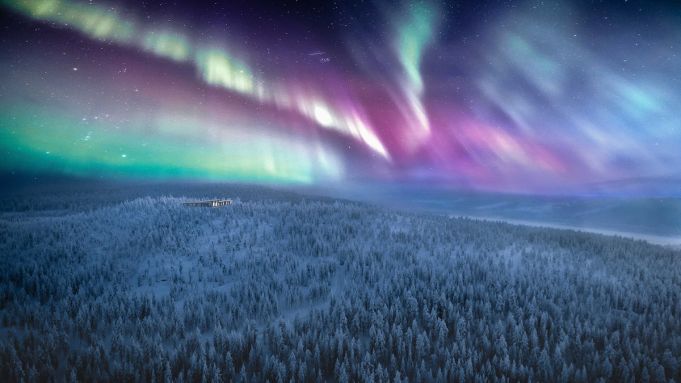
Riksgransen, population 60 (give or take), stands as Sweden’s northernmost ski resort, where adrenaline-seeking snowboarders and daredevils gather during the winter months for 360-degree heli-skiing. As far as remote destinations go, this is up there—125 miles shy of the Arctic Circle, where the summer sun never sets and winters are full of dancing Northern Lights and subzero temperatures (that extend well into May). A mere 17-hour sleeper train from Stockholm, Riksgransen remains reasonably unpopulated because of heavy snowfall (even snowmobiles get lost and buried here). If you choose to settle down, your closest neighbors are elk, reindeer, and grouse, depending on the seasons. Yet this tiny village has become paradise for finance guys, tech giants, and C-suiters who want to shred 2,000 square miles of off-piste powder and ride a helicopter rather than a ski lift. This is more than just a hobby—it’s a way of life, and the super rich can’t get enough. Unruly, untamed, and unlike any other destination in the world, Riksgransen is definitely never mentioned in the same vein as St. Moritz or Courchevel, but real powderheads know this is where skiers come to live with abandon. The Belmonds and Cheval Blancs of the world don’t exist here—they probably never will—but those in the know stay at Niehku Mountain Villa ($730/night, including breakfast but not activities), a 14-double-room lodge with an authentic Swedish sauna and aufgussmästare (sauna master), comfy Hästens beds, and a spectacular cellar stocking 3,000 bottles, including some crates from Romanée-Conti. The journey’s reward is an A+ day of skiing around Sweden’s northernmost resort. Mattias Fredriksson As ultra-high-net-worth travelers continue to seek out more one-of-a-kind, authentic experiences, remote destinations remain high on everyone’s lists. While Niehku Mountain Villa operates as a hotel, buyouts ($11,000/night) are common and a mere drop in the nearby Norwegian Ofotfjord for Nordic media moguls who frequent the property and just can’t stand another faux luxury hotel. “The category is having a moment,” says Lindsay Messina, cofounder of Fioraé Luxury Travel. “The rise of luxury lodges is a very exciting shift in high-end travel. For those who’ve already experienced top hotels many times over, they crave something more immersive, intimate, and rooted in place,” says the luxury travel adviser. Whether it’s a tented camp in Botswana, a cliffside retreat in New Zealand, or a converted manor house in Ireland, “a lodge isn’t a building type—it’s a feeling of being completely immersed in a place. Once clients experience it, they often don’t want to go back,” says Messina. According to Deutsche Bank Wealth Investment, the uptick in luxury lodges all started after the pandemic. Since then investors are increasingly backing “experience-rich assets,” including an influx of independently owned lodges. Though there isn’t an official global database tracking the number of independent luxury lodges, hundreds of high-end nature retreats and safari camps have debuted worldwide since 2023. The European real estate market also offers a good parallel. In Switzerland, demand for second holiday homes and chalet-style lodges by international buyers has led to way higher than average prices in alpine regions. Verbier and Gstaad have risen in rankings, and now stand as the most expensive tourist destinations in the country, only just lagging behind St. Moritz. “Across Europe, there is clearly growing demand for experiential luxury and nature-led hospitality,” says Joachim Jocab, general manager of Four Seasons Megeve in the French Alps, who cites the growth in alpine regions as more than just a trend. “Travelers are increasingly drawn to destinations that combine exceptional service with outdoor experiences, wellness, and a strong sense of place.” Niehku Mountain Villa has a spectacular wine cellar, stocking 3,000 bottles. Håkan Stenlund Perhaps a precursor and poster child for remote travel back in the late noughties, “glamping” was the first to stake a claim in remote-luxury travel, but the trend has transformed from tented camping to wilderness palaces that deliver traditional five-star accommodations plus perks: destination dining, longevity and wellness programming, and intangible experiences that speak to social circles. At Niehku Mountain Villa, co-owner and creative director Thomas Eidefors—who has worked with Sweden’s top Michelin and celebrity chefs—takes his hospitality program seriously. A typical Niehku outing sends guests out treading slopes, climbing summits, and swimming fjords with one of the best guides in the country, Robert Gustafsson, a master of free-ride competitions and stalwart in arctic mountaineering. Post-adventure, the lodge has serious cred as a culinary destination with an award-winning pastry chef, the country’s best sommelier, and a top Nordic chef. The hospitality indoors matches the superlatives found outdoors, which Eidefors says is an “extension of the hospitality” that many guests expect. “The beautiful settings do the heavy lifting, but the level of care and service rivals any five-star hotel,” adds Messina. “With lodges, you now get butler service, chef-driven dining, spa programming, and top-notch amenities alongside the privacy and setting. It’s genuinely the best of both worlds. But beyond amenities, I think what’s driving the shift is a desire for meaning.” Jocab agrees: “It is no longer simply about accommodation. It is about the emotional value of the experience and the sense of belonging it creates.” Deep into the ‘world’s last great wilderness‘ In the Nordics, where the wayfaring culture—foraging and getting back to nature—is a lifestyle, luxury lodges have opened up in a flurry. In Finland, spanning Lakeland to Finnish Lapland, more than a dozen luxury lodges have opened since the pandemic. Balder lodge, Aino Private Island Hotel, and Skyra Retreat have opened in the last year with full buyouts on offer, and some are already booked out for the upcoming winter seasons. Octola II, which opened in December last year, leads the pack as one of the most luxurious additions. “Octola was built around the idea that true luxury is privacy, silence, space, and a genuine connection with nature. We didn’t want to build just another luxury hotel which is increasingly standardized now,” says Janne Honkanen, founder of Octola, which was conceived as a response to conventional travel. “For us, luxury is not about excess,” he adds. “It’s about exclusivity, authenticity, and the freedom to experience one of the world’s last great wilderness.” New in December 2025, the Octola II Ultra Lodge is in an undisclosed location in Finnish Lapland. Octola The all-new Octola II Ultra Lodge sleeps 17 with both the exact price and location kept hush-hush, and all the mind-boggling logistics taken care of by Octola. That might include transfers by huskies, helicopter, or snowmobile, access to five en suite bedrooms spread out over 800 square meters, an in-house spa with three saunas, a fully equipped gym, a cigar lounge, a dedicated space to view the Northern Lights, and a wilderness guide to navigate more than 800 hectares of Lapland. “The remoteness is one of the defining characteristics of Octola,” says Honkanen. “It feels like you have reached the edge of the world.” Jason Squatriglia, founder of Your Favorite Travel Agent and a Robb Report Travel Master, says seclusion and exclusivity are top priorities for his guests right now. “In a hyperconnected world, we need to disconnect to reconnect,” he says. “The modern traveler is beginning to circle back to the reality that time is their greatest asset—privacy is non-negotiable.” Octola 1 was built around the idea that “true luxury is privacy, silence, space, and a genuine connection with nature,” says founder Janne Honkanen. Around the world, the list of luxury lodges setting up home bases among some of the world’s most pristine wilderness continues to grow: Flockhill in New Zealand, Bainslodge in Botswana, Wildland resorts in Scotland, Amankora in Bhutan. An early leader in next-level remote expeditions, Eleven Experiences began as a renovation project for Chad Pike and his designer wife, Blake, when they opened backcountry ski lodge Scarp Ridge in Colorado in 2011; it has since grown to more than a dozen luxury lodges, including 13-room Eleven Deplar Farm in a converted sheep farm in northern Iceland, where Justin Bieber famously holed up to record new music in 2025. Big hotel brands aren’t sitting idly by, watching the trend curtail their presence. “We’re seeing more luxury hotel chains—Four Seasons, Aman, One&Only—venture into the world of private homes, villas, and residences in order to maintain their market share,” says Squatriglia. HNWT individuals and families alike are seeking more off-the-grid vacations, “mainly because discretion is in and flaunting wealth is out. By replacing the same overexposed vacations in South of France or St. Barts with more remote destinations, they’re able to guarantee themselves maximum privacy while ensuring the same levels of safety and luxury.” “Seasoned travelers and explorers constantly long for the most hard-to-reach destinations,” says Johan ‘Jossi’ Lindblom, founder and co-owner of Niehku Mountain Villa. “Our purpose for opening Niehku comes from our own thirst to bring meaning to why we travel.” “This is not a trend we have jumped on,“ adds Eidefors. “From the start we have always extended our hospitality to match the surroundings around us and build curiosity.” “This is Europe’s last wilderness,” says Jossi, “and we make it accessible.”
Why Wealthy Travelers Are Flocking to Remote Destinations Across the Globe
Full Article
Original Source
Read the full article at Robbreport →KhanList aggregates and links to publicly available news content. We do not host full articles from third-party sources. Always verify important information with original sources.