
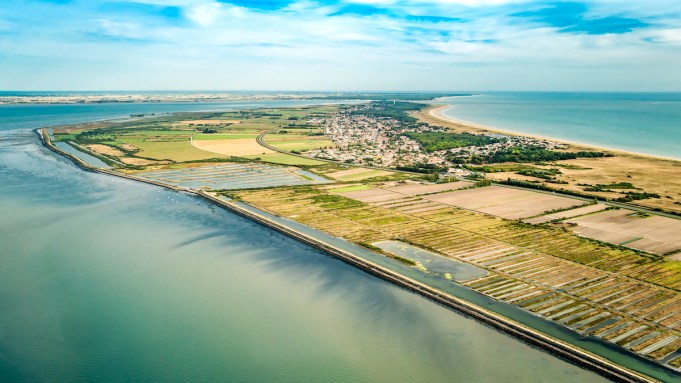
Twice a day, coming and going with the tide, a 2.5-mile road known as le Passage du Gois emerges from beneath the Atlantic Ocean, connecting the west coast of France to a petite island south of Nantes. Not even half the square mileage of Nantucket, Noirmoutier-en-l’Île is an idyll the French know very well but Americans may miss, drawn instead to the glitz of Biarritz or St. Tropez. Yet is there anything more exclusive than an island guarded by nature’s bouncers, keeping guests out until low tide? Noirmoutier is one of those quietly decadent destinations that’s low on pretense, high on bounty, where chefs craft three-Michelin-starred meals with seafood from the fish auction across the street and vegetables and herbs from the organic kitchen garden. (Truly: La Marine, led by chef Alexandre Couillon, is a hyper-local restaurant that needs no introduction and will start taking reservations for 2027 on November 4—mark your calendars.) Travelers familiar with Scotland’s Isle of Skye may recognize this recipe for remote luxury, though rather than craggy cliffs and emerald-green glens, Noirmoutier is closer to a little slice of California. Here, pine forests meet sand dunes, salt marshes yield a famous hand-harvested sea salt, and well-heeled locals aren’t heeled at all. They’re barefoot and surf bound. Happy hour is oyster hour, particularly in La Guérinière, a commune with a rich history of oyster farming. Mathieu and Aurélien Gendron, brothers and co-managers of Les Petits Bassets, renovated a former oyster hut in the marshes to be a seasonal “tasting cabin,” Le Bouclard, where visitors can feast on what’s harvested from April to October (and even tour the oyster farm with their father, Alain). If you visit the island in May, try to time it around the brief but glorious harvest of “La Bonnotte” potatoes—aka the world’s most expensive potato. These tubers have fetched $600 per kilo at auction, growing in three months and yielding a delicate, lemon-y or salty taste. Never go hungry in the Bonhomme oyster port in La Guérinière. Simon Bourcier Longtime Robb Report readers may recognize the name Bois de la Chaise, usually paired with “contemporary coastal retreat” or “exquisite manor for sale.” This protected pine forest on Noirmoutier’s northeast coast is home to multimillion-euro real estate, many of them second homes of Parisians or les Nantais. Aristocrats built grand villas here in the 19th century, and the Belle Époque architecture remains, mingling with more modern homes with private beach access. Plage des Dames is a particularly beautiful beach, its historic white wooden beach huts sheltered by oaks. Paparazzi don’t venture here. Instead, families will relax in peace knowing the secret isn’t out on Noirmoutier (until now—sorry). As temperatures continue to rise in the South of France, more travelers are looking north to the department of Vendée, home to Noirmoutier, Île d’Yeu (an even more laid-back, camper-happy island), and roughly 155 miles of windswept coastline. Given how much sunshine the region gets, it has also earned the nickname Côte de Lumière (Coast of Light), a cheery moniker for a place that hosts the world’s most grueling sailing race—the nonstop, single-handed, round-the-world Vendée Globe, which sets off from Les Sables D’Olonne every four years. Aerial view of St. Gilles Croix de Vie, the sardine capital of France. Pierre Ollier Kitesurfers know the seaside town St. Gilles Croix de Vie as a sublime launch site, while foodies flock here for the sardines. Kid you not: St. Gilles Croix de Vie is a Site Remarquable du Goût (Remarkable Site of Taste) and considered the French capital of sardines, with its own spring sardine festival; a museum, shop, and tasting room at L’atelier de la Sardine; and a 1.5-mile walking trail (marked with blue sardines) that point out 14 historic and significant sites related to the tiny fish. Lest you think sardines will get too big for their can with all that attention, agri-rich Vendée is also a place that celebrates flower festivals, chocolate festivals, astronomy festivals—you name it, it gets a festival. Nature is well and fully respected across the region, nowhere more so than the inland marshland dubbed “Green Venice,” a “magical maze of canals” (so lovingly depicted by The New York Times) shaded by willows and alders “like transepts in a cathedral. Driving across the small bridges, you can catch a glimpse of a lone barge (a yole), gliding flat along a canal, silently swaying, its boatman poking the water with a long paddle (the pigouille), standing upright like a gondolier.” Maybe it’s a little bit of Italy, a little bit of California, and a lot of understated France.
Why Wealthy Travelers Are Flocking to France’s ‘Little California’
Full Article
Original Source
Read the full article at Robbreport →KhanList aggregates and links to publicly available news content. We do not host full articles from third-party sources. Always verify important information with original sources.