
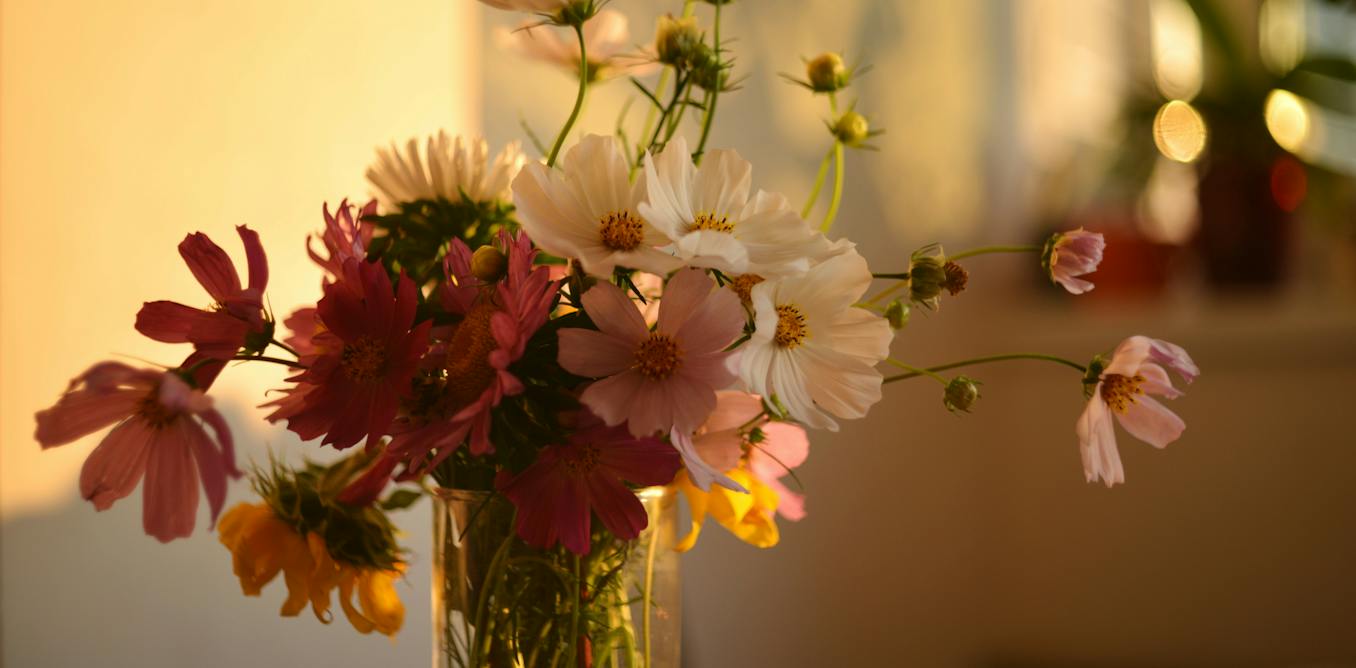
During his renowned excavations at the Shanidar Cave in the Kurdistan Region of Iraq, American archaeologist Ralph Solecki located burial sites with uncovered pollen and flower fragments from various species of wildflowers. He interpreted this as evidence that Neanderthals may have placed flowers around their dead at their burial sites around 60,000 years ago. Through the ages, flowers have provided comfort for numerous reasons – biological, psychological, cultural, sensory and symbolic. So why do cut flowers help and bring us comfort? And why do we give flowers to someone when they are grieving, or buy flowers for ourselves when we are sad? When words can’t be said Flowers have the capacity to convey comfort where or when words may be difficult to express. At times of mourning, a bouquet or bunch of cut flowers can be given without demanding a conversation which may be difficult, awkward or unnerving. Flowers acknowledge gentle recognition in a non-intrusive way. Their textures, colours, fragrance, shapes, formations, variations can stimulate or sooth our senses and elevate our mood. Flowers can lower stress levels and trigger calming chemical responses in the brain. Like all nature, flowers embody the cycle of life and represent life affirmation. As with life itself, flowers – and especially cut flowers – are attractive exactly because they, like us, have a shelf life: they acknowledge death has its place within the natural order. Multiple meanings Meanings of flowers and death vary around the world. The beautiful chrysanthemum flower, for example, has different meanings in different cultures. In Japan, chrysanthemums are associated with death and reincarnation and are placed in the coffin of someone deceased. In Chinese culture white and yellow chrysanthemums are often sent the family of the deceased, while other colours are usually avoided. Edgar Degas, A Woman Seated beside a Vase of Flowers, 1865. Metropolitan Museum of Art In the United States, where chrysanthemums symbolise truth and purity, they are used to honour and remember a person who has lived a full life. In France, Germany, Italy and Malta, chrysanthemums are viewed as flowers only to be given to the dead. Australian Indigenous peoples use native plants, leaves and flowers into holistic mourning customs and healing practices during Sorry Business. Living with grief Grief is tiring and may result in physiological and psychological fatigue. There is a psychological theory called Attention Restorative Theory which says mental fatigue and concentration can be improved by time spent in, or looking at, nature. Similarly, a vase or container of cut flowers when grieving can bring calm consolation and help lighten a solemn time. To live with grief, we should not seek to abandon the deceased, but to build the past into the present. Giving flowers to someone when they are grieving can maintain a nurturing presence of, and connection with, the deceased loved one while sustaining the lives of folk still living. These young girls in 1917 brought flowers to the funeral of the victims of a first world war air raid in Folkestone, England. © Hulton-Deutsch Collection/CORBIS/Corbis via Getty Images Grief, loneliness, sadness and other forms of suffering can narrow our focus to pain and loss: to being without. Cut flowers provide an opportunity to capture our attention differently. They can be a reminder that life continues and changes. They help us to recognise that beauty, joy and delight still can reside alongside sorrow, misery and distress. Flowers play a significant role for public outpourings of grief with floral tributes enabling a visual unity, quiet tangible support and shared mourning for communities. Caring for self The act of selecting, picking or buying cut flowers for yourself, at any time, is an expression of self-compassion and self-care. A solitary flower or a bunch of cut flowers cultivates a personal space into a space of caring worthiness, acknowledging kindness towards oneself. Flowers may offer you a range of meanings – pleasure, joy, bliss, happiness, contentment, celebration and gratification. Life challenges often are accompanied by struggle. Cut flowers help us soothe and attenuate during such stressful times. They quietly play a tangible role as a reminder that we are connected to life and others. Flowers provide a valuable gift and ritual linking us with life itself. They are living things that seed, grow and flourish before fading: a powerful metaphor representing the fragility of our human life. In their exquisite beauty and symbolism, flowers offer comfort – not to erase our grief or pain, but more to affirm our ongoing love, gratitude, memory and hope.
Why we give flowers to those in grief – or buy them for ourselves when we’re sad
Full Article
Original Source
Read the full article at Theconversation →KhanList aggregates and links to publicly available news content. We do not host full articles from third-party sources. Always verify important information with original sources.