
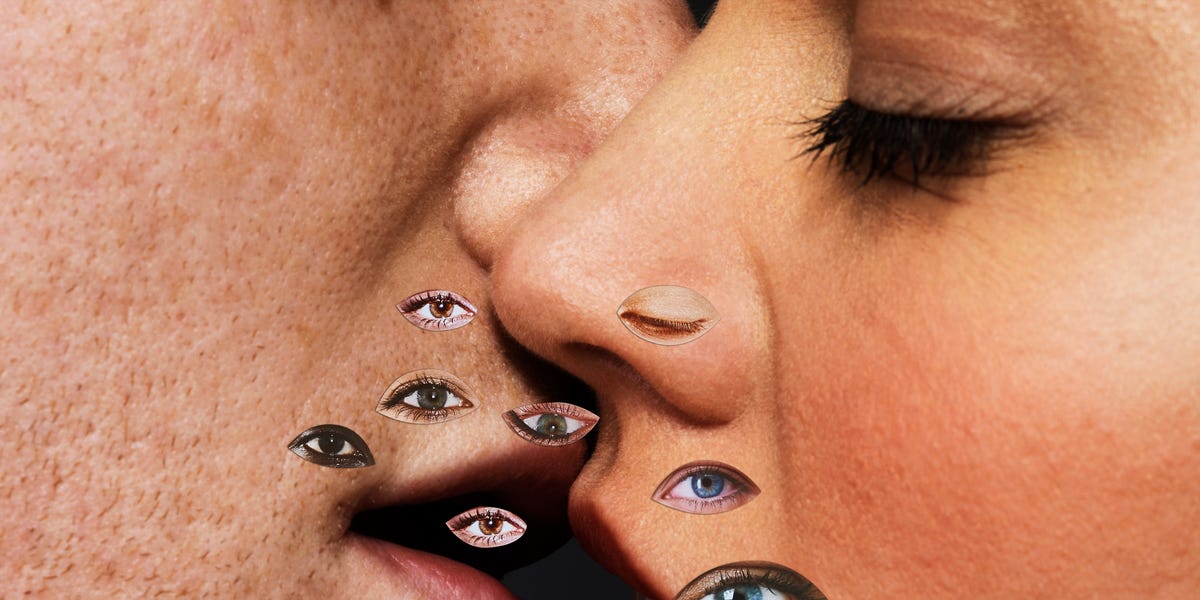
Admittedly, there are a few reactions people have to seeing others tangled up in a make-out session. Are you the type to say “Aww” to yourself and keep pushing? Do you roll your eyes? Or maybe, for reasons you may not admit, do you suddenly feel a little…sad? It turns out seeing other people bask in their romantic-related happiness evokes a lot of complicated and personal feelings in the innocent bystanders witnessing the whole thing.According to a survey conducted by the dating app Hily, a twinge of sadness may be more common among Gen Z witnesses in particular. Nearly 1 in 3 Gen Zers say they don’t like seeing couples make out in public, compared to fewer than 1 in 5 millennials. And it isn’t actually because they think it’s “gross” or “inappropriate”—more than half say seeing a couple kiss in public makes them feel straight-up lonely.So why does someone else’s PDA feel so personal?PDA has always been polarizing. For some, PDA—whether it’s holding hands, a kiss on the cheek, or swapping serious spit—is a sweet declaration that you’re in deep infatuation and you don’t care who knows it. For the pearl clutchers, it’s an unbecoming act that’s reserved for the privacy of one’s home. But for Gen Z, there are a few different things at play.Clinical psychologist Sabrina Romanoff, PsyD, says this generation has grown up in a culture where so much of what happens in public is performed—and potentially recorded. In an age of influencers and virality, it can be hard to imagine anything done in public without wondering about the motive behind it. “In some ways, PDA can feel performative,” she says.PDA is shining a light on what we don’t have in such an explicit, tangible, almost primitive way.—Sabrina Romanoff, PsyDBeyond that, though, Gen Z has had some pretty intense stats: The New York Times has said they’re having the least sex, the fewest romantic relationships, according to the Survey Center on American Life, and are being called the “loneliest generation.”Which brings us back to how deeply personal it could feel to watch someone else make out. If seeing someone else’s intimacy makes you feel bad, it may be less about the couple in front of you and more about what their intimacy brings up in you.“PDA is shining a light on what we don’t have in such an explicit, tangible, almost primitive way,” Romanoff says. “A lot of people tend to project their own insecurities onto PDA.”This spark of jealousy doesn’t necessarily mean that you want what that particular couple has. It can simply point to something you wish you had more of in your own life. As Romanoff puts it, that feeling can be a signal of an area of your life you want to “feel more full in” or “put more effort into.”The problem is what happens when we don’t stop to figure out what the feeling is trying to tell us. “Instead, when people are triggered with a bad emotion…it’s very easy to just turn on the person whi triggered you,” Romanoff says.Think about the Central Park bench incident. In July, a TikToker posted a video of two adult strangers kissing on a bench as he shouted, “Get a room! There’s kids around.” The video now has more than 4 million views. The people’s identities have been revealed, along with details about their workplace and families. But why the urge to record them?There is much to be said about the surveillance state we’re all living in and the increasingly blurred lines between witnessing something in public and making content out of it. But Romanoff also points to the emotional impulse behind recording strangers and shaming them.“If we aren’t willing to say, ‘Wait, maybe this is speaking to something that I have unresolved in me,’ it’s very easy to just project it out there and say the problem is there,” she says.What do you do if you recognize this feeling in yourself?For starters, don’t act on the emotion as it comes up. Romanoff recommends stopping to observe what’s happening internally before deciding what to do with it. A big reaction, she says, can be an indicator that something else underlying has been activated.“That’s a signal for you to take a step back and take inventory. Okay, what’s being activated in me? What wound is being reopened here?”That doesn’t mean you need to turn every make-out session you witness into a deep psychological analysis. Sometimes you’re simply annoyed. But if the feeling is bigger than the situation seems to warrant, it may be worth asking yourself what exactly you’re reacting to.As Romanoff puts it: “People make the mistake of having a big emotion and then following the action urge that comes with that emotion.”And more than anything, people make the mistake of forgetting that that couple on the bench is also human—and that perhaps there was a time when you were so enamored with another person that you would French kiss them in broad daylight in a public park and not care who was around to see.The idea that we should shame PDA ultimately means losing more than just people making out on the street. “The biggest thing that we are losing is our empathy for people,” Romanoff says.No one says you have to enjoy watching strangers make out. But maybe you don’t need to hate it either.
Why Watching PDA Feels So Personal
Full Article
Original Source
Read the full article at Cosmopolitan →KhanList aggregates and links to publicly available news content. We do not host full articles from third-party sources. Always verify important information with original sources.