
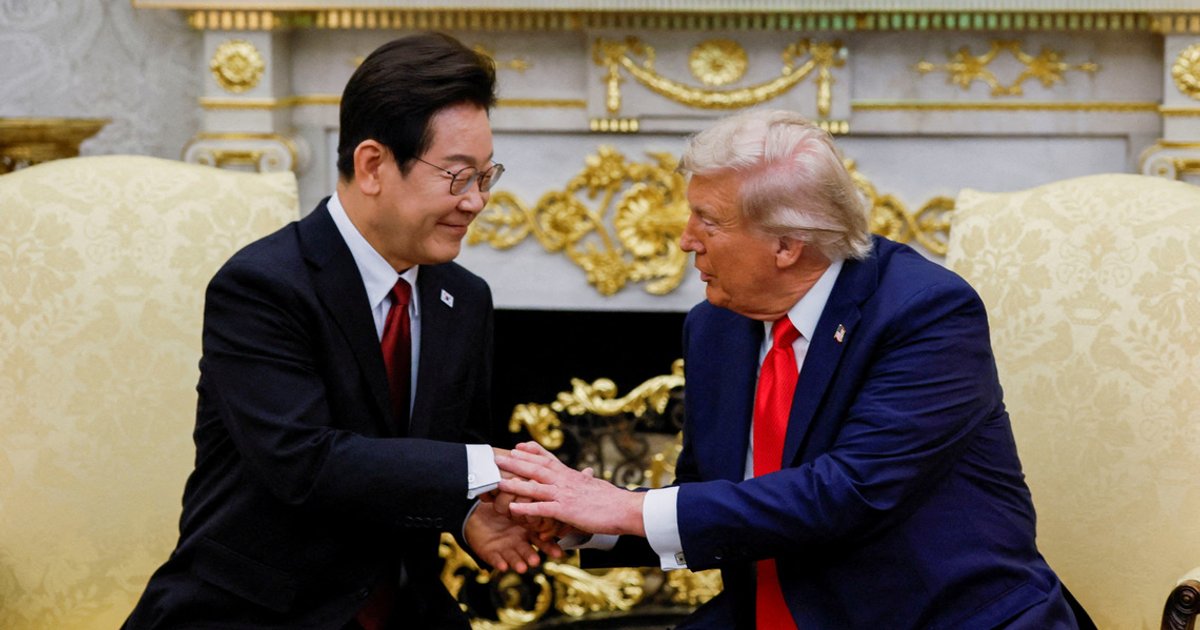
SEOUL – The “blue wave” that swept the Democrats into power in both the US Senate and House of Representatives in the midterm elections is unlikely to ease pressure on the US-South Korea alliance, already strained by Washington’s multiple demands on Seoul.While the results represent a political setback for US President Donald Trump, a divided Washington could add to the uncertainty South Korea faces over its future dealings with the US.Trump has repeatedly singled out South Korea, taking a transactional approach to the alliance and pressing Seoul on multiple fronts, from trade tariffs and investment commitments in the US to calls for it to help secure the Strait of Hormuz.Analyst Troy Stangarone told The Straits Times that even with the Democrats’ significant majorities, they will still be limited in their ability to force Trump to change course without Republican support to muster the two-thirds majority votes needed in both chambers to override a presidential veto.Stangarone, a non-resident fellow at the Carnegie Mellon Institute for Strategy and Technology in Pennsylvania, suggested that Trump may be more emboldened to pursue a deal with North Korea, amid expectations that he could meet North Korean leader Kim Jong Un on the sidelines of the upcoming Asia-Pacific Economic Cooperation (Apec) summit in Shenzhen, China.Although South Korean President Lee Jae Myung has offered to play the role of a “pacemaker” facilitating the resumption of US-North Korea dialogue, it remains unclear whether Seoul would be included in any potential talks.“Historically, lame duck presidents turn to foreign policy to add to their achievements before leaving office,” said Stangarone, adding that if Trump indeed prioritises North Korea, “there are no assurances that he would keep South Korea involved or take its interests into account”.South Korea has also been pushing to regain wartime operational control (OPCON) of the US-South Korea Combined Forces Command, which is currently led by a US general. Seoul has peacetime control of the forces, but the US still maintains command during wartime. A Democrat-controlled Congress could seek greater oversight and therefore “prolong discussions” over the process, said Leif-Eric Easley, a professor of international studies at Ewha Womans University in Seoul.On the other hand, Congress could also “further constrain any Trump effort to reduce the US troop presence in South Korea or scale back combined military exercises”, he added.Regarding tariff pressures, James Kim, director of the Korea Program at the Stimson Center, warned that South Korea could face renewed threats or fresh tariff measures, given Trump’s history of singling out the country.Under a trade deal reached in 2025, South Korea had committed US$350 billion (S$447 billion) in US investments in exchange for Washington lowering tariffs on Korean goods from 25 per cent to 15 per cent.But it did not stop Trump from escalating pressure on Seoul in early October, threatening to “charge it more” unless it committed to a proposed Alaska LNG pipeline project valued at more than US$50 billion.The project involves building an approximately 1,300-km-long pipeline across Alaska to transport natural gas from the North Slope to domestic consumers and to an LNG export terminal for overseas markets.Washington has been actively seeking participation and investments from key Asian allies and trading partners for the project, such as Japan and Taiwan.Seoul officials maintain they are still reviewing the project and that their participation remains to be finalised.Also, South Korea’s benchmark stock index, the KOSPI, fell nearly 4% on Nov 5 morning amid concerns that the Democrats’ push for tighter oversight of AI data centre expansion could slow US infrastructure investment, thereby dampening demand for semiconductors and affecting South Korea’s chipmakers.However, Stangarone expects the impact on South Korea’s semiconductor industry to be limited.“There is already more demand for memory than Samsung and SK Hynix can meet, and the tech industry will just look to build more data centres outside the US,” he said.At a press briefing on Nov 5, South Korea’s presidential office said that the US midterm election results would not affect the “strong and steadfast partnership” of more than 70 years, and pledged continued close cooperation with the US administration and Congress.Wendy Teo is The Straits Times’ South Korea correspondent, based in Seoul. She covers issues concerning the two Koreas.
Why US midterm results may bring little relief for South Korea
Full Article
Original Source
Read the full article at Straitstimes →KhanList aggregates and links to publicly available news content. We do not host full articles from third-party sources. Always verify important information with original sources.